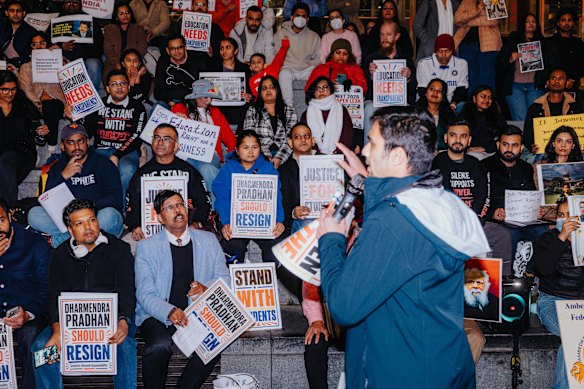
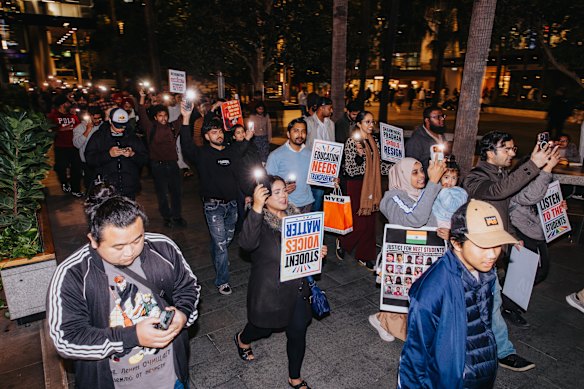
Parramatta Square is usually quiet once all the workers have gone home but, on Friday, outside Western Sydney University, hundreds of Indian-Australian protesters gathered. And in their swelling chorus of chants, speeches and singing, they joined themselves to India’s most significant protest movement in a generation.
Over the past month, tens of thousands of Indians – mainly university students – have been protesting daily on the streets of New Delhi and other cities.
The gatherings were initially triggered by outrage over revelations the entrance exam papers for the country’s most prestigious medical colleges had been leaked to those who could afford to buy them. Amid early backlash, the government cancelled the results of the exams and said the two million Indians who studied for it would need to retake the test – a pressure so immense that 21 students took their own lives, according to activists.
But the protests quickly grew as a broader movement against Indian Prime Minister Narendra Modi and the country’s overall decline in equity and political freedom. It attracted harsh police responses: more than 120 protesters in New Delhi were injured after police hit them with batons and sprayed tear gas throughout the crowds. After weeks of anger, protesters on Saturday had a major victory: education minister Dharmendra Pradhan, responsible for the exam, resigned.
The protesters mobilised under a new party: the Cockroach Janta Party, so named after the country’s chief justice described unemployed youth and some activists as “cockroaches” and “parasites of society”.
These are the stories of those who gathered in Parramatta, lightly edited for length and clarity.
‘It’s almost like ICE agents’
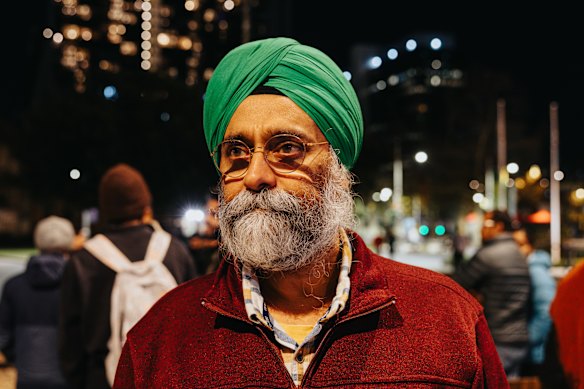
Manbir Singh Kohli
I’ve been in Australia for a long time, but I follow the events that happen in India. About 20 students, young students, have [died by] suicide because of the leak of the NEET [National Eligibility cum Entrance Test] papers.
It’s very indecent that there are people on hunger strikes there and no one has come to them to talk about, “OK, how can we help you? What’s bothering you?” Nobody has done that. Instead, [students] have been violently assaulted by plainclothed policemen, without name tags so they can’t be identified. It’s almost like the ICE agents in the USA. It’s quite scary.
What the students are asking for is a fair go, and being heard, and accountability with the resignation of the education minister. Education budgets have been cut, education standards have fallen, and parents are basically paying for what the government should be doing. They are sending their children to private tutors; that is costing hundreds of thousands of dollars per year. That’s the kind of money that is being spent so their children can get educated and take part in the entrance exams. But then the papers are leaked and their candidature is cancelled. So they’ve got to do it again. That’s what’s led to all this anxiety and the rest of the accountability.
The press freedom index in India has dropped. There have been indices that constantly show things are not looking good. In fact, it’s a partial democracy. That’s what has come out now. That’s my interest: our prime minister should actually approach the prime minister of India, who he’s friends with, and say, “Mate, can you slow things down?”
‘Critical thinking and dissent is not encouraged’
Apurva Mahireb, public servant
I feel really happy, really proud, actually. This is the first time, at least in my lifetime, that there’s been anything close to a protest against the government. And I’ve never been part of a protest in India. I’ve been in Australia for about six years, and I’ve lived in New Zealand before that for about 11 years. I’ve been part of a lot of protests ever since I was overseas, but I was never part of one in India.
![“People [are] standing up for themselves, standing up for their rights … holding truth to power”: Apurva Mahireb](https://static.ffx.io/images/$zoom_0.136%2C$multiply_0.7725%2C$ratio_1.5%2C$width_756%2C$x_0%2C$y_0/t_crop_custom/q_86%2Cf_auto/ef94dafa8649efbf766f97c4203c2fb35ff4b54e)
Indians are very gung-ho people, they kind of get on with life. A lot of them are just struggling to meet their basic needs. So protesting isn’t really something they’re really comfortable with.
So when something like this happens, it makes me really happy and proud to see there are people standing up for themselves, standing up for their rights, standing up for democracy, and actually asking questions, holding truth to power.
Critical thinking and dissent is not encouraged in India, especially in the education system. So when people do stand up, that makes me really happy and really proud.
‘There is no accountability’
Devibala Palanivel, technology worker
This is Anitha, who lost her life fighting against the medical entrance exam called NEET. She was from a rural part of Tamil Nadu. She scored around 98 per cent, but she couldn’t clear NEET. She went up to the Supreme Court against it, but unfortunately during the fight she took her own life. That’s when the fight against NEET intensified in the southern part of India, the place where I’m from. We were fighting it politically, legally. Now it’s good to see the whole of India is picking it up.
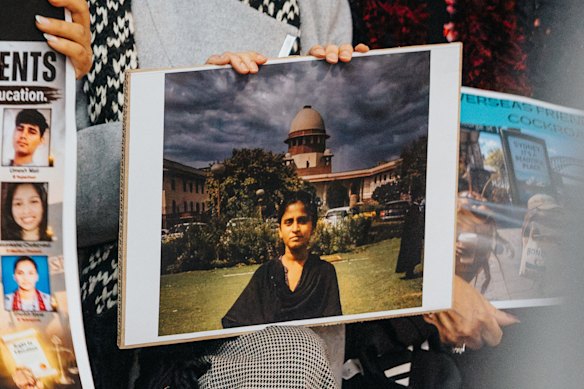
When there is no accountability from the government, disadvantages become systemic discrimination. That’s why we are against NEET, that’s why we need the current government of India to take some accountability and give their students a fairer education system.
We are all from the education system that has enhanced us and empowered us to be here today. We want that kind of India for the next generation of people, where they can be educated fairly and there is equitable space for all the communities of India – so that someone like me, from an oppressed community, is able to come this far.
That is not possible at the moment in India.
‘The diaspora is speaking up’
Sargun Saluja, international student
I am an immigrant from India. I know a lot of my friends have immigrated. We’ve been part of a system of oppression. I think about how my life would have been if I stayed in India. I study law at the moment. And the exploitation in India is different. The unpaid labour is different. The amount of stark privilege I see being here versus being in India is so different, and my heart bleeds for the students in India who are being exploited, whose dignity is not recognised.
I think it’s really important for Gen Z to speak up right now, because we’re the next generation in India. [The protests] matter because there’s accountability coming from all parts of the world, especially Gen Z and the diaspora is speaking up.
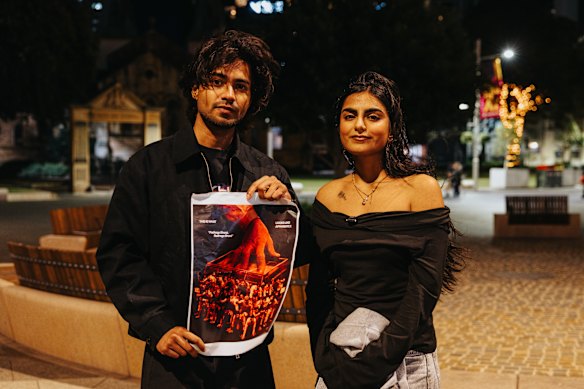
There have been recent developments for accountability. The prominent activist Sonam Wangchuk just ended his [26-day] hunger strike, and there are signs of accountability. That makes me hopeful. That is a testament to the actual movement.
People [in authority] are actually scared they can’t control the media. The propaganda can’t be controlled. The mainstream media is not a channel, it’s mostly social media and independent journalists we are taking the journalism from. It just goes to show that mass movements can actually lead to accountability, and I’m really hopeful about that.
‘You have to be a good citizen’
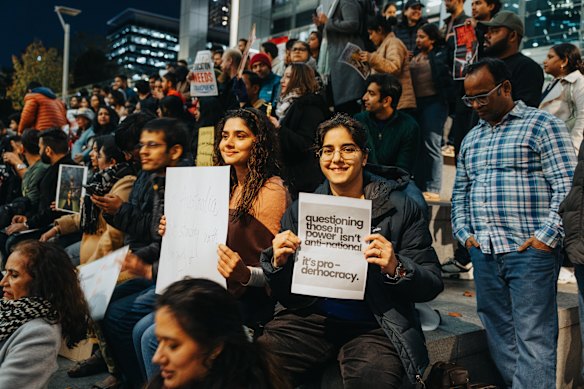
Amit Patel, international student
Last week we did a small protest at Town Hall in Sydney. There, I faced a lot of backlash from my comments, actually, and in my Instagram DMs. People started calling me anti-national; they were telling me, “Go back to India”, “What is the point of doing protests in Sydney?”
But I would like to say that it’s not just Sydney, it’s in every other nation. This protest has been happening on a big scale. Every other student is supporting this cause. It’s about speaking up for the cause.
We’ve come here [because Australia has] specifically addressed the Indian diaspora. They named the streets with Indian names, you cannot expect the street to be silent. Yes, of course we’d speak out. We have to speak out, no matter where you live – you have to be a good citizen, with a passport or not.
‘Australian politicians should know about this’
Abbas Alvi, community leader
Australia and India’s relationship in all sectors is excellent. It should remain excellent. But what is happening in India, Australian politicians should know about this. I personally feel that this is a time when Prime Minister Anthony Albanese should look into how we maintain a better relationship with India. It’s not just saying, “Modi, you are the boss”.
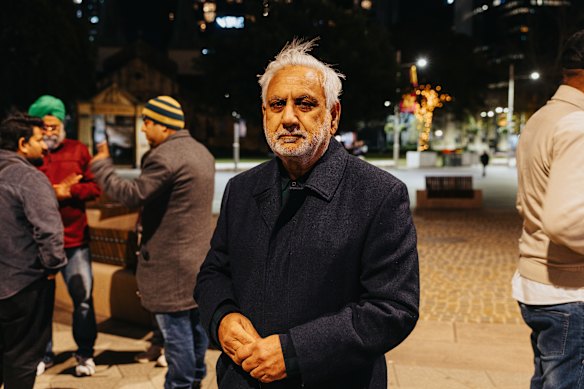
The Australian government is investing a huge amount of money establishing our university premises in India. So students who will be coming over there, they will be these Gen Zs. They will be your middle income group. So we need to make sure they are happy with us. That’s why it’s essential for our prime minister to put pressure on the Modi government to look after them.
As a community networker of 35 years, I think it’s high time for Indian politicians not to think [in terms of] Hindi, Muslim, Christians. They should look for unity and social cohesion. This is what is important. Somehow, Mr Modi is not understanding that, but he is only supporting the division and dividing the community. We need peace here. We need peace in India also.
Disclaimer : This story is auto aggregated by a computer programme and has not been created or edited by DOWNTHENEWS. Publisher: www.smh.com.au