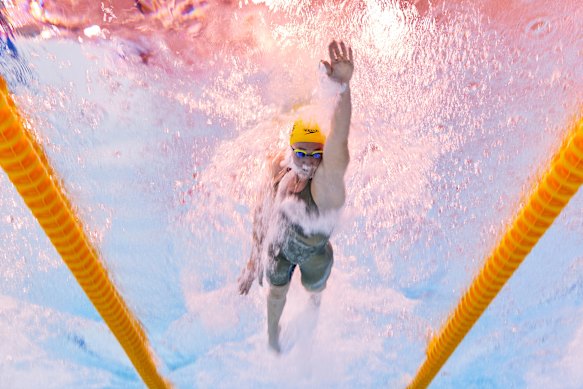

Glasgow: Australia’s swimmers won almost as many gold medals in six days at these Commonwealth Games as they have across every Olympic campaign combined since Sydney 2000.
The record 37 gold, 16 silver and 23 bronze medals accumulated by the Dolphins across 56 events in the Glasgow pool were great if you like seeing swimmers with big grins on medal podiums and the sound of the Australian national anthem.
But for most Australian sports fans, there is only one benchmark that matters when it comes to the country’s elite swimmers: the Olympic Games.
The recent medal avalanche against weaker Commonwealth opposition – and the fact some of those medals were won by para athletes when the Olympics are staged separately from the Paralympics – risks creating an inflated picture of where this Australian team sits two years out from the Los Angeles Games.
Make no mistake, this is an outstanding Australian team. Its results since the Tokyo Olympics in 2021 prove that, through consistency alone. Australia will be one of the dominant nations in LA. But next month’s Pan Pacific Championships against the United States in California should provide a much sterner examination and barometer of how they are faring.
How many of these swimmers are genuine Olympic gold medal contenders?
Based purely on times from Glasgow, compared with the Paris Olympics two years ago, Australia would have won two gold, five silver and six bronze medals in 2024 – Cam McEvoy (50m freestyle) and Sam Short (400m freestyle), with no relay gold medals.
The comparison comes with obvious caveats. The Commonwealth Games lacks Olympic depth, serving up less intense races, and athletes peak at different times with training geared all around a four-year cycle.
Meanwhile, some of Australia’s swimmers have done recent personal bests that would have won gold at the last Olympics. Mollie O’Callaghan’s 200m freestyle time at Australia’s trials last month (1:52.86) was faster than her gold medal-winning and Olympic record effort in 2024 (1:53.27).
Lani Pallister’s 800m swim at these Commonwealth Games was 0.08 seconds shy of US legend Katie Ledecky’s mark in Paris. If you took Pallister’s time from last year’s world championships, it would have been good enough for gold. But swimming is about racing, not times.
Australia won seven swimming gold medals in Paris, one fewer than the United States, with five of those in individual events. Ariarne Titmus has since retired, leaving O’Callaghan (200m freestyle), Kaylee McKeown (100m and 200m backstroke) and McEvoy (50m freestyle) as Australia’s reigning individual Olympic champions. All are expected to be there in LA.
McKeown, Australia’s most successful individual Olympian, missed Glasgow with glandular fever but remains one of the country’s greatest medal hopes. With the 50m backstroke added to the Olympic program, she could realistically contend for three individual gold medals if her body holds together.
McEvoy produced arguably Australia’s best swim of the week in Glasgow, stopping the clock at 20.97 seconds in the 50m freestyle – just 0.09 outside the world record he set in March. Breaking 21 seconds again only strengthens his status as the favourite for what would be a remarkable second consecutive Olympic title at the age of 34. McEvoy is 0.18 seconds faster than anyone in the world this year.
O’Callaghan was harder to assess. She took out 200m freestyle but her time in that event (1:54.66) was nearly two seconds slower than what she did at trials. Her 100m freestyle was also well down on her domestic form.
It also continued an emerging trend. O’Callaghan has now finished fourth at the Paris Olympics, second at the 2025 world championships and second in Glasgow in the 100m freestyle. She has not improved her personal best in the 100m event for three years.
At her best, O’Callaghan remains the world’s finest 200m freestyle swimmer, but questions remain over whether she can become the dominant 100m swimmer many expected.
Meg Harris completed the 50m and 100m freestyle sprint double in Glasgow, yet neither winning time would have been enough to reach the podium in Paris. She has more in her.
Short and Pallister both completed the 400m, 800m and 1500m freestyle treble, underlining their dominance at Commonwealth level. But neither lowered their lifetime bests. Doing that all the time is incredibly difficult in lung-busting events like theirs.
Short still owns the world’s fastest 400m and 800m freestyle times this year and looms as one of Australia’s strongest gold medal hopes in Los Angeles. Yet, Germany’s Lukas Martens and Johannes Wilhelm Liebham will present a far greater challenge than anything Short encountered in Glasgow.
Short thrives when he has someone to chase.
“I don’t think it would be too farfetched to say it’s one of the best teams we’ve had. Most people will be hitting their prime in LA,” Short said.
“I think I’d contend for podiums and wins [if an Olympics were held today]. I’m not saying I would win because it is so stacked.”
After significant improvements last year, Pallister wanted more from Glasgow, telling reporters she was disappointed with some of her times. The post-swim reactions of her coach Dean Boxall would suggest he wasn’t either. But Pallister has always targeted the Pan Pacs as her major meet when she races Ledecky and Canada’s Summer McIntosh. Two years of training and she could be Australia’s great hope in women’s middle- and long-distance events.
“I watched the 2018 Commonwealth Games team on the Gold Coast and they were superheroes,” Pallister said. “It’s unreal how well everyone swam here and I think it not only bodes well for not only 2028, but 2032.”
Flynn Southam may have been Australia’s biggest breakthrough performer.
The 21-year-old dethroned Kyle Chalmers with three swims under 47.3 seconds across the week, highlighted by a blistering 47.09 relay split – a 0.6 second personal best – that announced him as one of the world’s premier sprinters.
Olympic gold would require a sub-47 swim if the Games were held today, given Romania’s David Popovici and American Jack Alexy have shown they are very capable of that. But Southam is firmly in the medal conversation and, with another two years of development, could emerge as Australia’s next genuine sprint star. He is right in the conversation for a medal, not only in the 100m freestyle, but the 50m freestyle. Chalmers’ effort of 47.74, however, indicates he has work to do.
Silver medallists from Paris, Elijah Winnington (400m freestyle) and Zac Stubblety-Cook (200m breaststroke) appear a touch below their very best.
Elsewhere, Sam Williamson confirmed himself among the world’s leading breaststrokers, Jenna Forrester excelled across the medley events and Alex Perkins continued her steady rise in butterfly. Encouraging signs, certainly, but not quite Olympic gold-medal standard yet, given the form of McIntosh and American Gretchen Walsh.
“The Americans are going to be as tough as nails on home soil,” said Australian head coach Rohan Taylor. “Two years out, I still think there’s some growth from the youth and then our senior athletes maintaining [their form]. They still had to perform at this meet.
“World championships next year will be a really key indicator for us.”
Get around our Commonwealth Games coverage
Follow our coverage of the Commonwealth Games with live blogs covering every moment of the action from 6pm AEST daily.
News, results and expert analysis from the weekend of sport are sent every Monday. Sign up for our Sport newsletter.
 Tom Decent is the chief sports writer for The Sydney Morning Herald.Connect via X or email.
From our partners
Disclaimer : This story is auto aggregated by a computer programme and has not been created or edited by DOWNTHENEWS. Publisher: www.smh.com.au