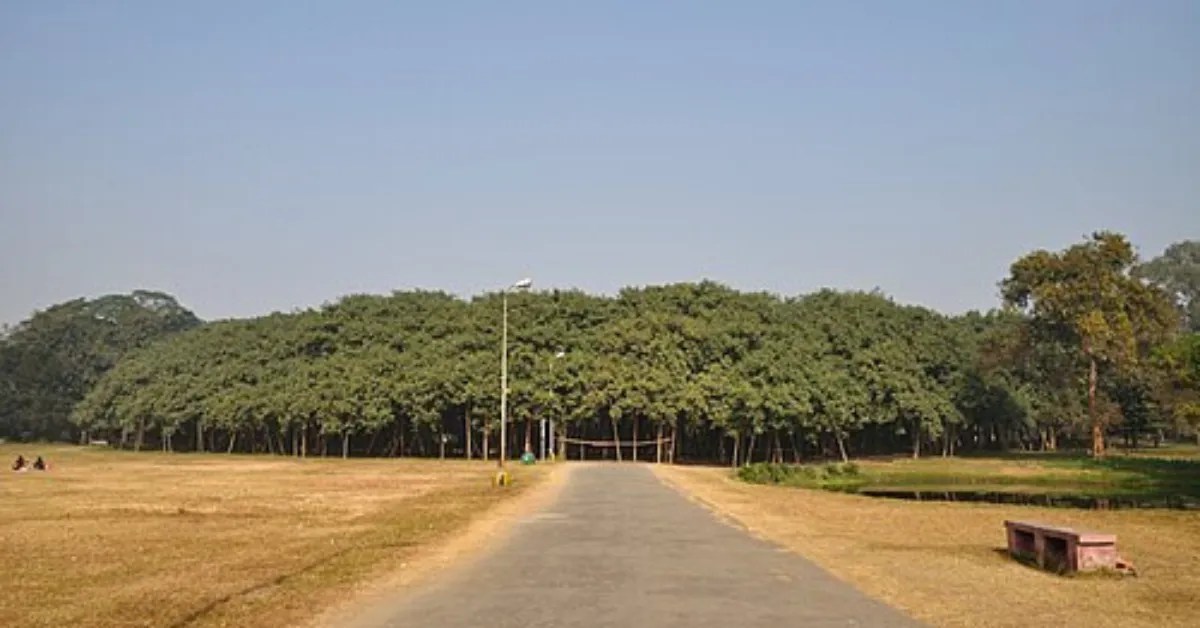
On the edge of a busy road near Bengaluru stands a banyan so vast it looks like an entire grove rather than a single tree.
Hundreds of kilometres away in West Bengal, another banyan has outlived its original trunk but continues to thrive through thousands of aerial roots.
In Telangana, towering banyans draw birds, bats and insects beneath their branches year after year.
And in Bihar, scientists have now confirmed that one banyan has stood for nearly 700 years, silently witnessing generations come and go.
Across India, these ancient giants are far more than landmarks.
Scientists classify mature banyans as keystone species — organisms that support entire ecosystems. Over its lifetime, a single banyan can feed, shelter and help sustain hundreds of birds, mammals, insects and other living creatures.
That idea has received fresh scientific support this year.
A recent study from Telangana’s Kanha Shanti Vanam, along with the radiocarbon dating of Bihar’s ancient Munger banyan, reinforces what ecologists have long known: protecting old banyan trees also protects the rich web of life that depends on them.
More than just shade
Earlier this month, scientists confirmed that a banyan tree in Bihar’s Munger district is around 700 years old, making it the oldest accurately dated banyan (Ficus benghalensis) identified so far.
Unlike earlier estimates based on folklore or historical records, researchers used high-precision radiocarbon dating to determine its age.
The discovery is more than a milestone in tree science.
It shows how tropical trees can preserve centuries of ecological history while continuing to support wildlife across generations.
That role is visible in some of India’s oldest banyans.
The Great Banyan, Kolkata
Perhaps nowhere is this more striking than the Great Banyan Tree inside the Acharya Jagadish Chandra Bose Indian Botanic Garden near Kolkata.
Spread across nearly 4.7 acres through more than 3,700 aerial roots, the tree no longer depends on the trunk from which it first grew. Although the original trunk died decades ago, the sprawling network continues to thrive, behaving less like a single tree and more like a living forest.
Its canopy shelters fruit bats, palm squirrels, barbets, bulbuls, parakeets, koels, mynas and countless insects.
Mosses, orchids, lichens and other epiphytes cover its branches, creating homes for spiders, reptiles and pollinators.
Every new aerial root expands this miniature ecosystem a little further.
Dodda Alada Mara, Bengaluru
Around 400 years old, Dodda Alada Mara near Bengaluru tells a similar story.
Its sprawling canopy attracts rose-ringed parakeets, white-cheeked barbets, jungle mynas, black drongos and Asian koels throughout the year.
As evening falls, Indian flying foxes arrive to feast on ripe figs before carrying their seeds across the landscape.
/filters:format(webp)/english-betterindia/media/media_files/2026/07/30/banyan-2-2026-07-30-19-29-36.png)
Palm squirrels, butterflies and honeybees occupy different parts of the tree at the same time, each relying on the same living structure in different ways.
What scientists found in Telangana
At Kanha Shanti Vanam near Hyderabad, researchers recently observed these ecological relationships up close.
Scientists Ananthaneni Sreenath and Rathinasabapathy Bhuvaragasamy studied six mature banyans growing among more than 1,000 restored plant species, including 26 native Ficus species.
Their study, published in the International Journal of Phytology Research (2026), found that when the banyans fruited between February and May, they became magnets for wildlife.
Common mynas, red-vented bulbuls, Asian koels, coppersmith barbets, golden orioles, rufous treepies, greater coucals, jungle crows and Indian grey hornbills all arrived to feed.
After sunset, Indian flying foxes took over, while three-striped palm squirrels fed during the day.
Unlike many forest trees that produce fruit for only a short period, different Ficus species fruit at different times of the year.
/filters:format(webp)/english-betterindia/media/media_files/2026/07/30/banyan-3-2026-07-30-19-34-29.png)
This creates a reliable food supply for wildlife throughout the seasons, helping maintain what ecologists call trophic continuity — the uninterrupted flow of energy through an ecosystem.
The researchers also made another important discovery.
Seeds recovered from bird and bat droppings germinated far more successfully than fruits that simply fell beneath the trees.
In other words, every bird, bat and squirrel feeding on the figs was also helping plant the next generation of forests.
Across quiet corners of the sanctuary, young banyan, peepal and Indian bat fig seedlings were already emerging naturally.
One tree, hundreds of lives
India is home to 115 recorded Ficus taxa, including 89 recognised species.
While many remain widespread, others, including Ficus beddomei, Ficus krishnae and Ficus anamalayana, are considered rare, vulnerable or data deficient.
Researchers say protecting this diversity also means safeguarding the ecological relationships built around these trees.
Across Gujarat, Kabirvad on the Narmada River supports riverine birds, fruit bats, macaques and countless insects.
In Andhra Pradesh, Thimmamma Marrimanu, whose canopy spreads across more than five acres, functions almost like a woodland, providing habitat for parrots, owls, reptiles, butterflies, bees and small mammals.
As India’s oldest banyans continue to stand across cities, villages and forests, they remind us that conservation isn’t always about planting new trees.
Sometimes, it begins with protecting the ancient ones that have quietly sustained life for centuries.
Sources:
‘Oldest accurately dated Banyan found in Munger, Bihar’: by Ministry of Science & Technology, Published on 3 July 2026
‘Bangalore Diaries: 400 Year Old Big Banyan Tree’: by Vinita Sanghi, Published on 23 March 2025
‘The keystone species: emphasizing the conservation of Ficus (Fig) species at Kanha Shanti Vanam, Hyderabad, Telangana, India’: by Dr Ananthaneni Sreenath, Bhuvaragasamay Rathinasabapathy, Published in January 2026
Disclaimer : This story is auto aggregated by a computer programme and has not been created or edited by DOWNTHENEWS. Publisher: thebetterindia.com