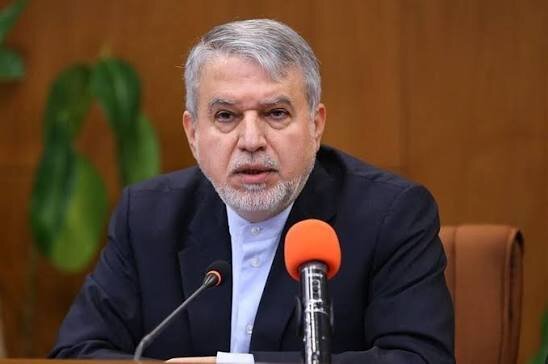
TEHRAN — Iran will pursue three new nominations for UNESCO World Heritage inscription next year following the successful listing of Alamut Castle and Related Fortifications, Minister of Cultural Heritage, Tourism and Handicrafts Seyyed Reza Salehi-Amiri said.
The minister on Thursday said the country plans to submit nominations for the historic ensemble of Tus in northeastern Iran, a serial nomination of historic Iranian mosques, and the ancient port of Siraf in the southern Bushehr province, IRIB reported.
The announcement comes a week after UNESCO inscribed Alamut Castle and Related Fortifications on the World Heritage list, bringing the number of Iran’s cultural and natural World Heritage properties to 30.
Salehi-Amiri said preparations for the three dossiers are underway as Iran continues efforts to expand the international recognition of its cultural heritage.
The proposed serial nomination of Iranian mosques aims to illustrate the evolution of mosque architecture in Iran from the early Islamic period to the present day. Iranian mosques are renowned for their distinctive domes, soaring minarets, intricate geometric designs and colorful tilework, reflecting regional architectural traditions developed over centuries.
Among the country’s best-known historic mosques are the Sheikh Lotfollah Mosque and Imam Mosque in Isfahan, Nasir al-Mulk Mosque and Vakil Mosque in Shiraz, the Jameh Mosque of Yazd, the Blue Mosque of Tabriz, Goharshad Mosque in Mashhad and Agha Bozorg Mosque in Kashan.
The historic city of Tus, near Mashhad in Khorasan Razavi province, is best known as the burial place of the celebrated Persian epic poet Ferdowsi, author of the Shahnameh. The ancient city was also the birthplace or home of several prominent scholars, including theologian Abu Hamid al-Ghazali, philosopher and scientist Nasir al-Din Tusi, early polymath Jabir ibn Hayyan, poet Asadi Tusi and Islamic scholar Abu Jafar Tusi. Tus has witnessed repeated destruction throughout history, including during the Mongol and Timurid invasions, but it remains one of Iran’s most significant cultural and historical centers.
Archaeological excavations carried out by the British Institute of Persian Studies between 1966 and 1973 uncovered extensive remains of the historic port city, whose population is estimated by historians to have reached about 300,000 during the early Islamic period. The site contains archaeological remains dating from the Elamite, Achaemenid, Parthian, Sassanid, Islamic and Qajar eras.
UNESCO’s World Heritage list recognizes cultural and natural sites considered to have outstanding universal value, with inscription often boosting international recognition, conservation efforts and tourism.
AM
Disclaimer : This story is auto aggregated by a computer programme and has not been created or edited by DOWNTHENEWS. Publisher: tehrantimes.com