
Poor governance systems for testing about eight million candidates for admission into college — the second largest examination process after China — can be traced to the 2018 ambition to scale up quickly, like a start-up, on-the-cheap. The consequence? A handful of permanent employees in a registered society called the National Testing Agency (NTA) under the Union ministry of education.
Add a layered multiplicity of state-level agencies for physically conducting the examinations, to keep costs low and yet tick the “inclusive governance” box. All this in a society where jugaad and hustling is a dominant skill waiting to exploit loopholes. The outcome is a porous system, unevenly empowered to monitor, detect or protect against fraud and collusion — a powder keg waiting to explode.
It took eight years for the accumulated faults and errors to discredit it in the eyes of the users — the candidates and their families. Paper leaks, cancellations and re-examinations and errors in tabulating scores, reduced it to a farce from a marvel of scaled up public digital rails for higher education. To be fair, the objectives remain laudable — reducing candidate stress from the earlier fractured system of appearing in multiple tests for admission to a specific university-level study programme.
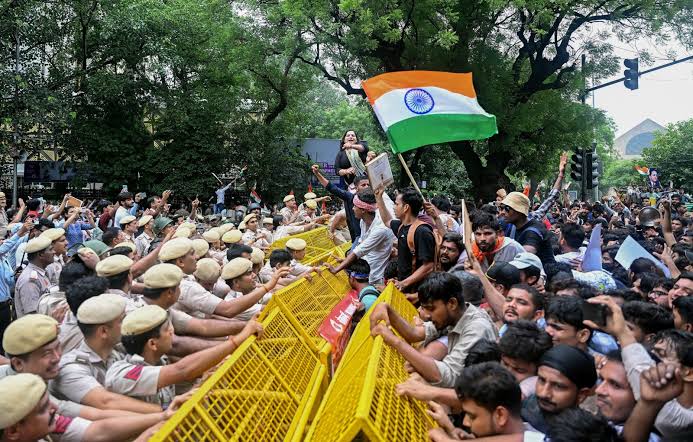
So, what forced the government to accept (a) the resignation of the Union minister in charge of education; (b) reform of NTA by proposing a high-powered committee headed by India’s celebrated, socially conscious, tech bro — Nandan Nilekani – the man who mothered Aadhaar and subsequently the ONDC, a widely held, not-for-profit Section 8 company, competing with Amazon and Flipkart; (c) agree to compensate the families of students who committed suicide because of systemic NTA faults; and (d) to ignore the minor violations of the protesters gathered at Jantar Mantar, a designated spot in New Delhi for protests after permission from the government.
The thirty-six-day long protest and a three week-long hunger strike was a novel agitation by Gen Z in Delhi and subsequently in a few other urban locations across the country. The never-before element was the leadership of an external saviour, very much in keeping with a globalised India — Abhijeet Dipke — an Indian student who jetted in from Boston University, carrying the Indian Constitution — reminiscent of the Congress Party’s less successful strategy in Parliament to corner the BJP.
Prior mobilisation on social media had already evoked a rapturous response and several million followers.
Unsurprisingly, the physical response was less fulsome, with only a few thousands gathering at the protest site over the next month. Possibly, the sweltering, extreme heat of June dissuaded many.
The Cockroach Janta Party is, for now, a social movement and not a registered entity. It focuses on student issues but more generally asserts liberal principles — the right to mobilise to be heard directly by the government. It reeled in social media support by simultaneously partying even as a select few went on a hunger-strike. It welcomes strategic collaboration. Sonam Wangchuk — a prominent, principled influencer and activist from Ladakh — made common cause and led the hunger-strike, raising the stakes higher.
Why has the government heard and negotiated with it so readily versus its reluctance during the agitation against the proposed farm legislation? The politically inclined point to the urban middle class, social base of the Gen Z protesters, which overlaps with the BJP’s core supporters, versus farmers in rural areas, where the BJP is less entrenched historically.
More substantively, the CJP demands were pitched so low that they were worth considering — change of the minister in charge, a standard demand when administrative lapses occur.
Protection for the protesters from police retribution: a no-brainer because they were more sinned against than sinners.
Compensation for the families of about a dozen students who committed suicide versus about 2,200 suicide cases, attributed to exam failure in 2022. In comparison, the year-long farmers agitation in 2020-21 sought to reverse new legislation for structural change via commercialised farming. They won because of the overwhelming numbers affected by the proposed changes.
Should students expect an overhauled, secure system for admission examinations? Given the proposed formation of an “A team” for this purpose, there is reason for hope.
Was it a mistake then to use an “out of government” model of a registered society in the first place? The gold standard for cooperatives has been the Gujarat Cooperative Milk Marketing Federation (GCMMF), better known by its brand name Amul. It remains the most successful scaled-up model of operations benefiting more than three million individual milk-producing members. The difference is that it is answerable to its beneficiaries and its institutionalisation largely due to Dr Verghese Kurien, whose pioneering work in professionalising rural management and ensuring that profits flow to the members, laid the foundations for transparency and performance efficiency.
The right lesson to draw from the NTA fiasco is that the agency suffered from insufficient institutionalisation per best-in-class similar public service entities, leaving open opportunities for inefficiency and corruption. The Kurian model advocates building a team of inspirational professionals- beyond the academic world — to handhold the NTA through a late institutionalisation. This is an unglamorous task with no positive metrics at the end, except the lack of complaints — much like efficient police work. It also requires diligent public investigations with adequate Right to Information provisions, to identify and root out systemic loopholes for corruption and fraud and bring the perpetrators to justice. Merely enhancing the punishment for transgressors, as proposed, is an ineffective eyewash.
Another option is to convert NTA into a Section 8 company where regular and timely accounting and more rigorous disclosures and auditing than currently prescribed for societies, could be voluntarily followed, thereby creating a new benchmark for wider compliance. Integrating the NTA into the government is a non-starter. Other than the ossifying impact of government procedures and practices, it invites competitive politicisation, with the ebb and flow of governments.
The good news is that a nascent, social media based, vigilante force now exists amongst the final users – the Gen Z examinees — to keep the NTA honest, even as they keep millions of social media watchers captive, with direct to viewers reporting and evocative, satirical themes like “Police wale babu….” set to a catchy, slow beat, heavy thump, rhythm, typical of techno dance music and reminiscent of new wave civil protest. If the government falters, look forward to more such music.
The writer is Distinguished Fellow, Chintan Research Foundation, and was earlier with the IAS and the World Bank
Disclaimer : This story is auto aggregated by a computer programme and has not been created or edited by DOWNTHENEWS. Publisher: deccanchronicle.com