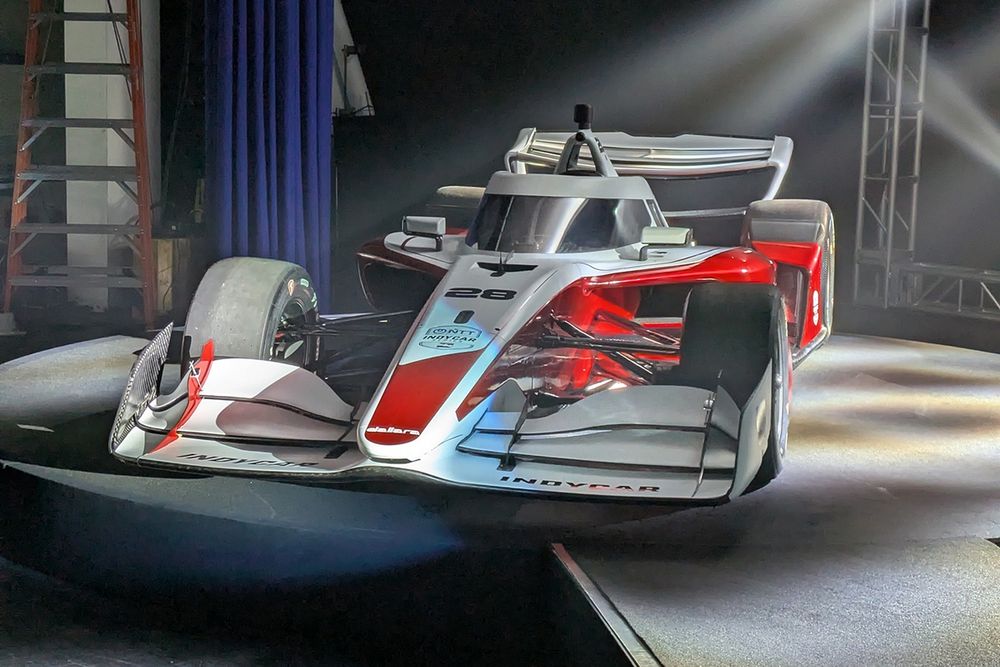
Motorsport.com was among a small group of media outlets granted a first look at IndyCar’s next-generation IR-28 chassis on Friday, ahead of a landmark step for the series. The new car is set to complete its first on-track laps this weekend during two days of initial testing on the 2.439-mile, 14-turn Indianapolis Motor Speedway road course.
Driving duties for the maiden rollout will be split between two of the paddock’s leading drivers. Ed Carpenter Racing’s Alexander Rossi, the 2016 Indianapolis 500 winner, will drive the car on Saturday, followed on Sunday by Chip Ganassi Racing’s Alex Palou, the reigning and four-time IndyCar Series champion.
The track debut represents the culmination of extensive design work as IndyCar prepares to move on from its long-serving DW12 platform – a chassis that has anchored the series since 2012 across multiple aero, safety, and engine configurations.
A Clean-Sheet Vision for Record-Breaking Speed
Mark Sibla, Senior Vice President of Competition and Operations for IndyCar, detailed the origins and ambitions behind the IR-28. Rather than modifying the existing platform, IndyCar partnered with Dallara on a clean-sheet design.
“When we looked at the benefits of going with the new car, whether that was its performance capabilities, whether that was going to be safety in and around the driver, whether that was going to be just the raceability of the car, we decided that was the way to go,” Sibla said.
A core mandate from the project’s inception was creating a car capable of raising performance standards and breaking track records across all circuit types. The IR-28 achieves this through a combination of increased horsepower from a new 2.4-liter engine, an overall weight reduction of roughly 100 pounds, and a newly integrated hybrid unit offering 14 times the energy-storage capacity while weighing 20lb less than the current system.
“We wanted to make this car safe so that we could break records,” Sibla said. “That was one of the first things was to break track records. We felt the technology was there where we could do this safely, responsibly, and it’s a good way to really continue the momentum that the sport’s under right now.”
The “Crawl, Walk, Run” Development Strategy
Dallara IR-28 detail
Photo by: Joey Barnes
Managing the testing and deployment schedule is Mike O’Gara, Vice President of Competition of Race Engineering. Having joined the program three months after work began, O’Gara is coordinating assembly, development milestones and track testing alongside IndyCar officiating technical director Nick Allen and Dallara’s engineers.
IndyCar is utilizing an early-stage “mule car” equipped with prototype and 3D-printed components to evaluate critical hardware including bell housings, gearboxes and dampers across road courses, short ovals, and street circuits. The initial test car uses an off-the-shelf, non-representative engine because the first phase is focused solely on evaluating its mechanical and aerodynamic characteristics.
“So right now it’s purely chassis testing… all we want to test right now are the aerodynamics and the mechanicals of the car itself,” O’Gara said. “Next step will be the OEMs putting their engines in without hybrids to make sure the engine does what it’s supposed to… Then the third phase of that will be the full hybrid running with the car.”
Once track testing wraps up in October, Dallara will initiate full-scale production. Engine manufacturers will receive development cars in late 2026 or early 2027, with hybrid systems introduced in the second quarter of 2027. To prevent teams from diluting their focus during the 2027 championship, official team deliveries of one car per entry will begin immediately following the 2027 season finale.
Aerodynamics, Wake Management, and Deeper Passing

Dallara IR-28 detail
Photo by: Joey Barnes
A primary objective for the IR-28 is improving racing by managing the turbulent air generated behind and alongside the car.
“One of the big goals that we gave Dallara when working on this car and designing the car is it has to race as good or better than what we have now,” O’Gara said. “We can’t roll out a new car and the racing be not as good as we have right now.”
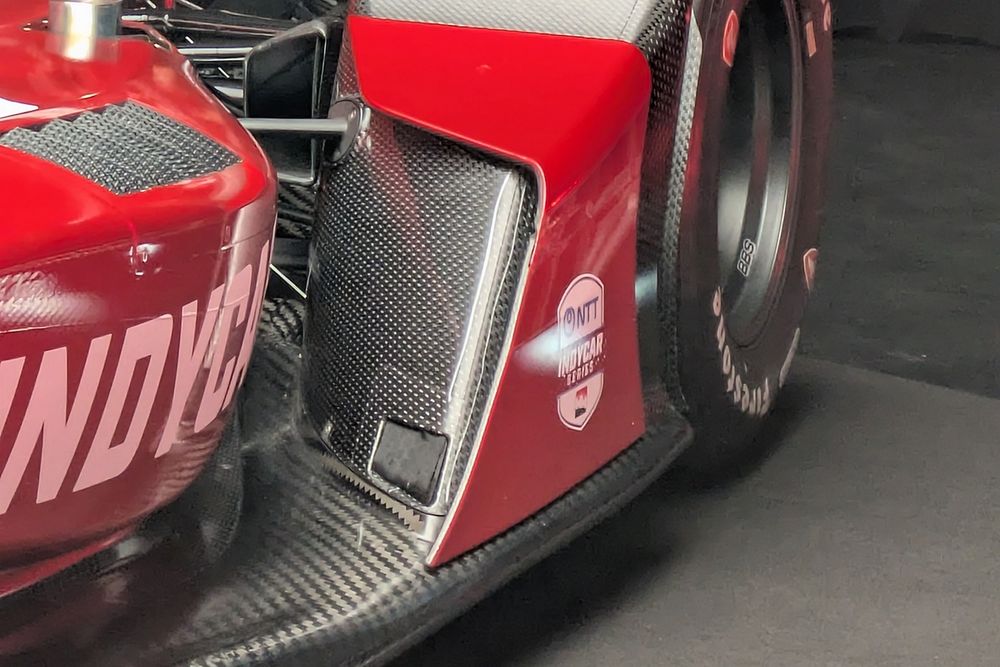
To solve this, Dallara incorporated “tire wake conditioners” (TWC) behind the front wheels to disrupt turbulent airflow for trailing cars, while anti-lift safety features are sculpted directly into the bodywork rather than added via external spines. Multi-car wake behaviour was assessed through driver-in-the-loop simulation using virtual lead cars before physical testing began.
Sibla noted that this aero focus is engineered specifically to facilitate passing deeper in the pack, particularly on high-speed ovals like IMS.
“The car is built to really, when we think about Indy, is [to have] the ability to pass, not if you’re just in second and third, but if you’re in fourth, fifth, seventh, ninth,” Sibla said. “It’s very much purpose-built for that.”
Ergonomics, Cockpit Safety, and Driver Comfort

Dallara IR-28 detail
Photo by: Joey Barnes
According to IndyCar, the chassis exceeds standard FIA crash and intrusion requirements, featuring a widened cockpit that allows for increased safety padding and accommodates a wider range of driver sizes. Rather than moving the driver’s seat, the IR-28 features adjustable pedal assemblies and steering columns to ensure driver’s helmet remains in the optimal safety window.
“Safety-wise, there’s an ideal position for the driver’s helmet to be… So the drivers that we fit to the car so far, we keep their helmet in the perfect space in the car, and then move the pedals and the steering wheel and everything to them,” O’Gara said.
Cockpit cooling has also been overhauled, replacing drag-inducing external scoops with integrated channels through the nose, radiator ducts, shock cover, and a bottom “keel” vent, plus integrated cool suit mounts. Additionally, wheel-mounted electronic anti-roll bar (ARB) controls replace manual cockpit levers, freeing up interior space and reducing hand injury risks.
Mechanical Grip, Future-Proofing, and Cost Control
Dallara IR-28 detail
Photo by: Joey Barnes
To protect mechanical grip, IndyCar partnered with Custom Access for a single-supplier damper and inerter package. Adapting technology previously used in Formula 1, the system offers an enormous range of damper adjustments, along with third-element inerters designed to give teams greater control over mechanical grip.
Unlike previous chassis in which components were retrofitted over time, systems like the Aeroscreen, hybrid unit, and LED position panels are integrated directly into the chassis from day one. Collaboration with suppliers like Helix and Bold for hybrid components allows engine manufacturers to focus solely on internal combustion development.

Dallara IR-28 detail
Photo by: Joey Barnes
The chassis is also designed to accommodate later increases in power and downforce, featuring strengthened suspension and redesigned wheels. Space beneath the sidepods is reserved for eventual brake-by-wire integration, while the steering box can accept electric power steering in later test phases.
To cushion teams against financial strain, initial development freedoms will be strictly regulated.
“I think year one you’re going to see the car pretty, you know, we would like teams to run it as delivered, and then eventually open different sectors of the car for development,” O’Gara said. “Limiting what they can change is just going to spread that investment over several years, and hopefully the financial impact on the teams won’t be as bad that way.”
Looking long term, Sibla revealed that IndyCar plans to maintain a shorter monocoque lifespan than the DW-12, paired with a regular three-year cycle of visual and aerodynamic bodywork updates to keep the series modern for fans, attract potential new OEMs, and ensure a structured path for ongoing technological growth.
We want your opinion!
What would you like to see on Motorsport.com?
– The Motorsport.com Team
Disclaimer : This story is auto aggregated by a computer programme and has not been created or edited by DOWNTHENEWS. Publisher: motorsport.com