
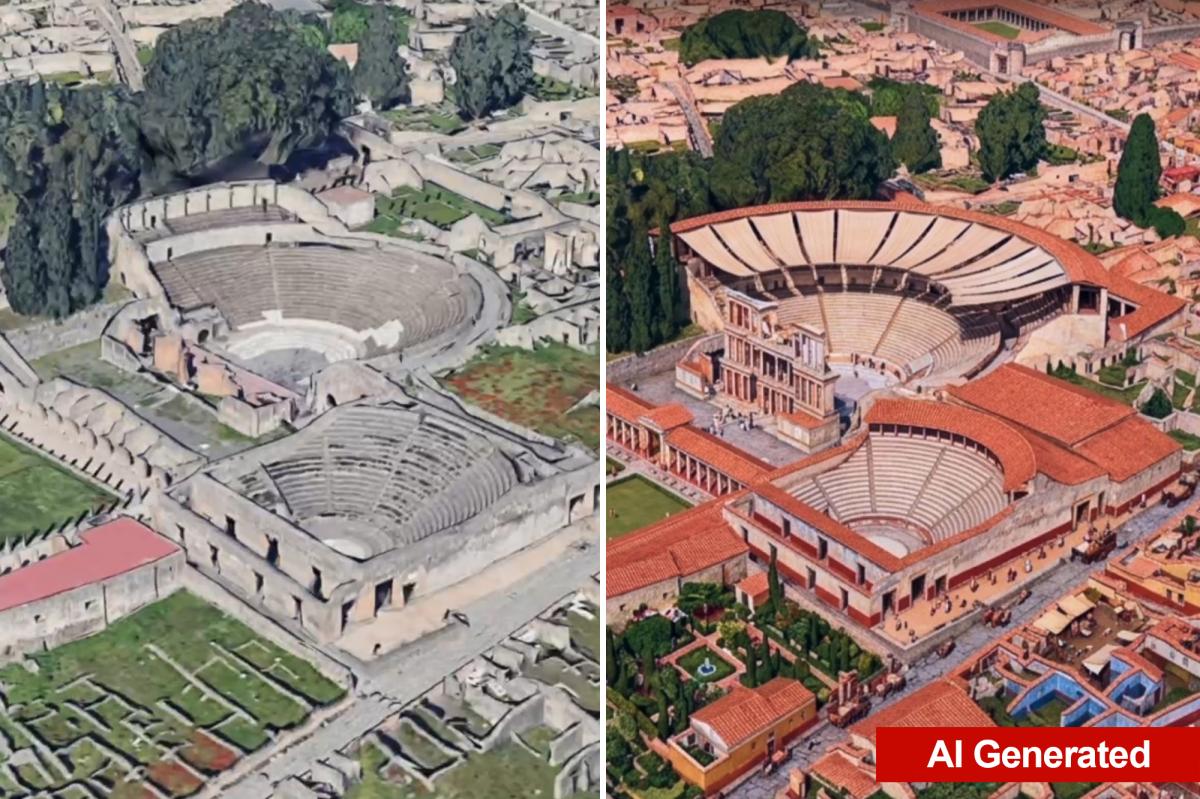
Google announced Friday that it’s rolling back a new AI image-generation feature for Google Earth after users sounded the alarm over misinformation concerns linked to easy-to-make fake satellite photos.
The decision to pull the tool from Google Earth came just one day after it was introduced to the company’s satellite-imagery program, resulting in a slew of bizzare and disturbing images, including fake bomb blasts in major cities.
Powered by Google’s Nano Banana 2 technology, the feature allowed Google Earth users to generate photorealistic images within the platforms satellite, aerial and 3D imagery by simply writing a text prompt for any location across the globe.
Users flocked to the new feature embedded within Google Earth’s interface after it was introduced Thursday and were able to create particularly harrowing, realistic images of war-torn cities and homeless encampments that did not exist.
“Tonight I typed just one sentence into Google Earth and put refugees near the Mexican border. Then I planted a nuclear plant in Iran. Then I put a fatal crash on a street in Amsterdam,” 404 Media reported, citing a since-deleted blog post by OSINT researcher Henk van Ess.
In a test by 404 Media, the outlet was able to generate skyscrapers in rural settings; add a homeless encampment to an an area of Los Angeles where homelessness is a major political issue; generated bomb blasts and craters in the City of Angels; and created protesters outside of Google’s corporate buildings.
German investigative reporter Ben Huebel slammed the new AI feature, calling it “absolutely irresponsible and plain bad for investigations,” in a LinkedIn post Thursday.
In a press release Thursday, Google advertised the generative tool as being able to create “custom images to help you visualize history, create real estate plans and more.”
“Have you ever looked at an empty lot in your neighborhood and imagined a community garden, or wondered what your city looked like a century ago? Now Nano Banana 2’s image generation capabilities in Google Earth can show you both,” the press release read.
However, Huebel strongly disagreed with the advertising of the AI product and said “this isn’t what many people will use it for.”
“If you type the address of your workplace and then prompt it to “make it look like a drone attack happened here,” it will create a damning image that looks very close to what we’ve seen in Ukraine, Russia, the Middle East, and other war-torn conflict zones,” he wrote.
“It’s harrowing and horrific, and it will make verification work much more difficult,” Huebel added, acknowledging that even if people “use detection tools to determine that an image was altered by Google, there are ways to override those indicators, no matter what people tell you.”
“This is BAD,” he wrote.
Van Ess told NPR that nothing was off limits when he trialed the feature.
“I tried refugees at the Mexican border, a nuclear plant in Iran, a crash in Amsterdam, a hospital with a bomb crater in Gaza. Nothing was refused,” he said.
After amassing sharp criticism online, Google acknowleded on X that they “take misinformation seriously” and “prevent image creation on harmful topics” and regularly update their protections.
Google also said every image created with Nano Banana in Google Earth has a SynthID digital watermark — an invisible digital watermark built directly into AI generated content to help people identify it through asking the Gemini App or Lens in Search feature.
However, less than a day later, Google announced it was rolling back the new AI feature in Google Earth, citing policy violations.
While the company did not specify what types of images violated its policies, it added that they will be working on “implementing stronger guardrails” to prevent such violations from occurring.
With Post wires
Disclaimer : This story is auto aggregated by a computer programme and has not been created or edited by DOWNTHENEWS. Publisher: nypost.com





