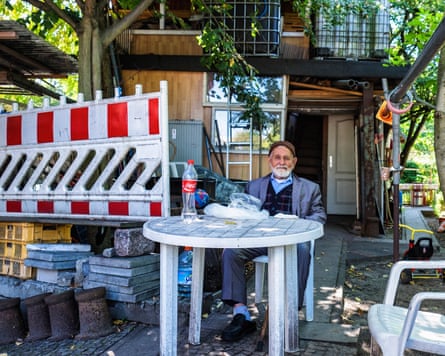
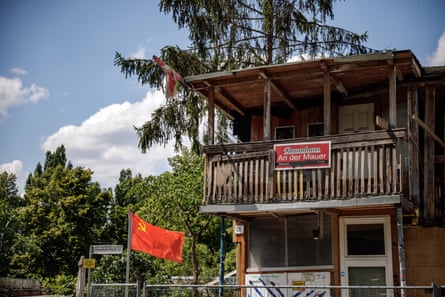
Sometimes the currents of history converge in a single spot. In Berlin, one of the most intriguing of those places is a small traffic island with a lovingly tended garden and a ramshackle two-storey structure called the Treehouse at the Wall.
In 1983, Osman Kalin, a Turkish “guest worker”, was looking in his corner of the city cleaved by the Berlin Wall for a patch of earth in which to plant his onions, garlic and cucumbers. Virtually on his doorstep in the Kreuzberg district was a slice of no man’s land next to the concrete barrier and barbed wire. Although it sat in West Berlin, cold war logic meant the lot officially belonged to the communist East.
The east-west border cut a sharp angle near a curved street called Bethaniendamm. The wall was built to slice straight across the road, which left a triangle-shaped scrap of land on the wrong side. Neither side could use it and so nearby residents commandeered it as a dump – until Kalin came along.
Perhaps it took an outsider such as Kalin to see the potential in the postage stamp of fertile soil beneath the orphaned furniture and discarded drug paraphernalia. And it required a certain audacity to build something abutting the wall patrolled by East German soldiers with shoot-to-kill orders.
Over the decades, the “guerrilla garden” came to symbolise a rebel spirit in dark times, the ingenuity of immigrants who were often made to feel unwelcome, and the tragedy and absurdity of great-power confrontation in a city where citizens on both sides just wanted to breathe free.
That’s a lot of mythology for one place to hold, and four decades of upheaval have left their mark. Now supporters of the Treehouse at the Wall fear it could be demolished by city authorities as a public safety hazard and are rallying to save it.
Kalin, one of the first generation of so-called Gastarbeiter brought by West Germany to plug a labour shortage, was “a remarkable figure”, said Suat Özkan, the general secretary of a Turkish community group in Berlin. “Perhaps he wasn’t a master of language, perhaps he wasn’t the perfect architect, perhaps he wasn’t the perfect artist, but he created something artistic – something that became totally unique.”
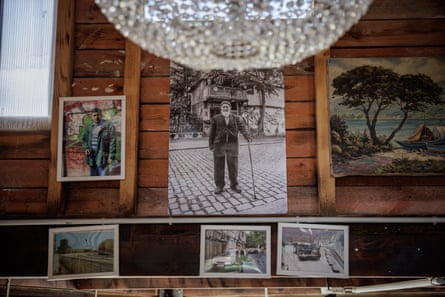
Kalin, who was born in 1925 in Anatolia, arrived in West Germany in the late 1960s as a manual labourer. Under the programme, about 14 million guest workers came to the country between 1955 and 1973. Despite the temporary nature of the scheme, many stayed on. Nearly 3 million people of Turkish origin now live in Germany, about 200,000 of them in Berlin.
Kalin at first squatted the land with his flower and vegetable garden and a small improvised shed. Then, eventually, against the odds, he won permission from the East German authorities to stay, so long as whatever he built there would not be taller than the wall.
In time he replaced the shed with the larger “treehouse”, which despite the name is not up in the branches but built around a mature trunk that was on the site.
After the city reunited in 1990, Kalin faced eviction orders but found an unlikely ally in the neighbouring St Thomas church, which located 18th-century papers showing it was the rightful owner of the land and allowed him to stay.
Since Kalin’s death as a local hero in 2018, his son Mehmet has tended to the property and his father’s legacy.
“Right when two global political systems were facing off,” Özkan said, Osman Kalin carried out an “act of defiance against the GDR regime, against the system, to show that it is possible to stand up and carry out a kind of revolution”.
He added: “It’s a symbol of resistance as well as a symbol against racism, discrimination and hostility.”
Özkan said that more than six decades after West Germany established the guest worker programme, it was long past time for the reunited nation to pay tribute to its waves of immigrants.
“We still haven’t managed to construct a central memorial,” he said, to the foreign labourers who helped build the postwar economic miracle. “This house should serve as a kind of memorial.”
Stefan Zeppenfeld, a historian who published a book in 2021 about Turkish labourers in West Berlin during the cold war, said it took decades for Germany to acknowledge its transformation into a “country of immigration”.
He noted that migrant labourers like Kalin were relegated to neighbourhoods close to the wall, such as Kreuzberg, that became prime real estate after the wall’s fall in 1989.
Zeppenfeld said the treehouse crystallised many aspects of what made up Berlin and its people. “The history of German division or the iron curtain is still absolutely crucial and defining for Berlin, for Berlin’s sense of identity,” he said. “And I find it absolutely fascinating that this building is still standing – it’s one of the few tangible legacies where we can actually see agency by Turkish guest workers as a real part of the cityscape.”
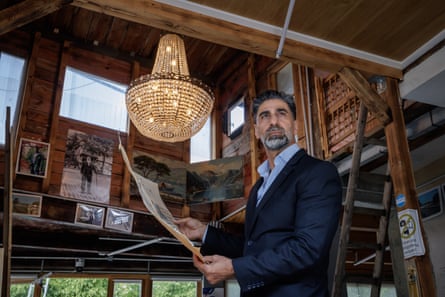
As a first step, Özkan is planning an open-air exhibition on the chain-link fence surrounding the structure, complete with archival pictures and Kalin’s extraordinary life story.
The tension with city authorities ahead of a Berlin election in September is that supporters of the treehouse want to maintain its scruffy authenticity while safety and legal concerns have forced a conversation about its structural integrity.
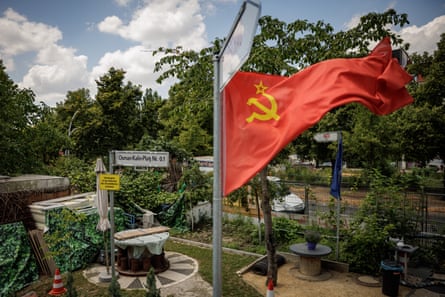
Outside, the wooden facade is made up of listing, mismatched planks. Tongue-in-check Nato and Soviet flags whip from erected poles while plum and apple trees mark the seasons. Inside, a jumble of black-and-white photographs and construction tools point to the Kalin family’s past and future in their garden idyll. A donated chandelier lends an unexpected touch of elegance.
Florian Schmidt, a Kreuzberg district councillor, said his office was working closely with the Turkish community and Kalin’s son Mehmet, who has done extensive repairs on the house, to “grant the necessary permits” for it to remain.
“Due to the unusual situation – the site being a no man’s land and the lack of planning permission – use of the treehouse was initially prohibited,” Schmidt said in an emailed statement, noting that Mehmet had been granted a temporary exemption to do work there. “Issues relating to ownership rights are also being clarified.”
Adrian Sampson, of Alternative Berlin Tours, which spotlights the city’s subculture and street art, was leading a group of visitors past the treehouse on a hot July day as he explained Kalin’s legacy.
“His story is about three things: resistance, community spirit and multiculture all together there. And that’s what Kreuzberg is about,” said Sampson, who is originally from Melbourne.
Asked about speculation that the site’s days could be numbered, he said: “I think it’d be an absolute shame, like really a pity for the city, because it just makes a lot of people happy.”
Disclaimer : This story is auto aggregated by a computer programme and has not been created or edited by DOWNTHENEWS. Publisher: theguardian.com