
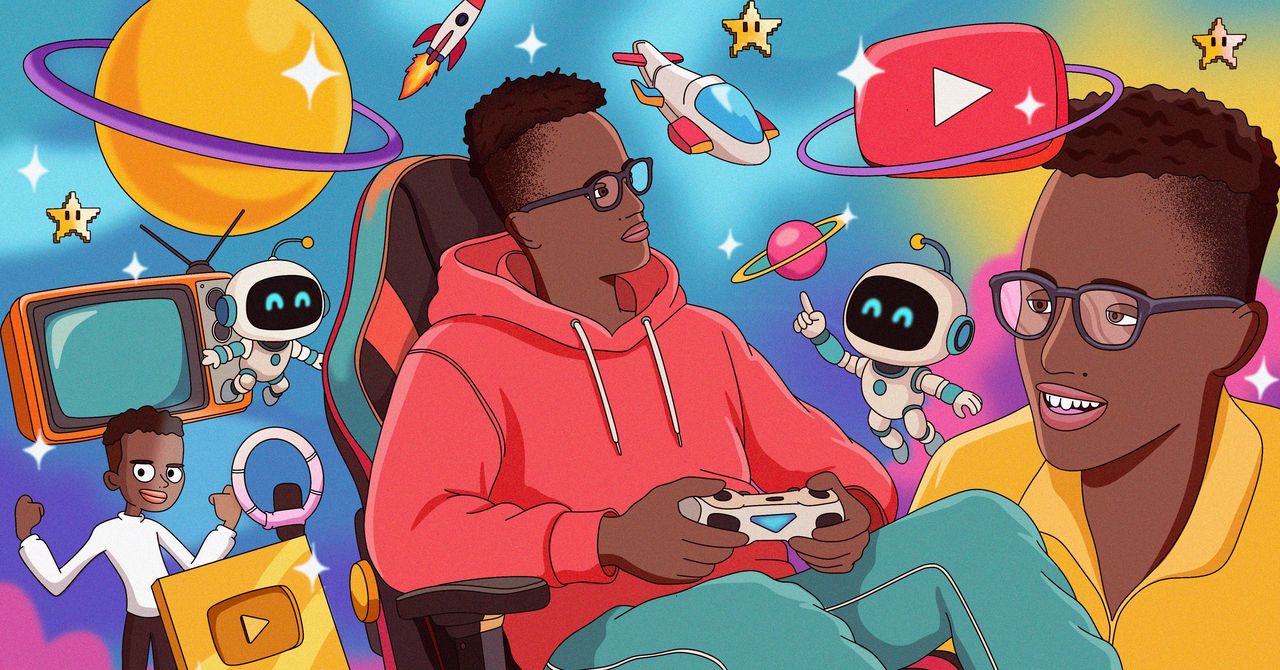
AboFlah keeps looking directly into the camera. He can’t help it—the YouTuber has collected 50 million subscribers and has spent most of his life streaming. For most people, a camera lens is intimidating and cold. For AboFlah, known as Hassan Suleiman in the few hours he spends offline, it is more comforting to look into it than to ignore it.
We have our conversation in the studio of 8Flamez, the company he cofounded alongside Eyad Siyam and Saad Sarwar to manage creators and build infrastructure for the creator economy. It’s a massive, white-walled space scattered with props, furniture, and recording equipment, ready to film at any moment. He arrives on time but slightly annoyed at having missed an appointment earlier in the day. He’s not one to miss an appointment; or even an email, as I later find out. His inbox has a measly 17 unread emails.
Online, he is frequently compared to IShowSpeed and KSI, both of whom he has collaborated with. But his defining moment goes beyond any clickbait; his charity livestream, where he spent 12 days locked in a glass box in Dubai, raised $11 million for refugees and broke two world records for the longest livestream video and the most viewers for a livestream charity donation event.
Seated on a beanbag on the floor of his studio, he talks the way he streams: fast and unfiltered, in long unbroken runs that he occasionally interrupts to apologize for. He does this before, during, and after our conversation.
At 50 million subscribers and with a company, a cartoon character on the way, and a target of 100 million subscribers ahead of him, he is thinking about what comes next.
He speaks in Arabic, his speech threaded with the expressions of faith—Alhamdulillah, Inshallah, Bi’ithnillah—that punctuate many of his answers, and which I’ve kept intact.
CARLA SERTIN: Tell me about the cartoon you’re planning with Spacetoon, Slayman. Why go with this concept?
HASSAN SULEIMAN: I love cartoons a lot. Spacetoon … I was born and raised watching Spacetoon. So as soon as they proposed the idea of me being featured as a character, I loved the idea. I mean, it’s a really beautiful idea, so I took part. So now Slayman is coming out, Inshallah. I expect it will release on Spacetoon at the beginning of next year or at the end of this year. And I’m very excited. I hope people like it, Inshallah.
TV is very traditional media, and you’re a streamer–
Yeah, it will be a new experience. But I expect, Inshallah, it will be a really great experience.
Why? Because my audience is mostly young and loves entertainment. And Spacetoon—and the character Slayman—will be a beautiful story that conveys a beautiful and nice message in an entertaining way for the young audience. So, Inshallah, they’ll love the idea.
Look, TV is not like social media; it’s different. That’s why I refused to go into acting, because I don’t really like acting that much. I refused things like, for example, being a TV presenter or doing a specific program and following the TV system. Because on social media, it’s much more relaxed. More spontaneous. You’re more yourself. You can do any idea. If I wake up today with a weird idea, I can do it on social media. In TV, you need a lot of approvals, a lot of things; it’s complicated.
I got carried away talking. I’m going to talk a lot. Forgive me, I will talk too much. Stop me if you want to change this up.
It’s better for you to talk too much than too little. Looking more in the social media sphere—not everyone understands that it’s a real job. You’ve said in the past that at the start, your dad didn’t understand it.
Oh, yeah.
What does he think about your work now?
My dad is satisfied now, he’s at ease. If at the end of the month there is money that comes in—that’s it, there’s money at the end of the month. He says, “OK. Oh, my kid is doing good. OK. You’re doing good financially. You’re sending me money. That’s enough.”
But he‘s satisfied. And he really loves it. I mean, honestly, he really loves what’s happening—the charity work—he’s really proud of it. He’s proud of these things—so Alhamdulillah, Alhamdulillah.
In the beginning he didn’t support me. But it’s the point you mentioned, awareness.
Many people don’t know that social media or YouTube is a job—that it can be better. It’s hard, high-risk, because there’s a big chance you might not succeed. But I believe that if a person loves the thing they’re doing, Bi’ithnillah, they’ll endure, and tawfiq [success granted by God] will come, and they’ll succeed. I mean, that’s the thing that made me succeed and endure. The first payment that I took from YouTube was after four years.
What’s kept me going those four years? What made me endure without money, with expenses and making content? Because I really loved it, and the situation helped me. So it was tawfiq from Allah. And at the same time, I loved it and was confident that, Bi’ithnillah, I would succeed. Yeah.
Do you feel like it’s harder now to succeed in YouTube?
No, no, no, no, no, no. Much easier. Much easier. The more time moves forward, the easier it gets. Right now the situation is much easier.
With short content, reach is much bigger than long content. So you have a chance to spread widely—there’s an opportunity. But a person has to focus and take the step and say, “I can do it.” And leave the rest to Allah. That’s the thing that, Bi’ithnillah, a person needs. But yes, the situation now is much easier, even the business parts. I’ve seen a lot of business people saying that if you want to be a millionaire in this—if you want to be a person who has a million or more—in this era, it’s much easier than before. They all say that, and it’s the same on social media.
Now that you’re building a production company, 8Flamez, and other projects, what’s the next era? Is it AboFlah the CEO?
AboFlah the CEO.
[He laughs]
As a content creator, becoming a CEO or becoming a business owner is not easy at all. It’s a big difference. Even the thinking, the mental side, is different. Financially, I am focusing on being a leader, not a boss, being a leader and knowing how to build a team, a system. I’m a content creator.
So Alhamdulillah. “أعط الخبز لخبازه” [“Give the bread to its baker”, which means “leave things to the experts”]. Find successful business people who have a beautiful idea, believe in the idea and partner with them. That’s what I’m doing. Alhamdulillah, I’m a partner with Mr. Eyad [Siyam]—he’s a business guy who has, Mashallah, knowledge, a wealth of expertise in social media and in marketing from the age of 25.
He made a very beautiful business in the UK, and he had an exit plan, made millions, so he has the experience. The point is that I partnered with capable people and joined hands with them, and, Mashallah, we are growing the business step by step. But I’m focusing on the thing I’m good at, which is making content.
I don’t want to lose focus across more than one thing. You need to be focused if you want to succeed in something. I’m focusing on content more than business, to be honest. I don’t know anything about business, by the way. I don’t know how much I made last month.
I was with the accountant just now, he showed me: “Hassan, you made this much money.”
“Oh, this money I made. OK, wow.”
So I don’t know, and that’s a good and bad thing. The good part is that you’re focusing on the things you know. That’s what the team needs from you. And the bad thing, OK, you’re supposed to have some clue … [he trails off, laughing]
It sounds like you’ve built a team around you that you trust.
Yes. And trust is the most important thing. Yeah. And agreement.
[He pauses]
Penalties.
[He laughs]
And then going to charity, because you did mention …
Oh, the charity. It is honestly the most beautiful thing I’ve ever done. Alhamdulillah rabbil alameen. “من يفعل الخير يكسب الدنيا والآخرة” [“Whoever does good wins in this life and the hereafter”]. Our religion teaches us that.
I want to say something about charity. I didn’t make anything financially from it. So Subhanallah, and this is proof that whoever does good wins in this life and the hereafter. It gave me a lot of opportunities. I mean, Alhamdulillah, I made a lot of money from the fame that came from the charity.
If we talk about the financial, business side, I made a lot of business deals, sponsorships. I became more famous—from 10 to 100 percent, from 10-plus to 100-plus—after I did charity, Alhamdulillah. Inshallah, Allah accepted this.
That’s the thing that matters the most. Doing good is very, very beautiful. It gives you energy. It gives you a reason to keep going. Sometimes—OK, you made money, you got fame, what do you want? That’s it. But doing charity makes you feel like, OK, I have reasons to keep going. I could make this guy’s family situation better. I could do something.
Is it also heavy as a responsibility? There’s a lot of people who trust you or who rely on you.
In the beginning. But after that, Alhamdulillah, I learnt how to deal with it. In the beginning I didn’t know how to handle this responsibility. But in the end I realized: No, Hassan, you’re human. You’re human, and pleasing everyone is an unattainable goal. I won’t be able to please all people. Impossible.
And also, “من عاش على مدح الناس ما تبي ذمهم.” [“Whoever lives for people’s praise will suffer from their criticism.”]
In a 2024 interview with The National, you said you’d only reached 30 percent of your goal. What’s the 70 percent that’s left?
I told you—it’s that I keep going, make people happy and make myself happy. I mean, enjoy the journey. When you ask someone—say, an employee who works eight hours and has a family—when I ask him, I say, for example, “What’s the new thing you’re going to do? You have a family, you’re an employee getting a salary of, say, 20,000 AED [about $5,450]. What’s the new thing you want to do?” I expect he would say, “I’ll buy a house, do this and that, and carry on with my life.”
What I’m doing now is I keep making content. I keep doing the thing that I love. I make people happy, I add more charity work to my videos, I continue with my business and I keep working towards reaching a bigger number of followers. Right now I’ve reached 50 million [subscribers on YouTube]. The goal became, Subhanallah, the more a person achieves, the more their ambition grows. So the goal now is 100 million. Bi’ithnillah, Bi’ithnillah.
I want to be the first Arab in the Middle East and North Africa—and all of Africa—to reach 100 million, Bi’ithnillah.
Inshallah.
More countries are banning social media for kids. What are your thoughts as a content creator?
This is very good, excellent.
The responsibility is on both: on the content creator, and even more on the family. The family has control to prevent the young child from following this or that. But when the family abandons its responsibility and puts it on content creators, it’s is dangerous and high-risk.
I don’t know where every content creator comes from. How was he raised? How does he think? I’m afraid of sharing bad things with a child, but there are many others—I’ve seen them with my own eyes, without naming names. For them, it’s normal. This is his life. This is his way of doing things. He doesn’t care. He doesn’t care that he shows this or that. The responsibility has to go back to the family.
If the family drops the responsibility, removes their responsibility for the child, who’s going to raise the child? Me, a content creator? Come on. I’m human—in the end, I will make mistakes. There will come a time when I’ll post a bad video because I made a mistake. But the effect on the child will be big, because you handed over your responsibility.
So it’s on both: The content creator should be respectful and present content that’s appropriate for his audience, and if he makes a mistake, he should apologize, because he’s human in the end. And the family shouldn’t put the responsibility on the content creator. It should put it on its own parenting. The family has the control to prevent the child from following this or that. Or, look, don’t give him a phone, for example.
One of the things I think about—I’m not married yet, but if I have a son, Inshallah, or a daughter—I expect I won’t give her a phone or let her know anything about social media until later. I don’t know if that’s honestly correct, proper parenting. I need to review it and be well prepared for parenting. But I won’t let her know about social media for a while. I’ll let her live, experience life.
Ah, those were the days. We’d go out of the house and come back at 9 pm, play football, fall down, get scraped up, and have fun. Now it’s iPad, now that’s it. Allah y’een [God help] the new generation. Allah y’een. It’s a positive for us, by the way—for us as a business, it’s more views. But from my view of humanity, it’s wrong.
For example, short content is cheap dopamine. Short content is engineered to take a person’s focus.
[He mimes someone doomscrolling and drooling mindlessly]
That’s how I feel. Cheap dopamine, very bad dopamine. Having said that, I’m doing many shorts. [He laughs.] My latest short made 5 million views in one day. Alhamdulillah. So I’m taking advantage of that. But the person himself has to have the awareness to control themselves.
I’m sorry, I talk too much.
But I mean, it’s just like the family’s responsibility toward the child is to make him aware once he grows up, so that he says, “I don’t need to waste my time on things that don’t benefit me or my family.”
OK, maybe entertainment—entertainment should have a set time. Half an hour, an hour, Salam Alaykum [Goodbye]. Not 24 hours. Not the first thing when I wake up—to wake up and grab the phone.
This story was originally published by WIRED Middle East.
Disclaimer : This story is auto aggregated by a computer programme and has not been created or edited by DOWNTHENEWS. Publisher: wired.com







