Elena Becatoros and Thomas Adamson
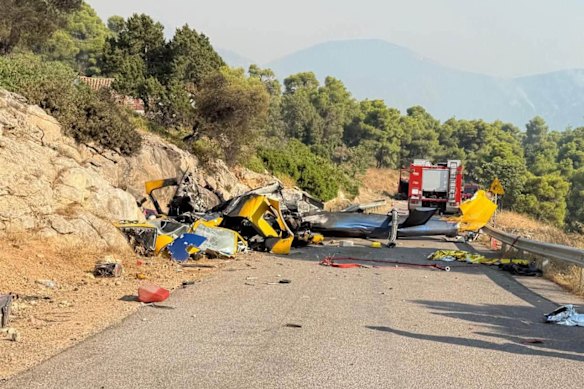
Athens: Two Greek firefighting helicopters collided in midair as they were battling a wind-driven wildfire west of Athens, sending one aircraft crashing to the ground. Two crew members, a Greek and a Danish national, died in the crash.
The collision on Sunday (Greek time) laid bare the danger at the most volatile front of Europe’s wildfire emergency. Strong winds drove flames deeper into the region of the Greek capital and forced fresh evacuations, France guarded a still-burning scar four times the size of Paris, while Spain’s major fires stopped advancing.
Greek Prime Minister Kyriakos Mitsotakis expressed “sorrow for the tragic accident” and extended condolences to the families of the firefighters killed in the crash.
“The loss of the Greek coordinator and the Danish pilot at the time they were attempting the major fire in Porto Gremeno fills us all with grief,” Mitsotakis said in a statement.
The aircraft were Bell helicopters operating over the Psatha area west of Athens, each with a two-person crew. Foreign firefighting and helicopter crews are often deployed in Greece to help tackle wildfires during the country’s hot, dry summers.
The Guardian reported that the helicopters involved had been leased from Australia’s McDermott Aviation and were part of a fleet of 15.
Video posted online and reported in Greek media appeared to show two helicopters closing to cross paths at low altitude, before the main rotor of the lower helicopter struck the underside of the other. The lower one then crashed in flames.
The second helicopter then dumped its load of water and flew away. Reuters has not yet verified the authenticity of the footage.
The two crew members who were recovered alive were a Greek and a British national.
The flames had spread rapidly, threatening communities and an industrial district as violent gusts prevented firefighting aircraft from collecting water from the sea. The blaze carried a grim resonance in a region where the 2018 Mati wildfire killed 104 people, Europe’s deadliest blaze this century.
Farther west, containment brought no end to the emergency. France’s largest wildfire remained held within its perimeter after forcing 224,000 people to flee in what may have been the country’s largest civilian evacuation outside wartime.
Hot spots still burned within a 420-square-kilometre scar, thousands remained unable to return home, and nearly 3000 firefighters were deployed against the Gironde megafire and a second, still-uncontained blaze in Provence.
Together, fires in France and Spain have driven about a third of a million people from homes and vacation sites, emptied communities at the height of the European summer and stretched emergency services across simultaneous disasters.
The mass evacuations in France and Spain are the latest measure of a wildfire threat growing across Europe.
The continent entered 2026 after its worst fire year on record, with more than 10,000 square kilometres burned in 2025. Over the past four decades, wildfires have been linked to nearly 800 deaths across much of Europe, according to the European Environment Agency.
Europe is the world’s fastest-warming continent. It has warmed more than twice the global average since the 1980s, according to the European Union’s Copernicus Climate Change Service.
Human-caused climate change made the extreme fire-weather conditions behind this year’s French blazes at least twice as likely, scientists at World Weather Attribution found in a rapid analysis conducted while the fires were still burning.
In Greece, nearly 500 firefighters and 23 aircraft were deployed, but gale-force winds drove flames through dry forest and crippled the response, preventing some aircraft from reaching the sea to collect water.
Authorities ordered the evacuation of Kandili, Agia Skepi and Toutouli as smoke rose over the mountains. Crews were particularly concerned about Porto Germeno, a seaside community on the Gulf of Corinth.
The fire began on Friday near Agios Vasileios before sweeping toward Porto Germeno and into the forested mountains west of Athens. Firefighters evacuated 254 people by sea Friday and another 12 Saturday – often the last escape route when fire and smoke cut the few roads from coastal communities.
Elsewhere in Greece, flames threatened homes on Kefalonia, forcing evacuations from inland communities as aircraft made water drops over the Ionian island. Firefighters battled another blaze near Nea Tenedos on the peninsula of Halkidiki.
Earlier this week, two firefighters died fighting a fire on Crete, while a third was killed on the Peloponnese.
In south-western France, the Gironde megafire remained held within its perimeter on Sunday but continued to burn after scorching 420 square kilometres of forest in 10 days.
“The fire is now fixed, which does not mean that the fire is extinguished,” the Gironde prefecture said, using the French firefighting term for a blaze whose advance has been stopped.
The region remained under France’s highest red forest-fire alert. Dry conditions, soaring temperatures around Bordeaux and afternoon winds threatened to rekindle the flames.
In Le Porge, local officials said about 150 homes were destroyed. Mechanic Matthieu Plessis returned Saturday to the ruins of a house that had been in his family for seven generations.
“There are places I don’t even recognise anymore,” he said. “You don’t even know what was here anymore, or who lived where.”
Firefighters from Ukraine, Lithuania and French Polynesia were expected Sunday and Monday to reinforce the operation.
In south-eastern France, nearly 1500 firefighters battled a separate blaze in the Var department that tore through about 18 square kilometres in little more than a day.
The Gros Bessillon fire was stabilised Sunday after its perimeter held overnight, but it remained uncontained. Some 2500 people were evacuated as flames threatened nearby communities.
It was the fourth major fire to strike central Var since July 19. A smaller blaze near Brignoles in the week forced actor George Clooney and his family, along with about 700 other residents, to evacuate before it was brought under control.
Prime Minister Sébastien Lecornu said France’s fires were generally under control but warned that conditions remained volatile. He appointed a national coordinator to oversee reconstruction in fire-ravaged areas.
More than 1170 square kilometres have burned across France this year.
Spain’s major fires – which have killed at least 13 people, produced the country’s largest recorded wildfire and prompted a national emergency – were no longer advancing on Sunday.
Spanish Prime Minister Pedro Sánchez has called for a national pact to confront wildfires, warning that climate change is making them increasingly destructive.
From our partners
Disclaimer : This story is auto aggregated by a computer programme and has not been created or edited by DOWNTHENEWS. Publisher: www.smh.com.au