Who would have thought it? The eurozone, derided by Donald Trump as a declining economy that was heading in the wrong direction, outpaced the US economy in the June quarter.
The eurozone economy grew at an annualised rate of 1.8 per cent that quarter, while the US economy grew at 1.5 per cent. Canada, hit hard by Trump’s tariffs, grew its economy over the quarter at an annualised rate of 3.4 per cent.
Europe’s growth rate was its fastest in more than a year, despite continuing energy shocks emanating from Trump’s war in the Middle East and his tariffs.
In the United States, growth slowed from 2.1 per cent rate in the first three months of the year, despite the continuing boom in artificial intelligence-related investment, lower oil and petrol prices during the ceasefire in the war on Iran and a surge in spending by wealthier Americans (with some assistance from the World Cup) in June.
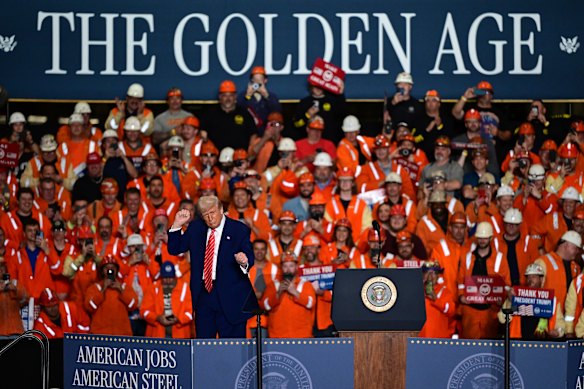
So much for an economic “Golden Age” for the US that Trump, his Treasury Secretary Scott Bessent and Commerce Secretary Howard Lutnick have repeatedly promised would arrive this year.
So far, the only gold is to be found in the White House, or on Washington’s monuments, where Trump has been gilding anything and everything, or in the wealth being accumulated by the Trump family and their associates.
The US economy would probably be running a lot hotter if not for the war in the Middle East and the global war on trade that Trump keeps trying to establish a legal basis for.
Along with the data on GDP that was published late last week, the Commerce Department put out personal consumption expenditures (PCE) data for June that showed the US Federal Reserve Board’s preferred measure of inflation, the PCE index, fell 0.1 per cent in June to be 3.7 per cent higher than it was in the same month last year.
While that’s well below the 4.1 per cent May-on-May rate, it is still way above the Fed’s inflation target of 2 per cent. Even stripped of energy and food prices, “core” PCE inflation was 3.3 per cent.
In July, the hostilities in the Middle East resumed and oil prices, which had fallen back below $US72 a barrel in June, spiked again after the brief ceasefire. They surpassed $US100 a barrel last month, before again falling, to around $US84 a barrel at present, as talks appear to have resumed.
US gasoline and diesel prices remain well above their pre-war levels – gasoline about $US1 a gallon higher and diesel about $US1.60 a gallon higher – and will continue to feed into the inflation rate.
It is inflation, a declining savings rate, and the fact that much of the equipment required for the boom in AI is imported (and therefore subtracts from GDP), that is weighing on US growth.
For a variety of reasons, not the least the stop-start ways in which the trade and the real war have been waged, their impact on the inflation rate, and economic growth, hasn’t been as significant as most outside the administration expected.
With another newly-imposed round of global tariffs on 99.4 per cent of America’s imports and the war in the Middle East dragging on without any obvious clean conclusion, their effects on the economy and the inflation rate might, however, have been stretched out and delayed rather than avoided.
Rather than a one-off shock before prices stabilised, they might still be bleeding into prices and the economy in a fashion that means they may not be “transitory” and therefore can’t be dismissed as such by the Fed, which left its policy rate unchanged – for the fifth successive time – after last week’s meeting.
With the Fed’s new Trump-appointed chairman, Kevin Warsh, creating an information vacuum by withdrawing any guidance on interest rates, the bond market has taken matters into its own hands.
The 10-year bond yield is now 4.74 per cent, compared with its pre-meeting level of 4.61 per cent. The 30-year yield has jumped 18 basis points to a 19-year high of 5.27 per cent.
Those yields, if sustained, will choke spending and investment and raise the borrowing and refinancing costs on the US government’s debt, which is rapidly nearing $US40 trillion ($57 trillion).
So far, the only gold is to be found in the White House or on Washington’s monuments, where Trump has been gilding anything and everything he can, or in the wealth being accumulated by the Trump family and their associates.
The eurozone data shows its economies, despite being battered by a series of energy-related shocks that started with the war in Ukraine and are continuing with the war in the Middle East, and having to deal with a tide of cheap Chinese imports that has swelled since Trump started building his tariff wall around the US market, are more resilient than expected.
All the major economies – Germany, France, Italy and Spain – grew solidly, if not spectacularly, in the quarter, and Ireland, a beneficiary of the AI boom, bounced back from a sharp contraction in the first quarter to growth of 3.9 per cent in the second.
Like most of the rest of the world (China and Canada being the exceptions), while it did threaten action, the eurozone didn’t respond to the US tariffs with retaliatory tariffs – taxes on its consumers – of its own.
It’s the US, thanks to the tariffs and the impact of the war-driven higher oil prices on domestic gasoline and diesel prices, that is hitting its own businesses and consumers and its own growth hardest.
A 1.5 per cent growth rate isn’t a disaster, but it’s hardly the “Golden Age.” The five or six per cent growth rates that Trump said his policies could generate haven’t materialised (which is no surprise) and neither have the trillions of dollars of foreign investment in the US manufacturing sector that he also said would flow.
Real wages for US workers are declining, manufacturing sector jobs have shrunk and it is the AI boom and those wealthiest households who benefited most from the tax cuts in Trump’s One Big Beautiful Bill Act and who have gained most from the AI-driven sharemarket wealth effects who are generating the reasonably solid but unspectacular economic growth rate.
If something were to disrupt the AI boom – and investors are getting nervous about the sustainability of the vast amounts of capital being poured into it, by increasingly negative cashflow-generating companies, relative to the cheaper Chinese alternatives and the returns in prospect – the implications for the sharemarket and economy would be threatening.
Trump and those in his team regularly denigrate the Europeans and their economies, saying the economies are over-regulated, stagnating or declining, being swamped by illegal migrants and effectively subsidised by the US (or leeching off it via unfair terms of trade).
Some of those criticisms might be valid, but the Trump alternative of aggressive deregulation, trade barriers and extortion, draconian crackdowns on undocumented migrants and immigration more broadly and a war in the Middle East that is delivering nothing but humiliation and higher energy costs make it difficult for the administration to claim the US, or at least this particular administration, has the superior economic or governance model.
The Business Briefing newsletter delivers major stories, exclusive coverage and expert opinion. Sign up to get it every weekday morning.
From our partners
Disclaimer : This story is auto aggregated by a computer programme and has not been created or edited by DOWNTHENEWS. Publisher: www.smh.com.au