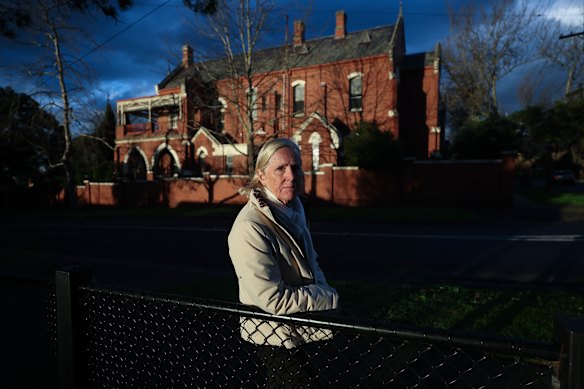

A push to convert one of Australia’s oldest orphanages into apartments in a sleepy suburb not earmarked for high-rise development has sparked a warning for other residential streets in Melbourne.
A developer wants to turn the former St Joseph’s Home for Boys in Surrey Hills into 76 apartments over four storeys which, if approved, would be two levels above the area’s existing height limit and include the demolition of a 1941 school, subject to local heritage protections.
Other historical buildings like the iconic chapel, which is more than 120 years old, would remain.
City of Boroondara Mayor Wes Gault said the proposal was “unlawful” given current height limits, but the council was powerless to stop it.
The developer has sought permission directly from the state Planning Minister Sonya Kilkenny through a pathway that bypasses councils.
The pathway applies to projects above $50 million if 10 per cent of homes are allocated to affordable housing or – in this case – developers contribute 3 per cent of construction costs to a fund to build them. Projects approved this way cannot be fought at the Victorian Civil and Administrative Tribunal.
Unlike many other housing projects under consideration through the state government’s Development Facilitation Program, the Surrey Hills site is not within a state-designated activity centre area, where high-density development is encouraged to address the state’s housing crisis.
However, planning advocates and even some residents say the site’s distance from the city, public transport options and size are an example of developments that should be encouraged to address the housing crisis – not ones blocked by council.
Planning Institute of Australia Victorian president Patrick Fensham said while the government sought to address the gap between housing supply and population growth, there was also a “question mark about the legitimacy” of approving medium- to high-density developments outside activity centres or in areas otherwise provided for in planning controls.
“Is this the new system? Is this a site-by-site assessment process rather than responding to strategic planning, which is based on good planning aims? The precedent is problematic,” Fensham said.
“The more we see ministerial discretion in these things and the lack of a process for the public to provide input, that there is a principle of integrity of the system which is somewhat at risk.”
Professor Andrew Butt, from RMIT University’s Centre for Urban Research, supports greater housing density in spots with good access to services such as transport. But he is concerned existing rules around height and setbacks could be waived, particularly as a community’s appeal rights diminish, and believes the public should be able to trust existing controls will be upheld.
“If you’re testing the limits of those controls and, in fact, breaking them, what faith would we have in the controls anywhere? This could happen anywhere,” Butt said.
Sally Forrester is among many Surrey Hill residents who lodged objections to the plans for the St Joseph’s site, and is concerned the development would overwhelm mostly single-storey heritage homes nearby.
“It’s time that it gets developed,” Forrester said.
“But in short, the current proposal is far too large, too intense, and it’s too inconsistent with the preferred neighbourhood character of the precinct.”
Boroondara Heritage Group committee member Christina Branagan worries about the potential loss of the school building. Not only was it a significant structure and enhanced the area’s character, she said, but it was vital to uphold the broader principle of protecting heritage assets for future generations.
However, other residents are broadly in favour, including Jocelyn, who asked for her surname to be used.
She has lived nearby for two decades and said the proposed height wasn’t a concern as the chapel was already tall, and she was relieved older heritage buildings would be restored. Her concern is how the narrow surrounding streets might cope with an influx of cars.
“As long as it looks the same and the features are preserved, it doesn’t worry me,” Jocelyn said.
There is a bus stop on the same street as the former boys’ home, and Chatham train station is about 500 metres away.
Some housing advocates argue many local planning rules are restrictive as they prevent more homes – including affordable apartments – from being built, particularly in inner-city areas.
A planning report prepared for Antipodean Land Developments, the company behind the proposed development, says the building would respond to housing demand, add to the diversity of homes available in the area and breathe life into underutilised land through a design by award-winning architects.
The report cites “extensive pre-application engagement” with the state’s development program, while a heritage impact report has also been released.
Gault, the mayor, described the plans as inappropriate for the site and said it would be “unlawful for council to approve a building of this size”.
“We want to see housing growth in Boroondara which is respectful of significant and irreplaceable heritage properties and doesn’t see oversize development in residential areas,” he said.
Antipodean Land Developments declined to discuss the proposal.
Critics of the current planning rules for the area argue they are restrictive and prevent more housing from being built.
A Victorian government spokesperson said the planning system was being overhauled to ensure more homes were built.
“Boroondara Council is working overtime to block new homes – locking out workers, families and young Victorians from living in these well-connected areas,” the spokesperson said.
“Any proposal will be considered on its merits and in accordance with the relevant planning scheme including heritage overlays.”
Former orphanages and children’s homes across Melbourne have varied uses.
The former St Vincent’s Boys’ Orphanage in South Melbourne is now occupied by child welfare agency MacKillop Family Services, and the Blackhall mansion, previously occupied by the Catherine Booth Girls’ Home in Kew East, is owned by Carey Baptist Grammar School.
The Box Hill Boys Home is part of a retirement village, and Abbotsford Convent, now an arts and cultural precinct, used to include an orphanage.
Start the day with a summary of the day’s most important and interesting stories, analysis and insights. Sign up for our Morning Edition newsletter.
 Rachael Ward is a journalist in the City team at The Age. Contact her at rachael.ward@theage.com.auConnect via email.
From our partners
Disclaimer : This story is auto aggregated by a computer programme and has not been created or edited by DOWNTHENEWS. Publisher: www.smh.com.au