For more than four decades, the investing world operated on a foundational assumption: that a portfolio consisting of 60% stocks and 40% bonds would protect you when markets turned. For roughly the past 20 years, a second assumption took hold alongside it: that a handful of dominant tech companies would keep growing into whatever price investors were willing to pay. This has taken on several shapes, with the FAANG companies morphing into the “Magnificent Seven” during the pandemic, and the AI boom crowning a new group of “hyperscalers.”
But these assumptions are taking a hit from sources that rarely deliver bad news about the markets they cover.
Goldman Sachs, one of the Street’s most consistently bullish research shops, published a note Monday authored by chief global equity strategist Peter Oppenheimer conceding that “there does not appear to be a valuation bubble, but there may be an earnings bubble” in the technology sector.
The same day, Apollo chief economist Torsten Slok wrote in his Daily Spark note that “the 60/40 portfolio is broken,” arguing that with the AI trade slowing down and government debt projected to reach 175% of GDP, “neither the 60 nor the 40 responds to what made it work in the first place.”
Both notes came after a week of Big Tech earnings that saw shockingly large moves both up and down for major tech firms, with analysts debating whether they reflected the true shape of the AI moat or “financial nihilism.”
Microsoft made history with a 17% stock surge, adding nearly $500 billion in market capitalization in one day, its largest single-day move since the financial crisis year of 2008. In fact, Oppenheimer said Monday that the market is seeing things change in a way they haven’t since the Great Recession.
A regime cracking, not just a ratio
The 60/40 rule wasn’t always gospel. Its theoretical roots trace to Harry Markowitz’s 1952 work on portfolio theory, but it only became institutional orthodoxy during the four-decade stretch of falling interest rates that began in the early 1980s. That decline let bonds do double duty as both income and ballast against equities, a dynamic that market analysts have called the “golden age” of investing.
Slok’s warning isn’t a reaction to one bad earnings season. He has argued since at least 2023 that rates would stay “higher for longer” than consensus expected. By late May 2026, he had sharpened that macro call into a specific yield-curve mechanism: front-end rates were rising on sticky inflation, the middle of the curve was under pressure “because of hyperscaler issuance,” and long-end rates were climbing on “more Treasury supply and less Fed demand.” His Aug. 3 argument that “the real risk emerges if the AI trade reverses or markets become more worried about government deficits” is a continuation of that multi-year thesis, not a new one.
Oppenheimer’s note doesn’t use Slok’s exact phrase, but reaches the same structural diagnosis from the equity side. “More government debt, increased issuance, and persistent inflation have all contributed to a higher cost of capital, leaving earnings as the key driver of returns,” he wrote. “We think this trend will continue.”
A rotation not seen since 2009
Oppenheimer’s team pointed out that for the first time since 2009, the equal-weighted S&P 500 has outperformed the market-cap-weighted index by more than 7.3%. Since the mid-2000s, and especially since the financial crisis, U.S. markets had grown increasingly dominated by a small number of mega-cap tech names. But now, “market participation has broadened beyond the largest stocks,” driven by resilient economies, a pickup in M&A, and what Goldman calls “the sharp momentum unwind of recent weeks.”
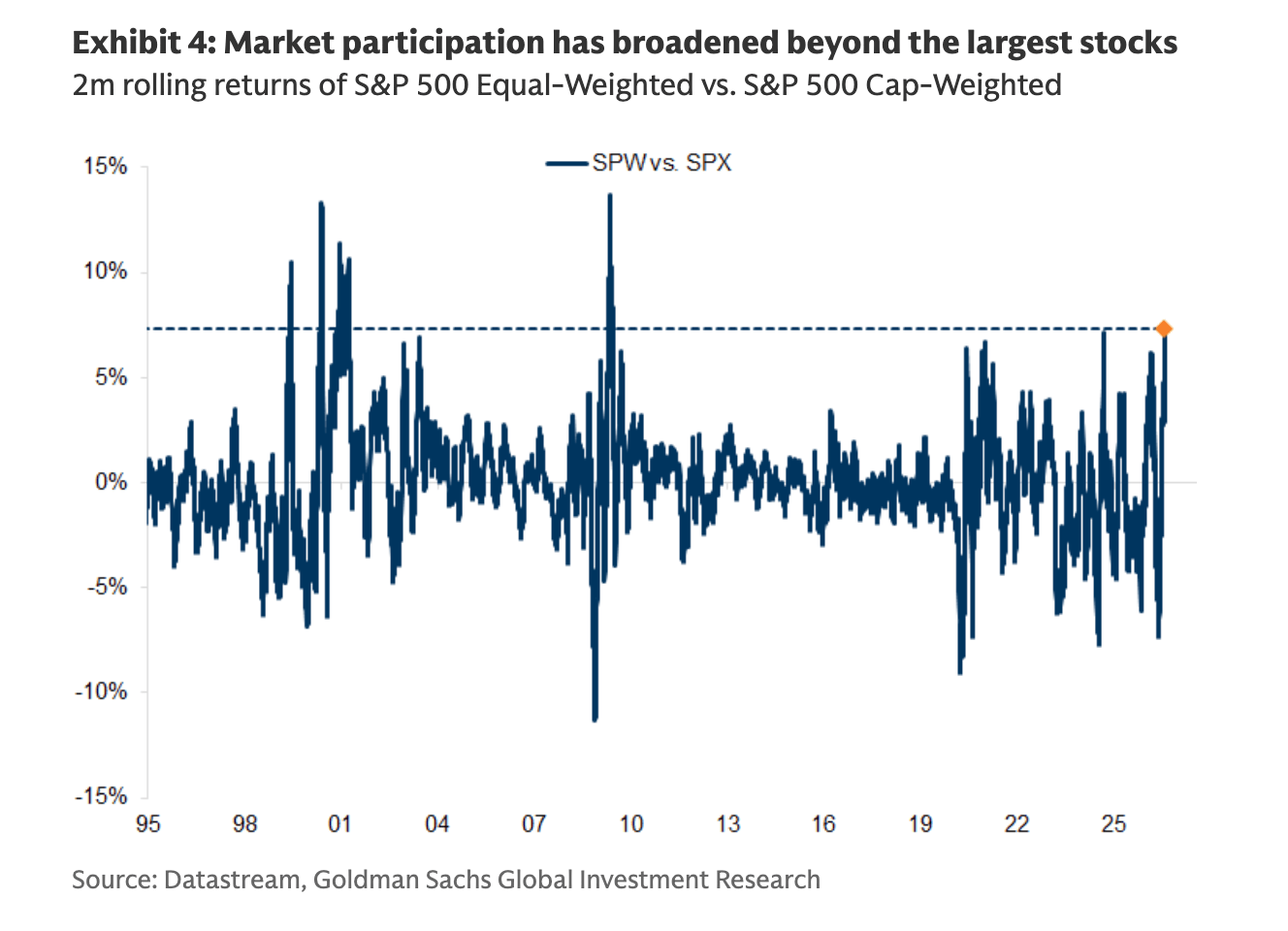
The mechanism behind that unwind is capital expenditure. Since ChatGPT’s emergence, Opennheimer noted, the explosion in capex among the hyperscalers has increasingly eroded their premium cash flows, forcing them to turn to debt and equity markets for funding. This means the premium the five biggest U.S. stocks once commanded over the S&P’s other 495 has “almost disappeared.”
Goldman called it “a healthy normalization following years of very high concentration in both market capitalization and performance.”
The bubble callers Wall Street ignored
Two months before Oppenheimer’s note, warnings were largely coming from outside the big banks’ official research. On June 3, Acadian Asset Management’s Owen Lamont argued that expected long-term S&P 500 earnings growth had hit 20.2%, exceeding 2000’s high of 18.6% — a statistic he said made “today’s optimism… yet another way in which 2026 is looking like 1999.”
JPMorgan CEO Jamie Dimon, speaking days earlier at Bernstein’s Strategic Decisions Conference, put it more bluntly: “It’s gung-ho, folks… There’s a lot of exuberance out there.” Dimon anchored his unease in 1972, 1986, 2000 and 2007. Each year was a moment when confidence was high, deal activity robust and the consensus believed the fundamentals justified the optimism—right before the music stopped.
He also flagged that $10 trillion to $12 trillion in deficit spending had mechanically inflated corporate profits, warning markets were treating a “sugar high” as organic strength.
Ray Dalio went further, telling Bloomberg Television that his bubble indicators showed markets “rising close to—not at—the same level in 2000 and the same level in 1929.”
These warnings served as a prelude to July 14, when IBM suffered the worst single-day stock crash in its 115-year history: a 25% collapse that erased roughly $40 billion in value on a revenue miss of just 3.7%. The crash landed the same day JPMorgan and Goldman posted blowout earnings, a juxtaposition that economist Steve Hanke said was evidence of two bubbles.
A classic valuation bubble is visible in metrics like the CAPE Shiller index, he told Fortune at the time, “but the more dangerous mispricing… isn’t in valuations at all. It’s in the earnings themselves.”
BCA Research’s Peter Berezin had been making the identical case for months, arguing the AI trade is “primarily an earnings bubble rather than a valuation bubble” — the kind that has historically clustered in boom-bust industries like pre-2008 banks and pandemic-era work-from-home stocks.
To be sure, the market has not crashed as a whole even as some tech stocks have been re-rated or de-rated, with stocks largely moving sideways for several months, lending credence to Oppenheimer’s observation that this dynamic is healthy for equities. But as Berezin pointed out, earnings bubbles are harder to detect than valuation bubbles, because analysts “typically only cut profit estimates after stocks have already fallen.”
IBM proved the point, with BofA and UBS trimming estimates only after the stock had already cratered. Weeks later, the earnings reports for Big Tech led the market to reassess reality yet again.
Over the week of July 26-31, the market split sharply on the five biggest AI spenders — not by earnings, but by capex credibility. Microsoft and Amazon rose 18% and 10% respectively, while Alphabet dipped as much as 4% and Meta fell nearly 10%, despite consistently impressive earnings and revenues from nearly all of them. Investors are no longer rewarding capex simply for existing — they’re starting to ask where the money comes from and whether each company’s balance sheet can sustain the pace.
Why the old playbook no longer works
Oppenheimer’s own numbers now show why the technology sector’s earnings story has become harder to trust. The bank’s forward-implied growth for the sector has risen since 2020, but the 10-year rolling earnings growth rate “has accelerated well beyond the 2000 peaks” — meaning realized growth has already exceeded dot-com-era extremes, while forward expectations technically haven’t caught u.
That leaves investors with an uncomfortable set of facts: the four-decade rate regime that made the 60/40 rule reliable has quietly ended, the two-decade run of tech dominance that defined this generation’s bull markets is de-rating, and even the analysts most inclined to defend the AI trade are starting, carefully, and on the same August day, to concede the skeptics may have been early — not wrong.
For this story, Fortune journalists used generative AI as a research tool. An editor verified the accuracy of the information before publishing.
Disclaimer : This story is auto aggregated by a computer programme and has not been created or edited by DOWNTHENEWS. Publisher: fortune.com