
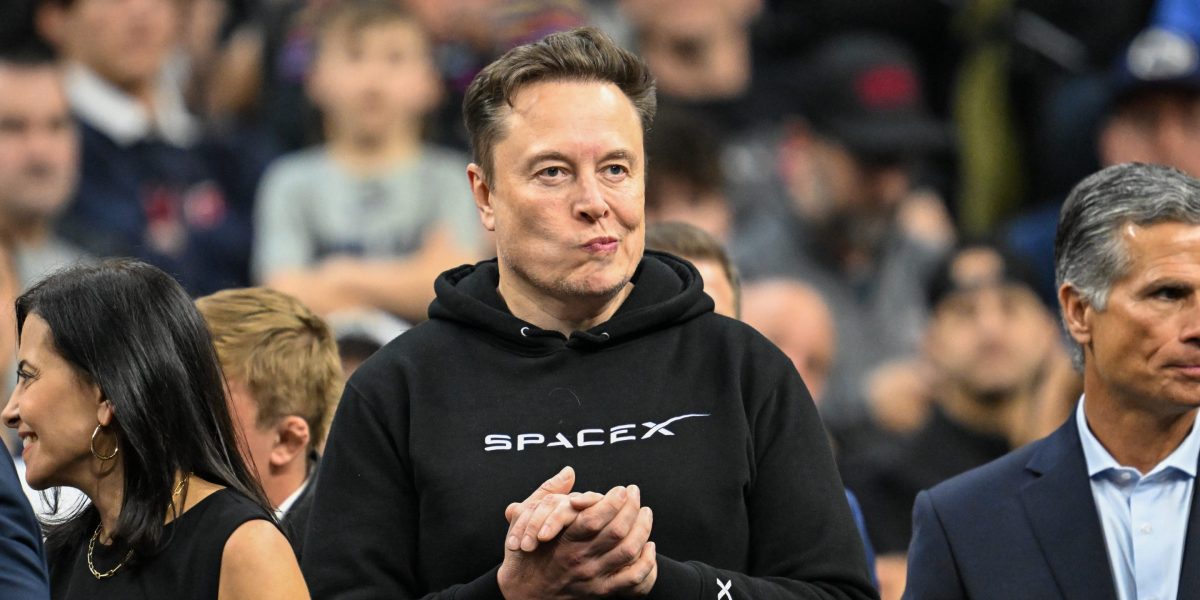
After spending nearly $16 billion on artificial intelligence infrastructure in the second quarter, Elon Musk used SpaceX’s first earnings call as a public company on Tuesday to explain why he believes SpaceX is uniquely positioned to dominate the AI compute race: rocket scientists.
Defending the company’s aggressive investment in AI, Musk argued that the engineering expertise required to design reusable rockets and satellites translates directly to building AI data centers, comparing the company’s advantage in the market to “the New York Yankees going in and playing a Little League team.”
Data centers are a “trivial problem” compared to what SpaceX’s rocket engineers work on every day, Musk said.
“We’re taking a small amount of the expertise that we use for rockets and satellites, and applying that to scaling terrestrial data centers,” he said, arguing that even a fraction of SpaceX’s aerospace engineering experience produces “an amazing outcome” when applied to AI infrastructure.
Musk made the boast without naming any of his “little league” rivals. SpaceX is a relative newcomer to the data center business, an industry long dominated by the giant cloud services providers such as Amazon, Microsoft, and Alphabet-owned Google. All three of those business reported record growth in their cloud divisions for their most recent earnings reports. A growing crop of “neocloud” startups are also racing to build the data centers and computing capacity needed to power artificial intelligence.
The comments come amid SpaceX’s aggressive expansion beyond its roots building rockets for the space industry. In February, SpaceX acquired xAI, an AI company also owned by Musk, and has since poured billions into AI infrastructure. Total companywide capex was $18.4 billion in the second quarter, up from $10 billion in the first quarter. And company executives on Tuesday’s earnings call said that capital spending is expected to remain at roughly the current level over the next two quarters.
The company reported AI revenue of $2.6 billion in the second quarter, up 213% sequentially, and announced $14.1 billion in contracted cloud services agreements. Among the deals powering SpaceX’s nascent cloud business are contracts with Anthropic and with Google.
Rocket scientists aside, one of the big draws of SpaceX’s data center business is its stockpile of Nvidia GPU chips. Musk said on Tuesday’s call that SpaceX will build its AI computing platform exclusively on Nvidia’s Vera Rubin architecture, calling it the industry’s best AI computing system and underscoring the company’s close partnership with the chipmaker.
“Our understanding with Nvidia is that we will receive a very significant percentage of their GPUs next year,” Musk said.
That confidence extends to how much compute SpaceX thinks it can bring online. The company ended the quarter with 1.4 gigawatts of nameplate compute and told investors it expects to exceed 2 gigawatts by year end. But pressed by an analyst on the call, Musk went further, saying SpaceX’s “tentative target” is 20 gigawatts of power and cooling capacity online by the end of 2027, and that even allowing for delays, the company would likely still land “close to 15 gigawatts.”
While SpaceX has also discussed building specialized space-based data centers that can harvest energy directly from the sun, Musk focused on terrestrial data centers on Tuesday’s call.
“Rocket science is literally our daily business,” Musk said, adding that engineers spend every flight trying to stop a rocket from doing what it “desperately wants to do,” which is blow itself apart. Applying even a fraction of that discipline to data centers, he said, is “kind of ridiculous, frankly,” given how much simpler the problem is by comparison.
Disclaimer : This story is auto aggregated by a computer programme and has not been created or edited by DOWNTHENEWS. Publisher: fortune.com







