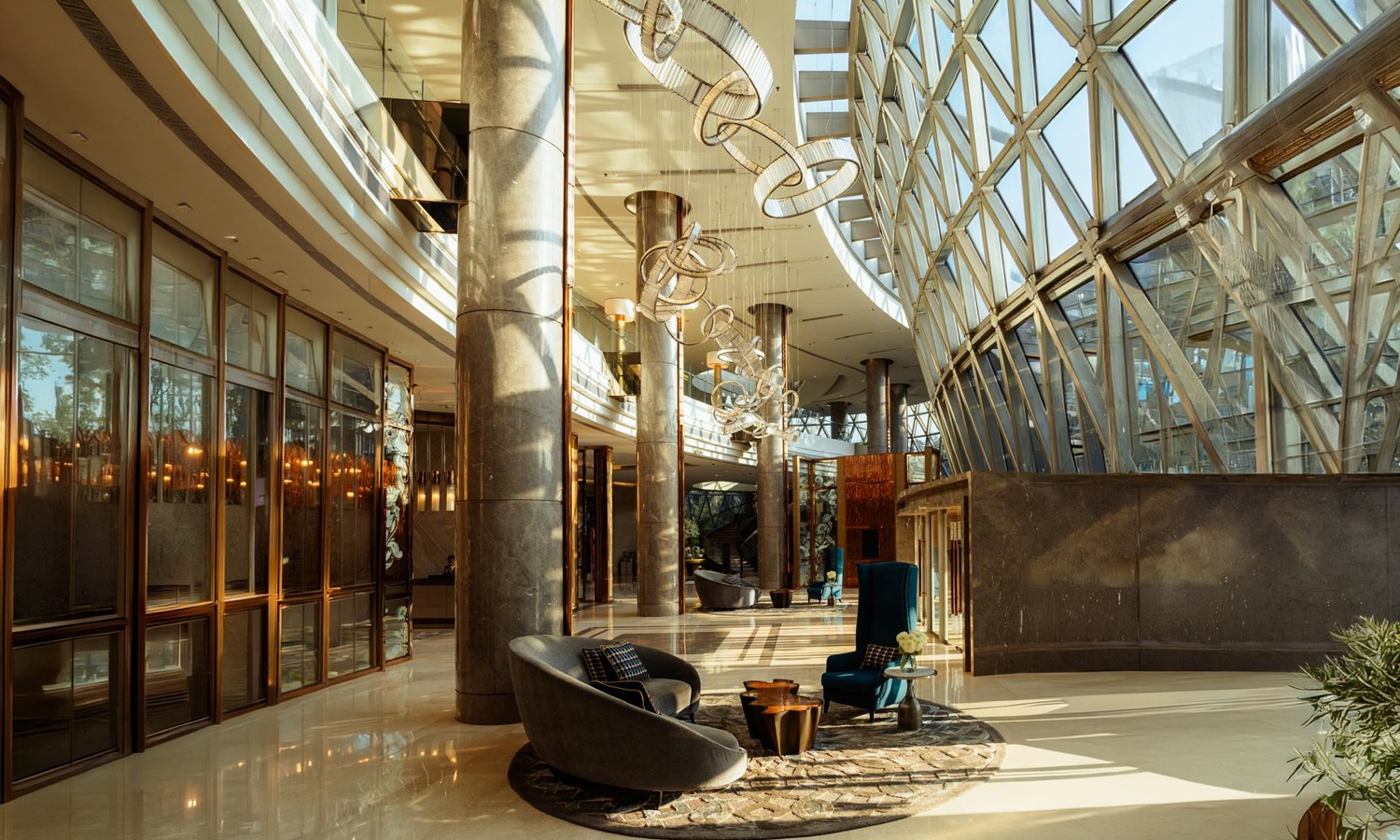
Walk into JW Marriott Kolkata and one of the first things you notice is not the marble, the lighting or the scale of the lobby, but the light itself. It changes through the day, entering the angular building from different sides as the sun moves across the city.
For Gorav Arora, General Manager, that was never just an aesthetic choice. “The building is a little angular. That is done not by design but by choice because that is what brings in the light inside,” he says.
It is an apt starting point for a hotel that has spent the last decade trying to find its own place in Kolkata. The address may carry the name of an international luxury brand, but Arora’s account of the property is less about importing a global template and more about allowing the city to find its way into the experience, through its food, culture, people and even the small details guests encounter along the way.
“It’s a vibrant city. The city is famous for food. The city is famous for its culture,” he says. And perhaps that is where the conversation about luxury hospitality in Kolkata really begins: not with what an international hotel brings to the city, but with how much of the city it is willing to take in.
General Manager Gorav Arora .
When JW Marriott Kolkata completes 10 years in the city this October, General Manager Gorav Arora believes one of the reasons the hotel has found its place here is that it has never really tried to exist apart from the city around it.
That relationship with the city is visible even before a guest reaches the rooms. The hotel’s spaces incorporate elements that draw from Bengal, while the lobby’s visual cues and the objects placed across the property offer small reminders of where the hotel is located. “At various touch points, there are elements of local culture which are kind of brought in,” Arora says.
The idea extends to the guest experience. “When a guest comes in, we welcome them with a stone. That stone is locally made,” he explains. Even the amenities placed in the rooms have been chosen to reflect the local culture. “The amenity which is kept in the room is again signified by the local culture of the city.”
It is an approach that does not necessarily announce itself loudly. Instead, Kolkata appears in details, in objects, in food and in the people who bring their own experiences into the hotel. Arora points out that the culinary identity of the property is not dependent on everyone being from the city. “It’s not necessarily that we used to be from Calcutta or from Bangalore. All of us bring in that experience.”
That diversity of experience, he believes, is part of what eventually makes a hotel work for its city.
There is another, less visible layer to the way the property has evolved: sustainability. For Arora, it is not restricted to the more obvious initiatives guests might notice. “Something as simple as the efficiency of our products” becomes important when operating a large hotel, he says, particularly when it comes to energy consumption.
The property conducts regular energy audits and even thermography audits, which Arora likens to “an x-ray of a machine”. These are meant to identify where energy may be getting lost, whether through equipment or operational inefficiencies. “Those energy audits we conduct ensure that there is no sort of a loss of energy which is happening, which in turn is loss to the environment and loss to us.”
Responsible sourcing is another part of that equation. The hotel sources cage-free eggs and follows responsible sourcing practices for seafood, avoiding species that do not meet the relevant requirements. There is also an in-house garden where vegetables are grown and used by the hotel.
“These all come in as a part of our sustainability committee,” Arora says, referring to the various parameters around energy, sourcing and maintenance that the hotel monitors. Sustainability, in this sense, is less a single initiative than a collection of decisions that have to be made repeatedly.
Interestingly, the building itself contributes to the experience. The hotel was designed with an angular structure that allows natural light to reach much of the property. “One thing very crucial about our hotel is that there are not many hotels in which the most rooms also get natural lighting,” Arora says.
“The building is a little angular. That is done not by design but by choice because that is what brings in the light inside.” The orientation allows the morning sun to enter from one side and afternoon light from another, giving the interiors a changing quality through the day.
For Arora, light and space are central to what the property offers. He applies the same thinking to its large banquet spaces, where a 32-foot ceiling, a substantial pre-function area and an attached lawn allow the spaces to be adapted to different kinds of events.
But perhaps the more telling measure of how the hotel has settled into Kolkata lies in something simpler: food. Arora points to the city’s culinary reputation as one of the reasons the hotel has to understand its audience closely. “Food is what makes a lot of difference.”
Ten years into its Kolkata journey, that seems to be the broader philosophy too. A global luxury hotel may bring an international identity with it, but to become part of a city, it has to leave enough room for the city itself to enter.
Disclaimer : This story is auto aggregated by a computer programme and has not been created or edited by DOWNTHENEWS. Publisher: deccanchronicle.com