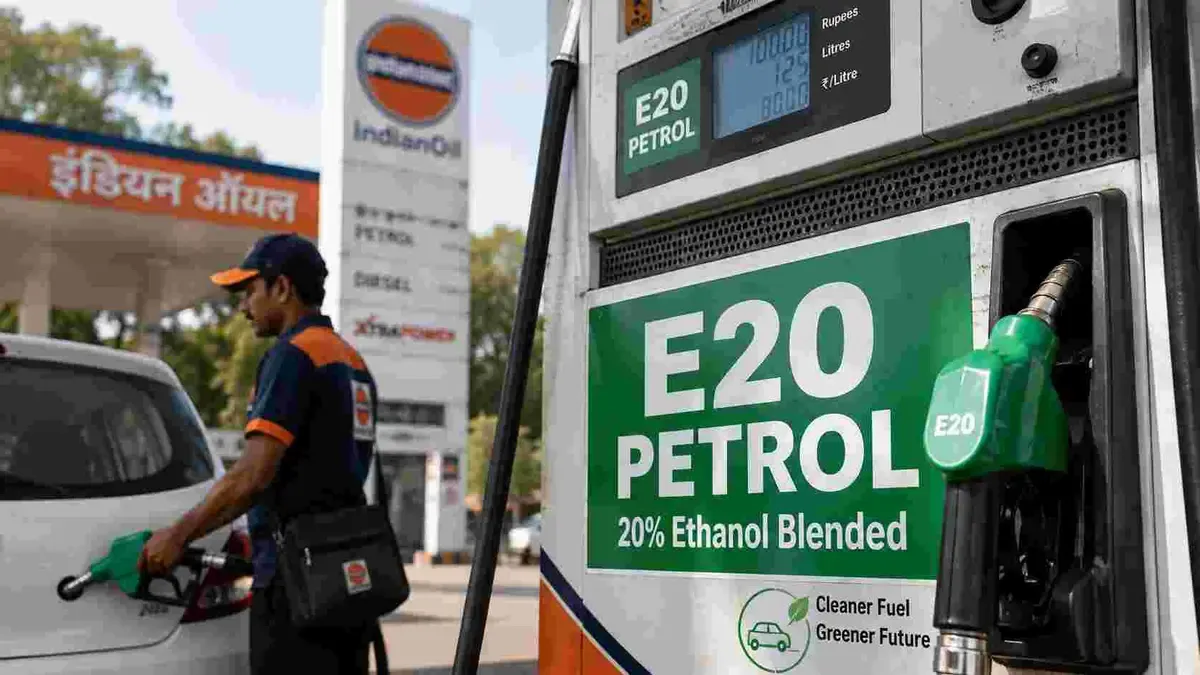
You pull up at your regular petrol pump and notice something new. A small sticker near the nozzle. A line on the receipt you haven’t seen before. The attendant mentions, almost casually, that this is E20 now.
For most drivers, E20 is simply what comes out of the nozzle today. It’s worth understanding exactly what changed, and what it means for the vehicle in your driveway.
What E20 actually is
E20 is petrol blended with up to 20 percent ethanol, an alcohol made from crops such as sugarcane and maize, mixed with 80 percent regular petrol. Since 1 April 2026, it has been the standard petrol grade at pumps across the country, meeting a minimum Research Octane Number (RON) of 95 under Bureau of Indian Standards norms. One in every five litres in your tank is now plant-based rather than crude-oil-based.
The blend before this was E10, with 10 percent ethanol. India moved from about 1.5 percent ethanol blending in 2014 to 20 percent in 2025, reaching the target five years ahead of the original 2030 deadline.
India isn’t the first to do this
Ethanol blending is neither new nor uniquely Indian. Brazil has run blends of roughly 20 to 27 percent since the late 1970s, built over five decades around sugarcane and flex-fuel cars, and now targets 30 percent. Paraguay mandates around 30 percent, also drawing on domestic sugarcane.
The United States offers drivers a choice between E10, E15 and higher blends rather than a single mandate. Thailand offers E20 as well, though take-up there has been slower, with some drivers choosing lower blends over engine-damage concerns despite E20 being cheaper.
What sets India apart is less the blend level, since several countries go higher, than the pace. The shift that took Brazil close to fifty years, India made in about a decade. The global experience offers a useful lesson both ways: it shows high blends can work well over time, and that consumer trust and older-vehicle compatibility are the recurring questions worth getting right.
What’s actually different about the fuel
The practical differences all trace back to how ethanol behaves compared with petrol.
Ethanol has a higher octane value, which is why E20 carries a raised RON 95 rating. Octane measures how well fuel resists “knocking”, the uneven ignition that can stress an engine, so a higher number means smoother burning in engines tuned for it.
Ethanol also holds less energy per litre than petrol, which is the reason mileage dips slightly on the blend. And because ethanol draws in moisture and is mildly corrosive to certain rubbers, it can wear older, unprotected fuel-system parts a little faster. Newer vehicles are built with ethanol-resistant seals and hoses, so this doesn’t apply to them.
On emissions, ethanol burns more completely and lowers some tailpipe pollutants. Whether E20 is cleaner across its full lifecycle, once the water, land and farming behind the ethanol are counted, is still debated among experts, and worth keeping in view rather than settling either way.
Is your car ready for it?
This is the question that matters most, and the answer comes down to one date.
Every petrol vehicle manufactured in India from April 2023 onwards is built to run on E20 as standard, with ethanol-resistant fuel lines, seals and engine tuning designed for the blend. If your car or two-wheeler is that age or newer, you have little to worry about.
/filters:format(webp)/english-betterindia/media/media_files/2026/08/06/3-2026-08-06-13-35-37.png)
Vehicles built before that cutoff, particularly those following older BS3 and BS4 emission norms, were designed for E5 or E10 and were not tested for E20. They won’t fail overnight, but over time owners may notice a modest mileage dip and slightly faster wear on rubber parts.
How to check yours: Open the fuel flap and look for a small E20 or E10 sticker, which most manufacturers print clearly. Next, check your owner’s manual under the fuel or specifications section. If neither is clear, call your authorised service centre with your Vehicle Identification Number, and they can confirm from production records within minutes.
If your car is older, a few small habits help. Get the fuel filter and injectors checked a little more often, since ethanol can loosen old deposits in the tank. Avoid leaving the tank near empty for long stretches, and ask your mechanic to look over rubber fuel lines during regular servicing. For vintage or occasional-use vehicles, some owners choose branded ethanol-free petrol, sold at select outlets for around ₹160 a litre, though for a daily commuter the premium rarely pays off.
Myth versus fact
Plenty of claims about E20 are circulating. Here is what the available evidence supports.
“E20 will damage my engine”: It divides by vehicle age. Cars and bikes built from April 2023 onwards are rated for E20 and carry no added risk. Older vehicles designed for E5 or E10 may see faster wear on rubber parts and a mileage dip over time, rather than sudden failure. The government notes that widespread damage would by now have produced a surge in warranty claims, which it says hasn’t happened, though independent long-term data on older vehicles is still limited.
“E20 should be cheaper because part of it is home-grown ethanol”: It isn’t, because of the price of ethanol itself. The government buys ethanol at fixed rates, around ₹71.86 a litre for maize-based ethanol before taxes, set to keep farmer incomes stable rather than to track crude oil. At current crude prices, blending ethanol can cost as much as pure petrol, so E20 is priced much like the fuel it replaced. As of mid-2026 that was roughly ₹102 a litre in Delhi; pump prices shift, so check your city’s current rate.
“Drivers have no choice”: Largely true at ordinary pumps, with one exception: branded ethanol-free petrol remains available at select outlets at a premium of around ₹160 a litre.
“E20 is a downgrade being forced on motorists”: This is a matter of judgment rather than fact. E20 lowers some emissions and reduces India’s crude oil imports, while trading a little mileage and asking for more attentive maintenance in older vehicles. Whether that feels like a downgrade depends on which of those you weigh most.
The bigger picture
E20 is best understood not as a product upgrade, but as a policy choice. India imports over 85 percent of the crude oil it uses, and every litre of ethanol is a litre of petrol not refined from imported oil.
The government links the programme to foreign-exchange savings, steadier fuel prices during global oil shocks, and additional income for farmers growing sugarcane and maize. Each of these carries genuine debate too, from water use to whether consumers see the savings directly.
For you at the pump, though, it comes down to something simpler. A quick look at your fuel flap or owner’s manual is all it takes to know where your car stands, and that small check now could save you a maintenance bill later.
Sources:
‘Worried About E20 Fuel? We Answer All Your Burning Questions‘: by Autocar India Bureau for Autocar India, Published on 24 July 2026
‘Food, Water and Fuel: The Trade-Offs Behind India’s Ethanol Blending Policy‘: by Anusha Fatima for Outlook Business, Published on 31 July 2026
‘E20 Fuel in India: What is its impact on vehicles and why is it not cheaper than petrol? | Explained‘: by The Hindu, Published on 30 July 2026
Disclaimer : This story is auto aggregated by a computer programme and has not been created or edited by DOWNTHENEWS. Publisher: thebetterindia.com