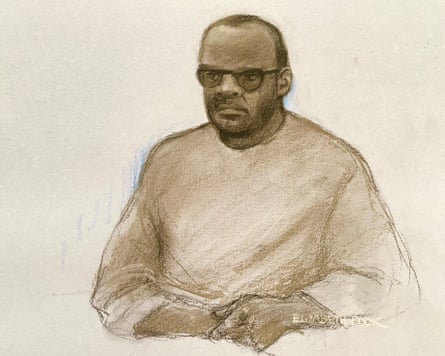
About 40 metres off Tottenham High Street, up a slip road for deliveries to a B&M homewares store, is a stretch of concrete paving behind a 2-metre wall topped with spikes.
This is the patch of ground that Simon Levy tried to turn into his personal killing field.
Twice he went with women, both of whom were sex workers, to the spot just eight minutes’ walk from the north London home he shared with his mother and sister. The spot is out of sight of CCTV cameras dotted around the area, and in the shadow of the Tottenham Hotspur football stadium.
One victim only just survived the sustained attack, including rape and strangulation, he inflicted on her in January 2025. Another, Sheryl Wilkins, paid with her life in August 2025.
Between those attacks Levy had travelled to south London and, in March 2025, he murdered Carmenza Valencia-Trujillo.
His double murder trial, which ended in convictions on Friday heard from the survivor. Her testimony, the prosecutor Tom Little KC said during the trial, probably revealed what the other victims suffered.
Little said the victims were vulnerable, and Levy believed that by targeting sex workers he was more likely to get away with his crimes.
The survivor, who is 35 and has her anonymity protected by law, had been trafficked to Britain from eastern Europe.
After they went behind the wall for sex, she asked Levy to pay. He jumped on her with such force he broke her clavicle. While raping her, he also started to strangle her.
She told the Old Bailey jury he said: “Shut up. Be quiet. I have got you.”
She added: “He was sticking his fingers in my throat so I could not make noise. I believe I’m going to die. I could not breathe … I was unconscious completely.”
She awoke feeling “burning and pain”, and was bleeding from her genitals.
Days after the attack, the woman was arrested on another matter. She told officers of her ordeal and said she knew Levy by sight; she knew where he lived but did not know his name. She would later correctly pick Levy out of a police lineup.
The Metropolitan police say she was unable to make a full statement for a further six months, despite their efforts to obtain one. The court heard that she was withdrawing from drug use.
Levy, 40, was linked to the murders by DNA samples from the victims, travel card and phone data, and CCTV footage.
After his arrest, he told police his eye injury, sustained during an assault in 2024, meant he rarely went out. He needed an appropriate adult present when detectives interviewed him and had dyslexia, autism and learning difficulties. He is believed to have been long-term unemployed.
Neighbours knew little about him, and searches of his electronic devices showed some viewing of material about crime, violence and sex.
The attacks on the women in 2025 were not Levy’s first.
A history of sexual violence
Levy is suspected of a sexual assault as far back as 2017, which is still under investigation.
His first convictions came in 2021: one for assaulting a woman at a party in Camden in 2018, putting his hands into her underwear and touching her vagina; another for sexual assault by penetration of a woman on her way to the Notting Hill carnival, having penetrated her with his fingers.
He was in prison first from 2021-23 during which time he sexually assaulted a female prison officer at HMP Brixton.. Searches of his electronic devices showed him writing about his attraction to her.
After his release, he carried out his first attack on a train in October 2023, for which he was only identified later.
In 2024 he allegedly raped a woman in Tottenham. He was recalled to prison to complete the sentence he received in 2021, but not charged over the rape allegation, which is under renewed investigation.
Released from prison later in 2024, he then intensified his attacks on London’s transport network, groping and sexually assaulting women on trains, often by trying to force his fingers into their vagina.
In other offences, the court heard, Levy used “the hustle and bustle of busy, rush-hour trains as his cover”. He would get close to women and conceal his hand with a jumper or coat before attacking them.
Peter Fulton, the head of crime for British Transport Police (BTP), said Levy’s victims, who were mostly in their 20s, were attacked at random and on impulse.
Levy crisscrossed London, armed with a stolen travel card, in one case boarding a train just minutes from his home, at White Hart Lane train station, to attack a woman.
After women reported the offences to BTP, Levy was arrested, charged and bailed.
Decades of failing women
There were so many signs Levy was a danger, but how clear was it that his offending could turn murderous?
After the first killing, in March 2025, Levy was arrested within days. The cause of death was inconclusive and he was bailed.
Police feel aggrieved that attempts to have Levy remanded in jail in May and June 2025, after he had been charged with several train attacks and was a murder suspect, failed.
The deputy assistant commissioner Kevin Southworth, head of public protection for the Metropolitan police, which investigated the killings, said: “I think on the basis that we put, and BTP put, this man before a court on two occasions and requested remand, I think the obvious conclusion is, had he been remanded at that time … he would have been in prison for sufficient period that he couldn’t have then gone on to commit a murder ….”

Experts in tackling male sexual violence see similarities between Levy’s case and that of Wayne Couzens, the Met officer who kidnapped, raped and murdered Sarah Everard in 2021. Previous, lower-level offending by Couzens, such as exposing himself to women, had been inadequately investigated by police.
Harriet Wistrich, of the Centre for Women’s Justice, said the Levy case “shows a very clear pattern of escalating offending, from sexual assaults of women on public transport to rape and murder … perpetrators can become emboldened and move on to even more dangerous offending.”
Wistrich added: “The failure of the criminal justice system to tackle his offending must have given him the message that it was easy to get away with it.”
Southworth said he accepted crucial questions needed answering. “What did our officers know? And what should they have done, if they didn’t do it? I think one of the points of reflection … for the senior leadership of the Met is how do we, as a collective system, reflect on what went wrong here?”
The Independent Office for Police Conduct is investigating the handling of the case.
The revelations follow scandal after scandal over decades about how the criminal justice system fails women.
Wistrich said: “The scale and variety of failings is shocking – in particular because had they been dealt with appropriately, two women need not have lost their lives.
“It is particularly concerning that this has happened within five years of the horrendous revelations around Met police officers Wayne Couzens and David Carrick, the Baroness Casey report into the Met [which found police to be institutionally racist, misogynistic and homophobic] …
“This type of scandal tells us little, if anything, has improved in practice.”
Disclaimer : This story is auto aggregated by a computer programme and has not been created or edited by DOWNTHENEWS. Publisher: theguardian.com