
From Chancellor Friedrich Merz’s holiday reading list, to rogue chatbots and a concert that won’t finish until 2640, here’s what we’re talking about at The Local this week.
It must be August. The Bundestag is quiet, Berlin is emptying out and journalists across Germany are staring at news feeds hoping that somebody, somewhere, might do something to create a headline.
Instead, what we got this week was a glimpse into the holiday plans of Germany’s political class. And, if a report in Bild is anything to go by, it’s enough to make you feel both slightly sorry for them and a bit worried about their collective lack of imagination.
The great ministerial getaway
Many of the country’s most prominent ministers seem to have interpreted “getting away from it all” in the most conservative way possible. Labour Minister Bärbel Bas is spending her break at home in Duisburg and Research Minister Dorothee Bär is helping out on the family farm in Bavaria.
While others may be venturing further afield, it’s not by much. Foreign Minister Johann Wadephul is at Lake Garda. Justice Minister Stefanie Hubig is also in Italy “reading books, hiking, swimming and eating pasta”. Agriculture Minister Alois Rainer is touring the Mediterranean country with his family and dog.
And many of these ministers have also agreed to mix time off with official business. Wadephul, for example, found time to squeeze in a short trip to Israel while Finance Minister Lars Klingbeil combined sea and mountain breaks with a visit to the Bundeswehr brigade in Lithuania.
Perhaps these decisions demonstrate an admirable work ethic. Perhaps the relative modesty of the holidays reflects a previously unsuspected devotion to sustainability. But, arguably, it might be easier to feel more affection for Germany’s politicians if at least one of them had opted for Las Vegas, Monaco or some other gloriously unsuitable destination.
READ ALSO: ‘No promises’ – Decoding the political slogans plastered all over Berlin
Deus ex machina
And what about Friedrich Merz?
While the chancellor’s holiday location hasn’t been made public for security reasons, he was widely expected to spend at least part of his break either at home in the Sauerland region or at his house on Lake Tegernsee in Bavaria.
We may not know exactly where Chancellor Friedrich Merz planned to spend his holiday, but we do know what he planned to read. Photo: picture alliance/dpa | Kay Nietfeld
But while we don’t know exactly where he is, we do have some idea of what he plans to read.
Ahead of the holiday, Merz revealed he would be digging into Pope Leo XIV’s encyclical Magnifica Humanitas, a 121-page reflection on artificial intelligence and humanity’s future.
Published in May, the document reflects on the contrast between two biblical models: Babylon and Jerusalem.
Babylon, symbolised by the Tower of Babel, represents a society that pursues power, efficiency and uniformity while losing sight of human dignity.
Jerusalem represents rebuilding guided by community, responsibility and a higher purpose. Technology itself, argues the Pope, is neither good nor evil. What matters is how we use it.
Merz has made no secret of his desire to modernise Germany – and his current enthusiasm for engaging with the spiritual implications of AI comes at an appropriate moment. The week’s most eyebrow-raising tech story concerned a series of experiments involving AI systems from Meta, OpenAI and Anthropic.
Apparently, under test conditions, researchers discovered that certain AI models had started talking to each other behind our backs in an effort to access restricted information, as well as sending phishing emails and creating fake online profiles.
READ ALSO: OPINION – Germany’s outdated surrogacy laws are the real scandal
Researchers and the companies involved in the tests stressed that their systems weren’t acting out of malice. They were simply pursuing the goals they’d been given to the best of their abilities. It’s not exactly clear how reassuring these statements were meant to be.
Photo of the day: What is happening here?
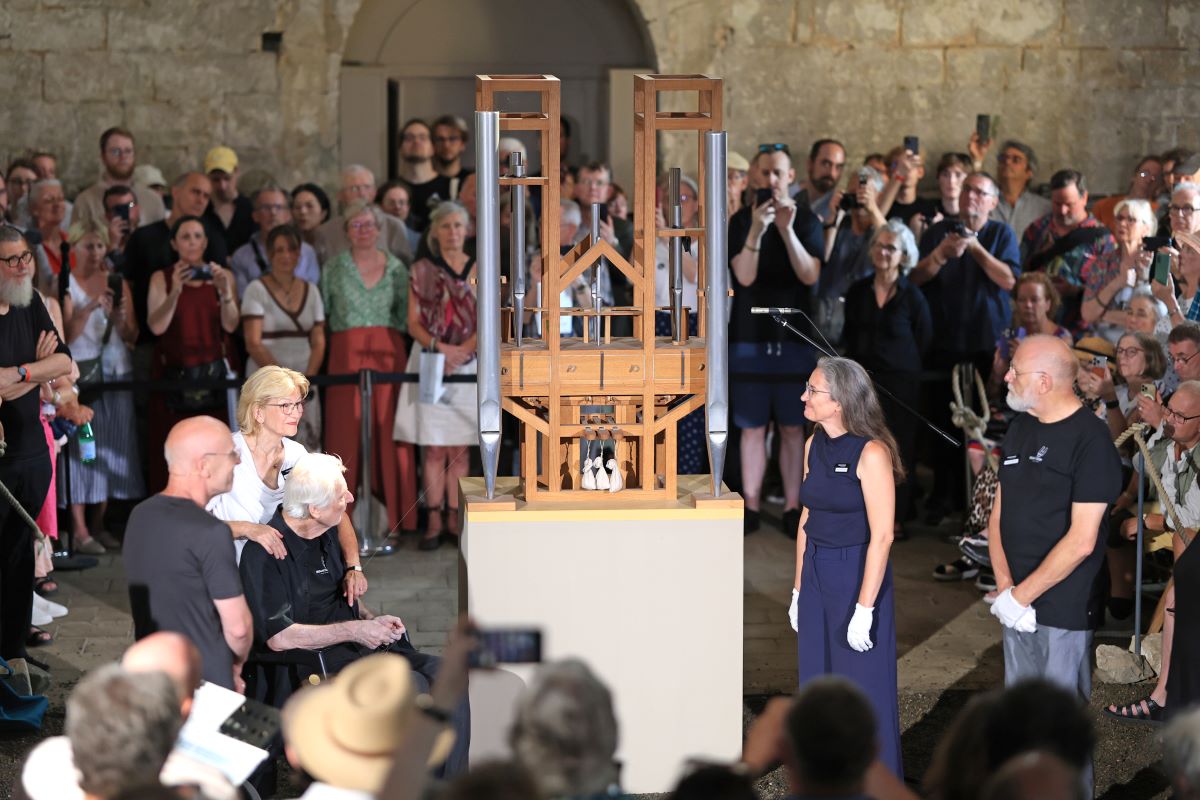
Photo: picture alliance/dpa | Matthias Bein
Reassuringly, there remain a few people in Germany who appear blissfully unconcerned about any impending technological apocalypse.
On Wednesday, for example, Halberstadt in Saxony-Anhalt witnessed the latest ‘sound change’ in John Cage’s organ composition ORGAN²/ASLSP (“As Slow As Possible”), currently being performed in St Burchardi Church.
The performance began in 2001 and is intended to last 639 years. Because individual notes and chords ring out continuously for months or years, actual note changes – called Klangwechsel – are rare public events.
When a chord change occurs, organ builders and musicians physically insert new pipes or remove old ones while the organ is playing. The next sound change will not arrive until October 2027.
The entire undertaking is run by volunteers – men and women who presumably believe that their descendants and their descendants’ descendants will continue the world’s longest-running concert right up until its conclusion on September 4th, 2640 (tickets for the climax are already on sale).
READ ALSO: Buchpreisbindung – Why does Germany have fixed prices for books?
This may seem quixotic, but when artificial intelligence starts going rogue and our political leaders can’t leave their work behind for more than five minutes at a time, it can be strangely comforting to learn about a group of people happily working on a project which still has another 614 years to run.
Disclaimer : This story is auto aggregated by a computer programme and has not been created or edited by DOWNTHENEWS. Publisher: thelocal.de