It’s easier and more affordable than ever to capture and channel solar energy for your home. These handy portable batteries can harness the power of the sun to give you free electricity for your campsite, RV, or home. Simply pair them with some of the best portable solar panels, and you have the means to generate your own electricity whenever the sun is out.
I’ll run through my top recommended brands with a few examples, the also-rans, what to avoid, and round things out with tips in an FAQ. Many of the best portable power stations are also great solar generators. If you want something smaller, check out the best power banks, best laptop power banks, or best MagSafe and Qi2 power banks.
Jackery Solar Generators
Rather than pinpoint specific products, I’ve found that it’s smarter to narrow it down by brand. There are a few brands that I’ve tested extensively over the last few years, and most folks will be best served by opting for a solar generator from one of these four manufacturers. For me, that starts with Jackery.
While Jackery’s solar generators aren’t the most affordable or innovative, they have consistently hovered around the top of my testing charts when it comes to delivering the stated capacity. Having tested several solar generators up and down the Jackery range, I recommend them as easy to use, reliable, relatively quiet, and built to last. Jackery’s SolarSaga panels are also among the most efficient I have tested.
The downside is that Jackery employs the proprietary DC8020 barrel port for its panels and generators. While it is possible to find adapters online, there doesn’t seem to be an official Jackery option, and I can’t vouch for what is available. If you don’t plan on matching your generator with solar panels from Jackery, I’d go for another brand.
If you need a decently chunky backup, this Jackery solar generator boasts a 3,600-watt output (7,200-W surge) and a 3,072-watt-hour (Wh) capacity. You can charge it from solar panels at up to 1,000 watts via two proprietary DC8020 charging ports (500 watts apiece). With decent sunlight, you can fully charge it in around 11 hours with a pair of 200-watt panels. The surge works well for power hungry appliances and tools, and you could use it to power a mini fridge, lights, and recharge your small gadgets over a weekend of camping, even if the sun isn’t out. The design is nice and durable with two handles, and there are plenty of ports, but I wouldn’t want to carry it far because it weighs 60 pounds. It works well as a home backup (it can also serve as an uninterrupted power supply with a less than 20 millisecond fallover) or with an RV (it has a TT-30 port).
I recommend opting for the HomePower 3000 bundle with two 200-watt Jackery SolarSaga panels, but only if there’s a good discount on it. At the time of writing, it is $1,900. Jackery also offers various accessories for this solar generator, including a carry bag and a trolley. My test unit is badged as the Jackery Explorer 3000 v2, but it seems to be called the HomePower 3000 in the US.
If you’re going further off-grid and want something that’s both a bit more rugged and easier to carry, I recommend the Jackery Explorer 1500 Ultra. It’s smaller, so the capacity is around half the 3000 above, at 1,536 Wh, but you can charge it at up to 800 watts via two DC8020 ports (400 watts apiece). It’s rated at 1,800 watts (3,600-W surge) for output and has plenty of ports. With an IP65 rating, you don’t need to worry about rain or dust, and it’s shock-proof, so it can survive an accidental drop (up to one meter). The handle is relatively comfy, so it’s easy to carry from the car to your campsite one-handed, along with other stuff (most power stations this size have two handles). It weighs just shy of 40 pounds.
If you don’t need as much power, both the Jackery Explorer 1000 v2 ($799) and the Explorer 2000 v2 ($1,499) are worth a look. I tested the smaller model, and it’s ideal for keeping small gadgets charged up on a trip, has a built-in light, and sports a handy pop-up handle.
Bluetti Solar Generators
If you’re looking for innovation, Bluetti’s solar generators deliver. The company makes relatively compact power stations for the capacity, has interesting portable options, and boasts a line designed to cope with cold weather. The build quality is great, and they tend to be feature-packed.


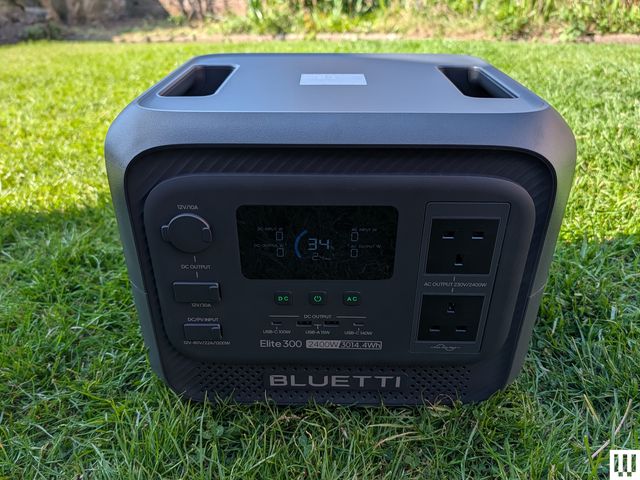
Currently the top pick in my best portable power stations guide, the Elite 300 offers an impressive 3,014 watt-hours in a compact body with built-in handles, though it weighs in at just under 58 pounds, so you won’t want to carry it far. It can deliver 2,400 watts steadily, with 4,800-W surge. It had no issues with a UK kettle and will happily run a fridge or TV for a weekend. The XT60 solar port can take up to 1,200 watts from solar panels, enabling you to fully charge it from dead in just over four hours in perfect conditions. You can also charge it from an outlet and solar at the same time to speed things up. It has every port you’re likely to want, including TT-30, making it ideal for RVs.
You can buy the Bluetti Elite 300 with a pair of 200-W solar panels, which might be worth considering if there’s a discount on the bundle (it’s $1,699 at the time of writing, which is not bad). But Bluetti’s 200-W panels are not the most efficient I’ve tested, and I prefer the larger 350-W and 500-W portable panels.
If you don’t need this much power, the Bluetti Elite 200 V2 ($1,070) and the Bluetti Elite 100 V2 ($619) are also excellent. If you are battling cold temperatures, take a look at the Bluetti Pioneer Na ($899).
If you’re out hiking and just want power for lights and small gadgets, the Bluetti Handsfree 1 Portable Power Backpack is neat. It has a built-in 269 Wh battery with a 200-watt maximum solar input, but you can also snag it bundled with a very portable 60-watt Bluetti panel ($599). The larger Handsfree 2 Portable Power Backpack ($699) has a 512 Wh battery and comes with a 100-W panel.
Anker Solar Generators
Anker has long manufactured many of the best power banks, but it also turns out some of the best solar generators on the market. Although it offers a wide range, Anker is my pick for smaller capacity generators, where it excels with smart, practical designs that look nice and perform well.
-SOURCE-Simon-Hill.jpg)
This is such a handy little gadget for outdoorsy folks. It has a 288 Wh battery (that can deliver up to 300 watts), and most helpfully, a handy pop-up lantern that makes it ideal for hiking and camping. It can fast-charge all your devices, too, including phones, laptops, headphones, and cameras. The included XT60 port has a maximum solar input of 100 watts and can fully charge in around three or four hours. If you plan on hiking with it, consider the 60-W panel bundle ($299), as it folds down very small.
From power cuts to camping trips, I’ve used this solar generator more than any other and have tested it with a wide variety of different solar panels. It has an XT60 port with a maximum solar input of 600 watts and can charge in under two hours. The design is solid and durable, weighing in just under 30 pounds, and I find it relatively easy to lug around using the two strong handles. It offers a 1,024-watt-hour capacity and can deliver 2,000 watts (3,000-W surge).
If you need more power, Anker offers a wide range, including the expandable Anker Solix F3000 with 400-W solar panel ($2,000).
EcoFlow Solar Generators
Another manufacturer that offers a wide range of solar generators, EcoFlow’s power stations stand out on charging speed and can often be charged more quickly than competitors in the right circumstances. They also tend to feature robust build quality, generous port options, and easy expandability.

This stylish, compact design has the screen and ports at one end. It offers 1,024 watt-hours, can consistently provide 1,800 watts, with a 2,600-W surge mode. I’m highlighting this model because of the two solar ports (XT60i) for faster solar charging up to 1,000 watts (500-W apiece). It can also charge from an outlet in an hour, has lots of ports (6 x AC, 1 x Car, 2 x USB-A, 2 x USB-C, 2 x DC5521), and can pull UPS duty with an impressive 10-millisecond response time. The only drawback I encountered was the fan noise. It wasn’t overly loud, but I found that it kicked in very frequently even under a low load.
If you can get by with something smaller, the 768 watt-hour River 2 Pro is even more portable and has an XT60 port, but the maximum input is 220 watts. It’s a nice size, with a big handle along the back, and can put out 800 watts (1,600-W surge). You can also buy it bundled with a 160-W solar panel ($569).
EcoFlow’s Delta range includes a ton of different capacities and designs bundled with various solar panel configurations.
Disclaimer : This story is auto aggregated by a computer programme and has not been created or edited by DOWNTHENEWS. Publisher: wired.com