
TEHRAN – Iranian and Indian officials have highlighted the need to foster scientific ties between the two countries, particularly in education, research, technology, and innovation sectors.
Acting Minister for Science, Research and Technology of Iran, Masoud Shams-Bakhsh, and India’s Minister of Education, Shri Pralhad Joshi, met on Friday on the sidelines of the 13th BRICS Education Ministers’ Meeting held from August 5 to 7 in Odisha, India.
The meeting focused on expanding academic interactions among Iranian and Indian universities, promoting cooperation among scientific institutions, enhancing educational opportunities for students and researchers, and benefiting from existing capacities and digital education to empower new generation and promote innovation, IRNA reported.
Moreover, Shams-Bakhsh along with Mohammad-Nabi Shahiki Tash, Deputy Minister for Technology and Innovation, Government of the Islamic Republic of Iran, and their delegation paid a visit to India’s International Center for Genetic Engineering (ICGEB), ICGEB.org reported.
The delegation was received by the Director of ICGEB New Delhi, who, together with the Centre’s Group Leaders, engaged in productive discussions on advancing scientific collaboration, promoting research partnerships, and exploring opportunities for future cooperation in areas of mutual interest. The interaction highlighted the shared commitment to fostering excellence in biotechnology, innovation, and capacity building through international scientific engagement.
Discussions focused on enhancing scientific cooperation, fostering research partnerships, providing training to Iranian researchers and exploring future opportunities in biotechnology and innovation.
As part of the visit, the delegation toured the ICGEB Biofoundry and several of the Centre’s state-of-the-art research facilities. The visit provided an overview of ICGEB New Delhi’s cutting-edge research programmes, advanced technological platforms, and innovation ecosystem, showcasing the Centre’s contributions to biotechnology research in human health, agriculture, industrial biotechnology, and sustainable development.
The visit reaffirmed the importance of international partnerships in addressing global scientific challenges and strengthening cooperation in science, research, and technology.
The 13th BRICS Education Ministers’ Meeting brought together education ministers, senior officials and delegates from all 10 BRICS member countries—Brazil, Russia, India, China, South Africa, Egypt, Ethiopia, Indonesia, Iran and the United Arab Emirates—to deepen collaboration under the BRICS Education Track.
It concluded with the adoption of the BRICS Education Ministers’ Declaration, reaffirming education as a key pillar of BRICS cooperation and outlining a shared roadmap across five priority areas under India’s 2026 BRICS Chairship.
The Declaration identified five key areas for enhanced cooperation among BRICS nations: Strengthening Early Childhood Care and Education (ECCE) and Foundational Literacy and Numeracy (FLN), Strengthening Cooperation in Skill Development and TVET, Enhancing Research, Innovation and Start-up Ecosystems, Advancing Mutual Recognition of Qualifications (MRQ), and Strengthening Capacity Building for Academic Leadership and Institutional Development.
Tehran puts forward proposals at BRICS–TCA
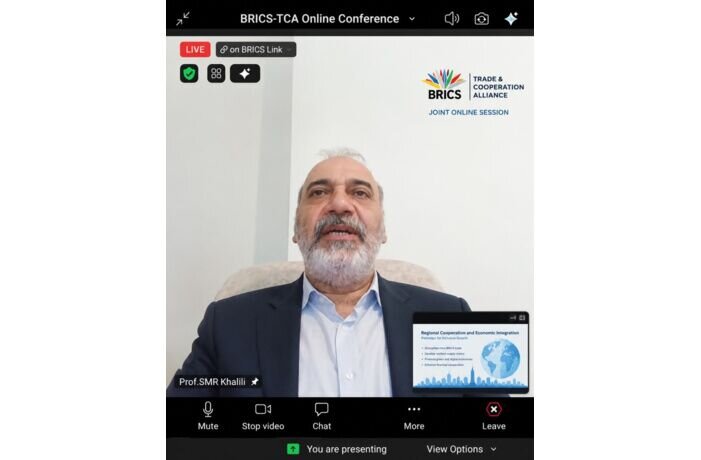
The vice president for Research and Technology at the University of Applied Science and Technology, Mohammad-Reza Khalili, put forward proposals at the BRICS Technical and Vocational Education and Training Cooperation Alliance (TCA) Research Symposium and Joint Management Committee (JMC) Meeting held on August 3 and 4, at Kaushal Bhawan, New Delhi.
Convened by National Skill Development Corporation (NSDC), under the guidance of the Ministry of Skill Development and Entrepreneurship (MSDE), Government of India, the event was held under the theme “Sustainable and Digitally Enabled TVET: The BRICS Perspective”, the two-day meeting brought together representatives from BRICS countries, international organizations, academia, industry and training institutions.
Delivering a speech on the transformation of technical and vocational education in Iran, Khalili elaborated on green skills, digital skills, and practical experiences, which was well-received by the participants.
During the meeting, Iran’s proposals on green skills, digital skills, the practical experience of the University, and joint cooperation frameworks among BRICS member states were fully discussed and assessed.
CPDI depicts ways to improve Iran’s sci-tech co-op with BRICS
In June, the Center for Progress and Development of Iran (CPDI) prepared a report illustrating Iran’s participation in scientific, technological, and innovation cooperation within BRICS, as well as strategic opportunities and required measures to enhance the country’s role in this sector.
BRICS, as one of the most important players in the international system in recent years, has made extensive investments in science, technology, and innovation in addition to economic and political cooperation. Now, the bloc has turned into one of the largest scientific cooperation networks in developing countries, benefiting from 14 specialized working groups and dozens of joint research and technological programs.
CPDI, as the center for the coordination of Iran’s technological and scientific interactions with BRICS, is responsible for leading the country’s representatives, analyzing special documents, providing technical advice, and developing connections among domestic institutions and BRICS specialized structures.
According to the report, 2025 can be considered as the starting point for Iran’s involvement in BRICS scientific, technological, and innovation structure, which has succeeded in showcasing the country’s capabilities in science and technology, laying the basis for active participation in collaborative projects in the future, and strengthening the country’s position in scientific and technological cooperation.
The country had a dynamic participation in BRICS technical and specialized meetings in different scientific fields like artificial intelligence (AI), biotechnology, neurosciences, ocean sciences, spatial information technology, astronomy, photonics, nanotechnology, material sciences, social and human sciences, and research infrastructures in 2025.
BRICS, a platform for expanding research collaborations
One of the main focuses of BRICS activities in 2025 was the development of collaborative research projects among member states in fields such as AI, health, clean energy, food security, quantum technologies, data sciences, and advanced materials.
Iran’s membership in this network would provide a great opportunity for researchers and scholars to participate in international projects.
In 2025, BRICS member states discussed developing data infrastructures, sharing supercomputer capacity, creating joint scientific networks, and utilizing new technologies to address global challenges.
Featuring its capacities in AI, data processing, and knowledge-based companies, Iran has tried to gain a greater share in BRICS future technological projects.
BRICS Action Plan for Innovation 2025-2030 is a document that outlines the roadmap of cooperation among member states in the digital economy, technology transfer, support for knowledge-based companies, and the development of an innovation ecosystem.
Iran’s engagement in the plan can pave the way for the exchange of technical knowledge, enhancement of industrial cooperation, and entry of Iranian knowledge-based companies in new markets.
The report also shows that human capital and innovation are among the top priorities of BRICS; the 10th Young Scientists Forum, 8th BRICS Young Innovator Prize, and the first BRICS Startup Forum are among the main events held in this sector.
Iran’s membership in BRICS can bring about numerous advantages, such as greater access to international scientific and research networks, collaboration in joint research projects, enhancement of technological and industrial cooperation, utilizing the capacity of the technology transfer network, developing a market for knowledge-based companies, and attracting investment in technology and innovation sectors.
The report highlights AI, biotechnology, nanotechnology, quantum technologies, digital economy, and space technologies as the most important axes for future cooperation between Iran and BRICS member states.
It also calls for the promotion of scientific ties among universities, research centers, knowledge-based companies, the private sector, and executive bodies to establish a national coordination mechanism to enhance cooperation with BRICS member states.
MT/MG
Disclaimer : This story is auto aggregated by a computer programme and has not been created or edited by DOWNTHENEWS. Publisher: tehrantimes.com





