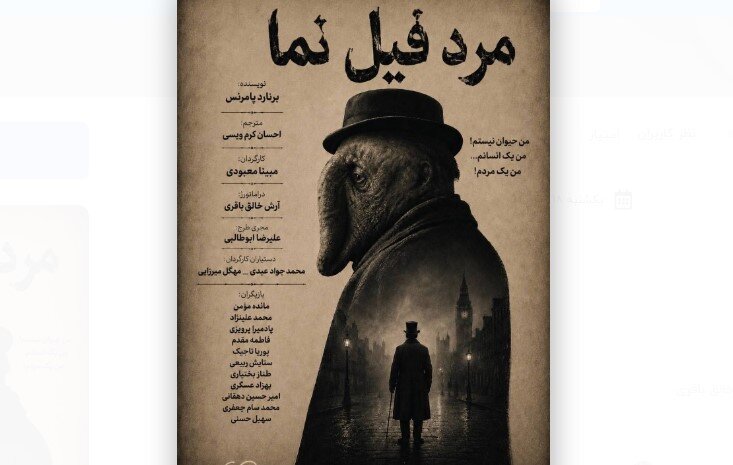
TEHRAN- A stage reading of American playwright Bernard Pomerance’s play “The Elephant Man” will be held at Sahne-ye Abi Cultural and Artistic Center in Tehran on Sunday.
Mobina Maboudi is the director of the reading performance, which is based on a Persian translation by Ehsan Karimi.
The performance will be held by a cast composed of Maedeh Sadat Momen, Mohammad Alinejad, Padmira Parvizi, Fatemeh Moqaddam and Pouria Tajik.
“The Elephant Man” is a harrowing exploration of identity, dignity, and the cruelty of the “normal” world. The play follows the life of John Merrick, a man whose severe physical deformities made him a pariah in Victorian London. After a successful premiere in London in 1977 and a legendary run on Broadway, the play became a timeless study of the human condition.
The narrative centers on the relationship between Merrick and Frederick Treves, an ambitious surgeon. Treves first encounters Merrick in a “freak show” run by the predatory Ross. Driven by scientific curiosity and a savior complex, Treves brings Merrick to the London Hospital. While the hospital provides safety, it also transforms Merrick into a different kind of specimen—one studied by doctors and visited by the curious elite.
The play reaches its emotional peak through Merrick’s interactions with the upper class, particularly the actress Madge Kendal. In a poignant scene, Merrick and Mrs. Kendal discuss Romeo and Juliet, revealing Merrick’s deep sensitivity and intellectual sophistication. When Mrs. Kendal shakes his hand—the first time a woman has ever done so—Merrick’s breakdown in tears exposes the profound isolation he has endured. As he builds a model of St. Phillip’s Church, Merrick muses that his work is an “imitation of an imitation,” a metaphor for his own struggle to fit into a society that only sees his exterior.
The cycle of abuse comes full circle when Ross, now dying and broken, returns to beg Merrick for money. In a powerful moment of growth, Merrick refuses, echoing Treves’ own cold words from earlier in the play: “That’s just the way things are.” This reversal highlights Merrick’s internal strength compared to the moral decay of his former tormentor.
The play concludes with a haunting meditation on the impossibility of “normality.” Treves, haunted by a nightmare where he is the one on display, realizes that his attempts to civilize Merrick were perhaps just another form of control. He struggles with the frustration of being a doctor who can cure symptoms but cannot heal the human spirit or stop the inevitable march of death.
Merrick’s end is as poetic as it is tragic. Because of the weight of his head, he must sleep sitting up. In his final moments, he has a vision of the “pinheads” from the freak show, who have transformed into the “Queens of the Cosmos.” In this surreal dreamscape, they gently lay him down to sleep normally for the first time in his life. He dies in a state of peace, finally free from the physical and social prisons of his existence. The play closes with Treves and Carr-Gomm reflecting on his legacy, leaving the audience to wonder who the real “monster” was: the man with the deformity, or the society that could not look past it.
Beyond the stage, the play earned immense critical acclaim, sweeping the 1979 awards season with Tony and Drama Desk wins for Best Play. Its influence extended to a 1982 ABC television adaptation, which earned Penny Fuller an Emmy, and a 1988 BBC radio drama. The legacy of the work continues to evolve with a 2026 film adaptation written by Moby Pomerance.
SAB/
Disclaimer : This story is auto aggregated by a computer programme and has not been created or edited by DOWNTHENEWS. Publisher: tehrantimes.com