
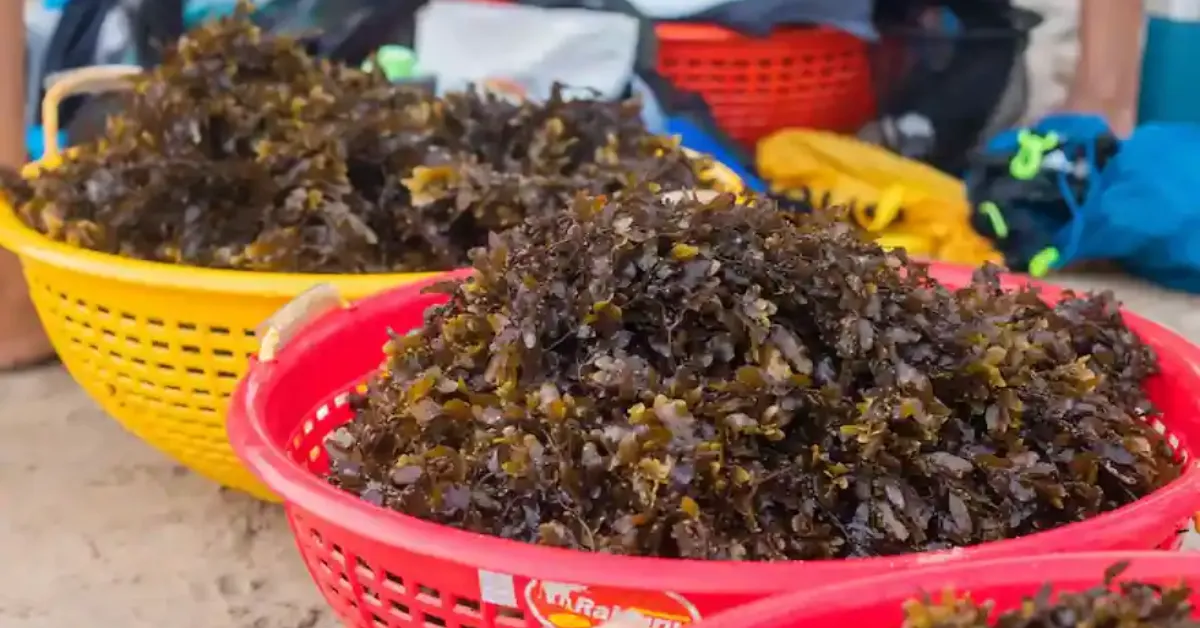
The seaweed growing along India’s coast may be closer to you than you think.
It could be helping your ice cream stay creamy, keeping the ingredients in your toothpaste from separating, or even forming part of a medicine in your cabinet.
You may never taste it, see it or know its name.
Along India’s 7,500-km coastline grow more than 800 species of marine algae, from red seaweeds clinging to rocks off Tamil Nadu to bright green varieties found in shallow coastal waters. Around 60 of these species have commercial value, and some already make their way into foods, cosmetics, pharmaceuticals and laboratories.
Take a tub of ice cream. Its smooth texture and lack of icy crystals can come partly from carrageenan, a natural thickening and stabilising agent extracted from red seaweed. The same ingredient can help keep cocoa evenly suspended in chocolate milk.
And that is only one example.
Three major seaweed extracts, carrageenan, agar and alginate, already form a global industry worth more than half a billion dollars. A 2023 World Bank report estimated that 10 emerging seaweed markets could grow to $11.8 billion by 2030.
Their appeal also lies in how they are grown. Seaweed needs no agricultural land, freshwater, fertiliser or pesticides, making it especially relevant as pressure on land and water continues to rise.
From “green caviar” and laboratory agar to toothpaste, snacks and medicines, here are eight seaweeds found along India’s coastline and the surprising places they show up in everyday life.
1. Kappaphycus alvarezii: In chocolate milk and ice cream
Found along: Tamil Nadu coast, especially Rameswaram and Pamban Island
Walk through the shallow waters near Rameswaram at low tide, and you’ll likely see rope lines strung between wooden poles, with thick, rubbery reddish-purple fronds tied along them. This is Kappaphycus alvarezii, a seaweed that produces carrageenan, one of the food industry’s most widely used natural additives.
/filters:format(webp)/english-betterindia/media/media_files/2026/08/10/seaweed-3-2026-08-10-14-32-34.png)
Carrageenan is extracted by boiling and processing the dried seaweed. The result is a gel-forming agent used in ice cream to prevent ice crystals from forming and in chocolate milk to keep cocoa evenly suspended instead of settling at the bottom.
Global carrageenan trade is valued at around $240 million.
2. Gracilaria: The agar powerhouse
Found along: Tamil Nadu, Gujarat, Andhra Pradesh
Gracilaria is a major source of agar, the transparent, odourless gelling substance known as China grass, widely used in desserts and jellies across South Asia.
But agar’s more consequential role is in science. Microbiology laboratories around the world rely on agar plates, which are flat dishes containing a nutrient-rich gel where bacteria and fungi can be grown and studied.
And Gracilaria may find its way into your food in another form too.
Fibre from Gracilaria edulis contains up to 96% dietary fibre and is colourless, odourless, and highly functional. Researchers have explored its use in foods such as sausages and noodles to increase their fibre content.
The agar market is worth approximately $132 million globally.
3. Gelidiella acerosa: The lab essential
Found along: Rocky shores of Tamil Nadu, Kerala and Karnataka
Gelidiella grows alongside Gracilaria on exposed rocky coastlines, forming dense, wiry mats that cling firmly to rocks. Like Gracilaria, it yields agar. The difference lies in the agar’s purity and gel strength. Gelidiella’s agar is particularly suited to biotechnology and pharmaceutical applications.
Research institutions, diagnostics companies and drug manufacturers value it for these specialised uses.
/filters:format(webp)/english-betterindia/media/media_files/2026/08/10/seaweed-2-2026-08-10-14-28-42.png)
Gelidiella also contributes to research into seaweed-based bioplastics. Such materials can be biodegradable and renewable alternatives to petroleum-based plastics, with the potential to be produced at lower costs.
4. Sargassum: From the sea to rice and corn snacks
Found along: Gujarat, Tamil Nadu, Andaman & Nicobar Islands
Sargassum is among India’s most widespread brown seaweeds, recognisable by its olive-brown colour, leaf-like fronds and tiny air-filled bladders that keep it buoyant.
On land, it is processed into biofertilisers, used as a livestock feed supplements and studied as a source of biofuel and biodegradable materials.
Sargassum is also being incorporated as powder into rice and corn-based extruded snacks, adding macro- and micro-nutrients without altering taste significantly.
5. Hypnea: What’s really in your toothpaste?
Found along: Tamil Nadu, Gujarat
Hypnea is a thin, highly branched red seaweed found in tropical coastal waters.
Like Kappaphycus, it can be a source of carrageenan. That means extracts from this seaweed can end up in chocolate milk, ice cream, processed foods, toothpaste, cosmetics and pharmaceutical formulations. They help stop ingredients from separating, extend shelf life and create consistent textures while serving as alternatives to some synthetic additives.
As consumer demand shifts towards natural ingredients on product labels, Hypnea’s commercial relevance continues to grow.
6. Turbinaria: Medicine from rocky reefs
Found along: Western and southern coastlines, particularly Karnataka and Kerala
Turbinaria is a tough, robust brown seaweed with stiff fan-shaped leaves, strong enough to remain attached even as waves crash over rocky reefs.
It has been used in pharmaceutical applications including formulations studied for inflammatory pain and arthritis. Its efficacy has been evaluated against standard non-steroidal anti-inflammatory drugs in animal models.
According to the Indian Council of Agricultural Research (ICAR), one such product is available as plant-based 350 mg capsules suitable for vegetarians, with no recorded side effects reported so far.
7. Ulva (Sea Lettuce): A nutrient-rich green
Found along: Intertidal zones throughout India’s coastline
Bright green, thin, translucent and leafy, Ulva grows in intertidal zones from Gujarat to the Andaman Islands.
Nutritionally, it is packed with useful compounds, including vitamins A, C and B-complex, calcium, iron, dietary fibre and protein. Globally, it is attracting growing interest as a sustainable food ingredient.
/filters:format(webp)/english-betterindia/media/media_files/2026/08/10/seaweed-4-2026-08-10-14-36-48.png)
In India, researchers are processing it into powders that can add protein and fibre to plant-based foods, including vegetable patties.
8. Caulerpa (Sea Grapes): ‘Green caviar’ and cookies from India’s reefs
Found along: Gulf of Mannar, Lakshadweep, coral reef ecosystems
Caulerpa grows in clusters of tiny green bead-like structures that look remarkably like miniature bunches of grapes.
It is eaten fresh as a salad in several coastal cultures across Asia and marketed elsewhere as “sea grapes” or “green caviar”.
Indian researchers have developed cookies using Caulerpa racemosa as a functional food ingredient, drawing on its high protein and dietary fibre content and antioxidative potential.
The product has already been commercialised through two Kerala-based companies and is being marketed as an organic biscuit aimed at supporting digestive health.
Sources:
‘Seaweed: A Nutritional Powerhouse From The Ocean’: by Ministry of Fisheries, Animal Husbandry & Dairying, Published on 3 April, 2025
‘New Farmed Seaweed Markets Could Reach $11.8 Billion by 2030’: by World Bank Group, Published on 16 August 2023
‘ICAR Technologies: High-Value Nutraceutical and Nutritional Products from Seaweeds’: by A. Gopalakrishnan, C. N. Ravishankar, P. Pravin, J. K. Jena-Indian Council of Agricultural Research, Published on October 2020
Disclaimer : This story is auto aggregated by a computer programme and has not been created or edited by DOWNTHENEWS. Publisher: thebetterindia.com






