
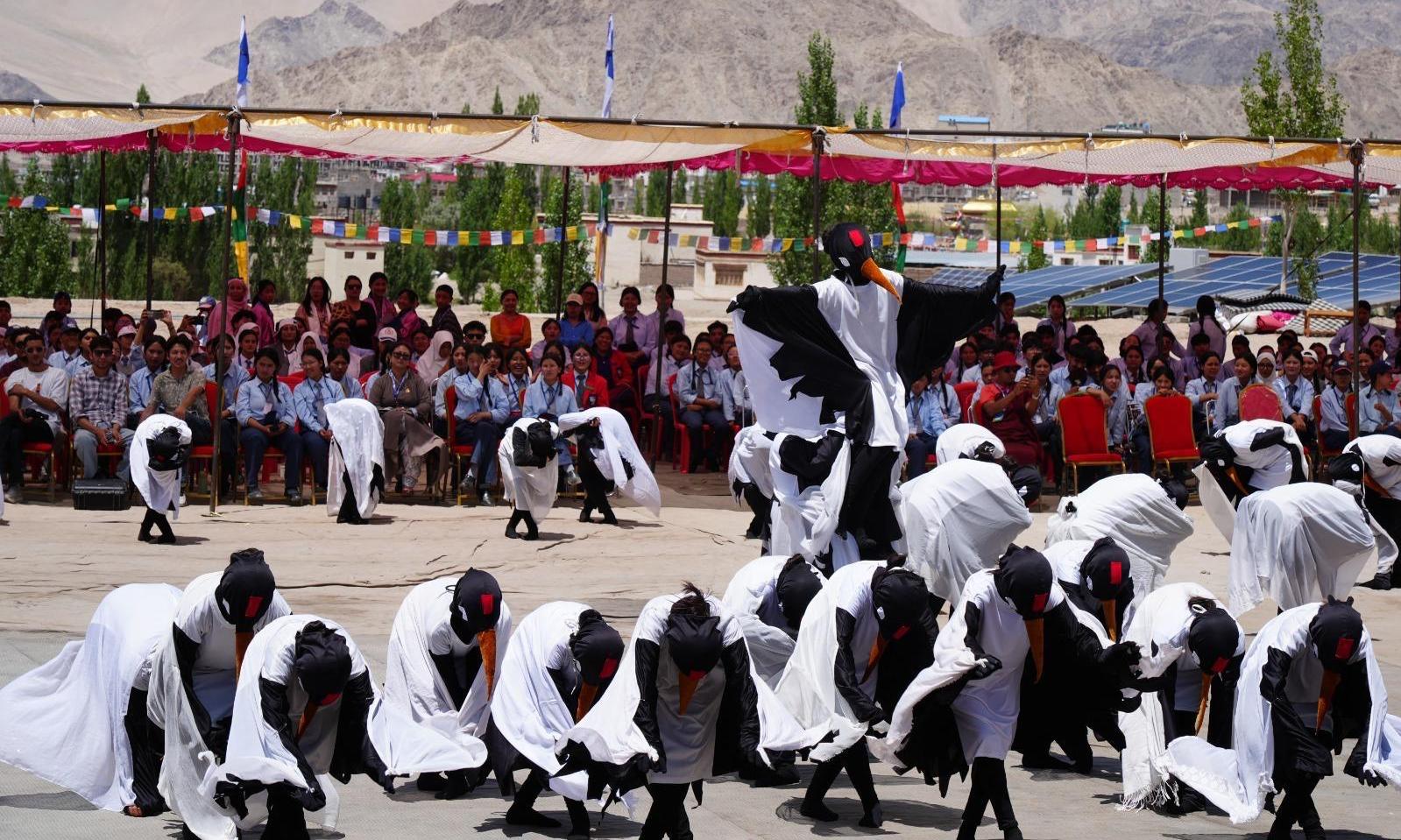
Srinagar: India’s first Black‑Necked Crane Festival commenced in Ladakh on Tuesday, bringing together conservationists, researchers and experts from across India and abroad, including representatives from the United Nations. Delegates from Bhutan and Nepal—countries that hold significant populations of the species—also joined the event, underscoring the festival’s international conservation relevance.
Lieutenant Governor Vinai Kumar Saxena, while inaugurating the festival, described it as a landmark initiative dedicated to conserving the endangered Black‑Necked Crane and strengthening environmental protection, economic welfare and sustainable livelihoods for Ladakh’s local communities. The festival’s diverse participation reflected a shared commitment to safeguarding this rare alpine crane, the only crane species in the world adapted to high‑altitude ecosystems.
Across India, Bhutan, China and Nepal, an estimated 16,000 Black‑Necked Cranes survive today, with India hosting a small but crucial portion of this population. Ladakh is the only breeding habitat of the species in India, making the Union Territory indispensable to its long‑term conservation. Recognising its ecological and cultural importance, the UT Administration has declared the Black‑Necked Crane the State Bird of Ladakh, where it is revered as a symbol of peace and an ambassador of the region’s fragile high‑altitude ecosystems.
Addressing the gathering, Saxena emphasised that conserving the Black‑Necked Crane is inseparable from protecting Ladakh’s wetlands, grasslands and high‑altitude landscapes. Wetlands such as Tso Kar, Hanle and other breeding sites are not merely wildlife habitats but complex ecological systems that regulate water, support biodiversity and sustain pastoral communities, he said. Protecting the crane, he added, also means safeguarding the environment and the livelihoods intertwined with these landscapes.
The Lt. Governor highlighted the need to recognise local communities as partners and custodians of conservation rather than passive beneficiaries. He called for integrating traditional ecological knowledge with modern scientific approaches to ensure effective protection. “The Black‑Necked Crane is much more than a bird. It is a symbol of peace, an ambassador of our high‑altitude ecosystem and a bridge between wildlife conservation and the well‑being of our communities. Our goal must be to protect nature while creating sustainable opportunities for the people who have safeguarded these landscapes for generations,” he said.
He also pointed to the potential of responsible birdwatching, nature tourism, wildlife photography, local handicrafts and traditional products to generate sustainable income for Ladakh’s communities. Initiatives such as the Community Knowledge Circle and Community Eco‑Market, organised as part of the festival, were cited as examples of linking conservation with culture and livelihoods. Saxena reiterated that Ladakh must follow the principle of “more value from nature, with less pressure on nature,” ensuring that tourism and economic activity do not degrade the ecosystems that draw visitors to the region.
The festival further spotlighted the urgent need to protect breeding grounds and wetlands from pollution, unregulated tourism and other pressures, while raising public awareness about the ecological significance of the species. As part of the event, the Lt. Governor released several knowledge products on the Black‑Necked Crane, including India and Bhutan editions of the Black‑Necked Crane Book, a coffee table book, an action plan for conservation, a status and distribution report, a bird economy status report for Leh, a special postal cover and cancellation in collaboration with India Post, and the Ladakh Declaration for Black‑Necked Crane Conservation.
Disclaimer : This story is auto aggregated by a computer programme and has not been created or edited by DOWNTHENEWS. Publisher: deccanchronicle.com







