

New laws that criminalise coercive control put vulnerable women at risk of being wrongly charged with family violence crimes, women’s safety advocates say.
They say the law, which has been introduced in Victoria following similar legislation in other states, will be too easily “weaponised” by men against women.
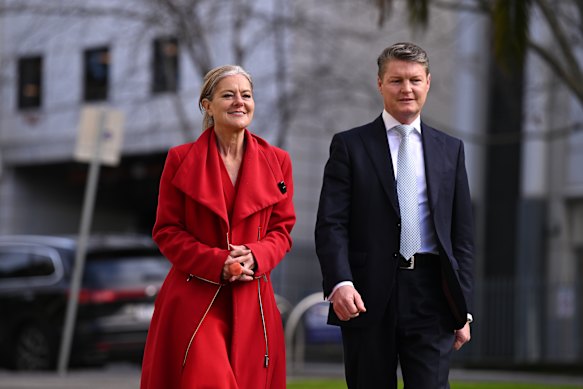
Victorian Premier Ben Carroll on Tuesday introduced legislation to criminalise coercive control, bringing Victoria into line with Queensland and New South Wales. Victim/survivors had campaigned nationally for the offence following the murder of Queensland woman Hannah Clarke and her three children.
NSW jailed its first coercive control offender, Callum Fairleigh, in February for two years with a non-parole period of 15 months. The maximum jail term for coercive control in the state is seven years.
In the first five months after what is known as Hannah’s Law (criminalising coercive control) came into effect in Queensland in May 2025, police laid 53 charges after receiving 149 reports. The crime can result in up to 14 years’ jail time in the state.
But a spokesman for the key Victorian provider of specialised women’s legal advice says the law lacks safeguards to prevent it “harming those it is meant to protect”.
“It would make it easier for perpetrators of violence against women to further persecute partners by alleging they are offenders,” said Roj Amedi, policy and advocacy director at Women’s Legal Service Victoria.
“People who use family violence are often really good at using systems, performing, seeming very charismatic and engaging in public, and behind the scenes they are asserting power, control and dominance, isolating and instilling fear in another person all the time,” she said.
“This will compound existing problems, especially with victim/survivors who are already often criminalised, Aboriginal and Torres Strait Islander women, culturally and racially marginalised women, disabled women and LGBTQI women.”
These groups were among the 58 per cent of clients to the service who need support with false allegations against them, “victims misidentified as the person using violence rather than the person in need of protection”.
A spokeswoman for Domestic Violence New South Wales, Angie Gehle, said this was already happening in NSW, where coercive control became a standalone offence in July 2024.
“What we see is that some perpetrators are really smart and are using the system to further abuse victims; this [coercive control law] is giving them an avenue to elevate their control because they can use it in an unintended way,” Gehle said.
“Some are really well versed, they know the language to use and are using it to turn the tables on the victim survivor, saying ‘she is doing A, B and C and I’m feeling threatened’ … when this happens it is devastating.”
National community support for outlawing coercive control with specific laws is strong, but the Victorian women’s safety sector had argued that a standalone offence was not necessary because the behaviours are already well covered by the state’s nation-leading family violence provisions, and a separate law would carry too many risks.
Opposition Leader Jess Wilson made introducing the offence of coercive control her first major policy pledge in November 2025, after which the then-Allan government vowed to do the same, reversing its previous stance that coercive control was already considered part of family violence crime.
Dr Joumanah El-Matrah, chief executive of the Victorian women’s safety peak body, Safe and Equal, said any such reform must “prioritise safety over speed” and ensure victim/survivors are really made safer, rather than “creating new pathways for further harm”.
“There is no substantive evidence that a standalone criminal offence [of coercive control] will improve victim/survivor safety or increase accountability,” she said.
Her predecessor, Tania Farha, warned the then-Allan government against it in late 2025, when it mooted the introduction of the coercive control law after Wilson’s comments.
What is coercive control?
According to NSW law, coercive control involves deliberate, repeated patterns of physical or non-physical abuse used to hurt, scare, intimidate, threaten or control someone.
Behaviour can include:
- Limiting freedom or controlling choices
- Harassing, monitoring and stalking
- Shaming, degrading or humiliating
- Social isolation
- Threats, violence and intimidation
- Emotional, financial or sexual abuse
- Systems abuse, such as making false reports to authorities
It carries a maximum sentence of seven years. The law currently only applies to behaviour after July 2024 towards current or former intimate partners.
She said then that “these laws will provide yet another opportunity for people using violence to weaponise the system and accuse the person experiencing violence of being the primary aggressor”.
“We already see this happening with existing laws and the justice system.”
But Tessa Boyd-Caine, chief executive of the national violence against women research agency ANROWS, said research demonstrated that victim/survivors very much wanted the coercive control they had experienced to be criminalised, and thought such laws helped raise awareness.
She warned that to do so effectively, governments needed to provide new justice-system capability and resourcing, to avoid the risks highlighted by the sector.
Police forces also needed training to understand how to identify coercive control as a pattern of behaviour and not as an incident-based crime: “That’s not a useful way to understand coercive control, you need to understand the context with training and capability.
“The effectiveness of any reform depends on how well systems recognise patterns, protect victim/survivors and hold the person using violence to account for that violence,” she said. “We need to do everything we can to ensure coercive control laws are not weaponised.”
Family violence advocate, author and academic Jess Hill said that when laws officially recognised coercive control, “systems and institutions including police, health, education, policymakers and government services take it more seriously”.
She said studies showed the vast majority of victim/survivors of all background supported the introduction of such laws. “I think we should advocate on their behalf. As they clearly indicate, and as other advocates have emphasised repeatedly, it’s not just about getting more prosecutions,” she said.
“It’s getting society to draw a red line under this form of intimate terrorism – to signal very clearly that it is taken just as seriously as physical violence … Our laws should recognise this: domestic violence is not merely a collection of incidents, it is an unrelenting system of entrapment.”
Start the day with a summary of the day’s most important and interesting stories, analysis and insights. Sign up for our Morning Edition newsletter.
 Wendy Tuohy is a senior writer focusing on social issues and those impacting women and girls.Connect via X or email.
From our partners
Disclaimer : This story is auto aggregated by a computer programme and has not been created or edited by DOWNTHENEWS. Publisher: www.smh.com.au





