Mercedes technical director James Allison says the team’s decision to keep developing its 2026 Formula 1 car late has put it “out of phase” with the other teams around it, causing a leapfrog effect as in-season updates produce large performance gains.
The W17 has been the class of the field so far, starting out the year with a 1-2 finish in Australia and going on to claim eight wins in the opening 11 races of F1’s new era. Although the team is the firm championship favourite, this has not stopped the likes of Ferrari and McLaren beating it to victories on merit over the course of 2026.
Allison, speaking on the team’s Nu Silver Arrows Radio Show podcast, stated that the team was finding “about six to seven times” more lap time per week in the wind tunnel compared to last season. This demonstrates the difference between finding gains under a new ruleset compared to a more mature, end-of-life set of regulations.
He also revealed that the team had elected to push the design of its W17 car late. When teams design their cars, they usually elect a “design freeze” point, where the car will be manufactured as-is and further developments will be packaged up as updates for later in the season.
Mercedes chose to move that freeze point back, compressing the manufacturing time but allowing it to effectively include early-season updates into the launch car. Allison says that this had “less than no contingency” if issues arose, but it allowed the team to take advantage of the continued development curve.
“Aerodynamically, the gain rate for each passing week in the wind tunnel, the amount of lap time we find – that’s the gain rate – is about six to seven times what it was last year,” Allison said.
“It’s about half a second every two months, something like that, so that’s really, really steep. And we did everything in our power to launch a car at the start of the year that was going to be strong.
“Thank goodness it was a fair effort. But one of the things about our development strategy was we took a decision internally on the aerodynamic side and on the bodywork side of the car that we were going to leave it later than we’ve ever left a car before, by several weeks. And that we were going to do a plan that had less than no contingency in it.
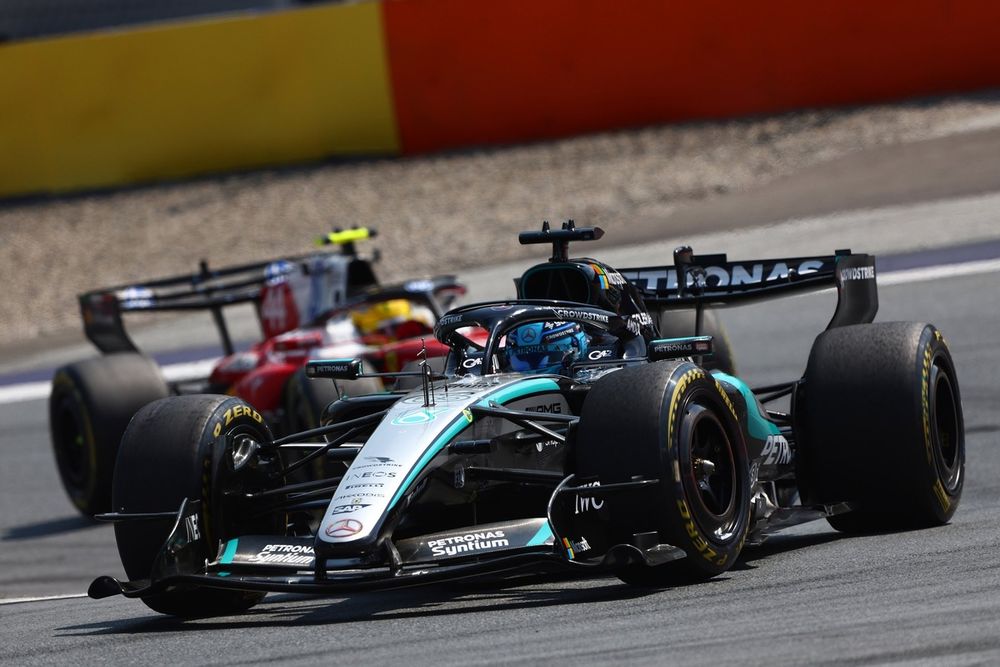
Lewis Hamilton, Ferrari, George Russell, Mercedes
Photo by: Andy Hone/ LAT Images via Getty Images
“As a result of that plan, we got as much, that very, very steep development slope, we got as much of that steep development slope in the first car at the first race as I think was humanly possible to get in there. And we emptied everything out to do that. Other teams maybe didn’t arrive with quite the sort of quite such a late braking, as close to the wire result. As a consequence, they updated their car sooner.”
Allison says that, although this offered Mercedes an advantage at the start of the year, it left the team with nothing in the pipeline. This has put it “a race or two” behind its rivals in terms of producing updates, as it had to stock up on its further refinements.
He explained that a half-second advantage could be completely wiped out by the time other teams bring their updates, and this has left Mercedes potentially vulnerable while it awaits its own developments in the hope of restoring that advantage.
This explains the ebb-and-flow in performance between the teams; Ferrari found pace in Barcelona with a considerable update package, while McLaren’s new floor in Hungary greased its own path to a first race win of the season.
“They fixed their car earlier in time, they then were developing the first upgrade to arrive sooner in the season. So we arrived, you know, bristling with performance, but with all of it spent,” Allison continued.
“We’ve been filling up our tanks to give more, and we’re a bit out of phase. And our development program, as a result of arriving early, is now running a race or two after the update rates of the others.
“It appears, looking at the lap times we’re seeing, that everyone’s on this same slope we’re on. Everyone is developing around about half a second every two months. And so with that, being out of phase half a step with the development cycle means that you can have half a second like we did at the start of the year.
“One development cycle will bring that to nothing. And that feels quite scary. But also, you know that there’s a load in the tank. It’s just a question of when we’re going to bring our bits.
“Our strategy is just to try to keep our nose ahead and to make sure that the next lump of performance that we deliver will restore the status quo ante, restore the goodness we put in at the beginning of the season.
“We just have to ride out these scary events where other people bring all their fancy new bits.”
Watch: The Mid-Season Review
We want your opinion!
What would you like to see on Motorsport.com?
– The Motorsport.com Team
Disclaimer : This story is auto aggregated by a computer programme and has not been created or edited by DOWNTHENEWS. Publisher: motorsport.com