
ARDMORE, Pa. — If you read Ann Patchett, you will seldom, if ever, encounter the four-letter word that draws you to this website. The author of “Bel Canto” and “Tom Lake” and a current New York Times bestseller, “Whistler,” has plenty of themes in her typing life without ever falling under the spell of ye olde game.
But Patchett’s brother-in-law is a golf pro. And Andy Brennan, the general manager of the bookstore Patchett owns in Nashville, is a golf bum with impeccable credentials. He has actually read John Daly’s “My Life In and Out of the Rough,” just as he has read the Bernard Darwin, Henry Longhurst and Herbert Warren Wind canon. Before he fell into the book business, Brennan was a course superintendent and a course builder. (He once made an ace on one of his own holes.) He has known about a strain of grass called Merion Blue forever, or at least 1971, or circa* 1971. It was in 1971 that Lee Trevino won his U.S. Open at Merion, in a playoff over Jack Nicklaus. Brennan also attended the 1981 U.S. Open at Merion. Classic busman’s holiday**. On Thursday he was back at Merion, for the Am. The U.S. Amateur.
(*Circa: from the Latin, meaning around.)
(**Busman’s holiday: Late 19th-century phrase, of English origin, to describe a vacation that mimics a person’s working life.)
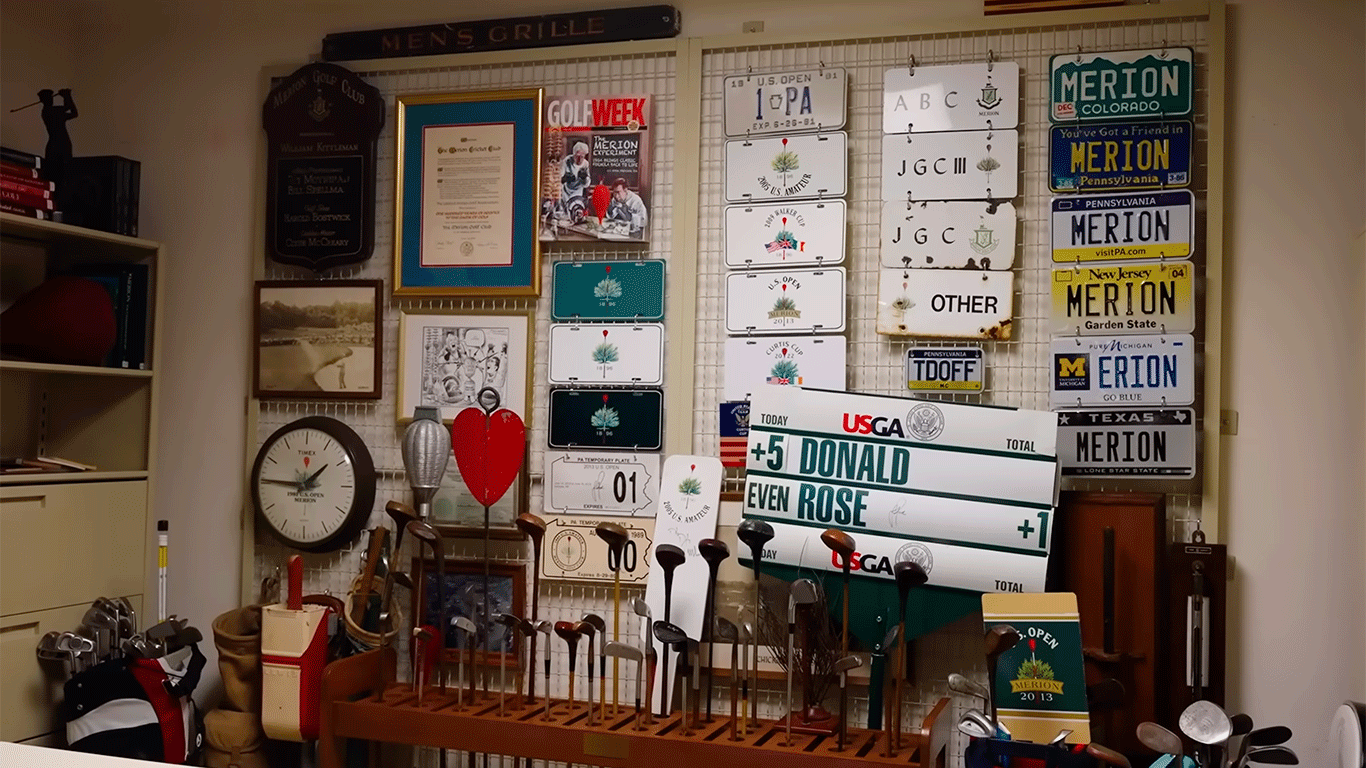
On Thursday, Brennan spent an hour or so in Merion’s windowless archives room, in a deep and hidden part of its twist-and-turns clubhouse, getting a tour and a dissertation from Merion’s resident historian, The Very Rev. John G. Capers 3rd. Set to words, the scene could have appeared in a Mark Frost novel — or would Steven Pressfield be a better fit for this tortured analogy? The fellas compared notes on Bob Jones (the golfer and writer) and O.B. Keeler (the writer and duffer), wondering who did what to make “Down the Fairway” the artwork it is.
Brennan was at Merion for the first time since ’81 and paid the club a great compliment — it has not changed. (You could also say everything has changed here, but unless you knew you wouldn’t know. A phrase of the club was once, “The greens are air-conditioned. The locker room is not.” Now they both are.) Capers has won 19 club titles at Merion. (No need to describe these victories as “legit,” as that is always presumed to be the case in these matters, or nearly always.) Capers has been at the club most of the days of his life. Capers, like Brennan, breathes the game, and their discourse was rich. A USGA official leaned in the whole while, in total silence. A GOLF.com videographer, Alex Gelman, was, fortunately, in the room where it happened, his finger on record.
The two men discussed Mason Rudolph and his appearance in the 1950 U.S. Open as a teenager, taking the train to the course and waiting in the caddie shack for his first tee time, pointed there by the caddie master, who mistook him for a looper. Brennan knew Rudolph. Capers attended the 1950 U.S. Open, a junior member and the son of the winner of the Merion Women’s club championship in 1942 (and a bunch of other years). Hogan won that Open on ‘50. Ben Hogan. If his name came up once with Capers and Brennan, it came up 100 times.
They discussed Johnny McDermott, the first American to win the U.S. Open, which he did in 1911 and ’12. They talked about McDermott visiting Merion for the ’71 Open, on a day when he was permitted to leave Norristown State Hospital for the day, in the care of his sister. (The hulking facility was once known as the State Lunatic Hospital at Norristown.) It is a visit shrouded in mystery and wistfulness. McDermott, like Hogan, was an American original. Capers, in his own way, is, too.
The two men discussed the 2013 U.S. Open and how, after it, Rory McIlroy donated a bent-shaft club to Merion, but only before breaking off its head with his bare hands.
They talked about the 2005 U.S. Amateur at Merion, won by Edoardo Molinari, who wore a striped polo with the Merion logo on it for the finale. Shortly after the end of play, as Capers described the scene to Brennan, Capers made the dashing Italian golfer an offer he could not refuse: an identical brand-new shirt for the one that had just gone 33 holes. The shirt, his gameday shirt, lives on in Merion’s archives, signed by the winner and unwashed to this day.
Before long, John Capers was telling his new pal about his Sunday-night plan for this week, to get in front of the U.S. Am’s winning caddie as soon as it is polite to do so and find out what neat and unusual trinkets might be in the winner’s bag. An archivist is always looking for a new discovery, just as a book seller is. Andy Brennan was hanging on the archivist’s every word.
Michael Bamberger welcomes your comments at Michael.Bamberger@Golf.com.
<figure class="youtube-facade" data-content="
“>
Disclaimer : This story is auto aggregated by a computer programme and has not been created or edited by DOWNTHENEWS. Publisher: golf.com





