
The question of whether AI is a bubble is the wrong one, Dhaval Joshi argues. The right question is: which AI bubble is popping today?
Joshi, until recently the chief strategist for Counterpoint at London’s BCA Research, has been building a reputation for contrarian, structurally minded calls on the AI trade. A week ago, he reframed the entire “is AI a bubble debate” itself, writing on LinkedIn.
Rather than your classic idea of one giant bubble building until it implodes, this is rather a rapid-fire sequence of bubbles popping and inflating in a rolling pattern. Investors are misjudging, and then correcting, who or what will actually capture AI’s value. One commenter, Artificial Genius President Paul Burchard, asked Joshi whether AI is like the infamous tulip bubble of the Netherlands in the 17th century. After all, that bubble rolled through rare bulbs into tulip futures.
Joshi responded that the AI bubble is rolling through sectors beyond the proverbial tulip. It would explain the “SaaSpocalypse” in the software-as-a-service sector, as well as volatility in silver and semiconductor stocks. But is this just the market doing what it’s supposed to do, namely price discovery?
The rolling hills of bubbles
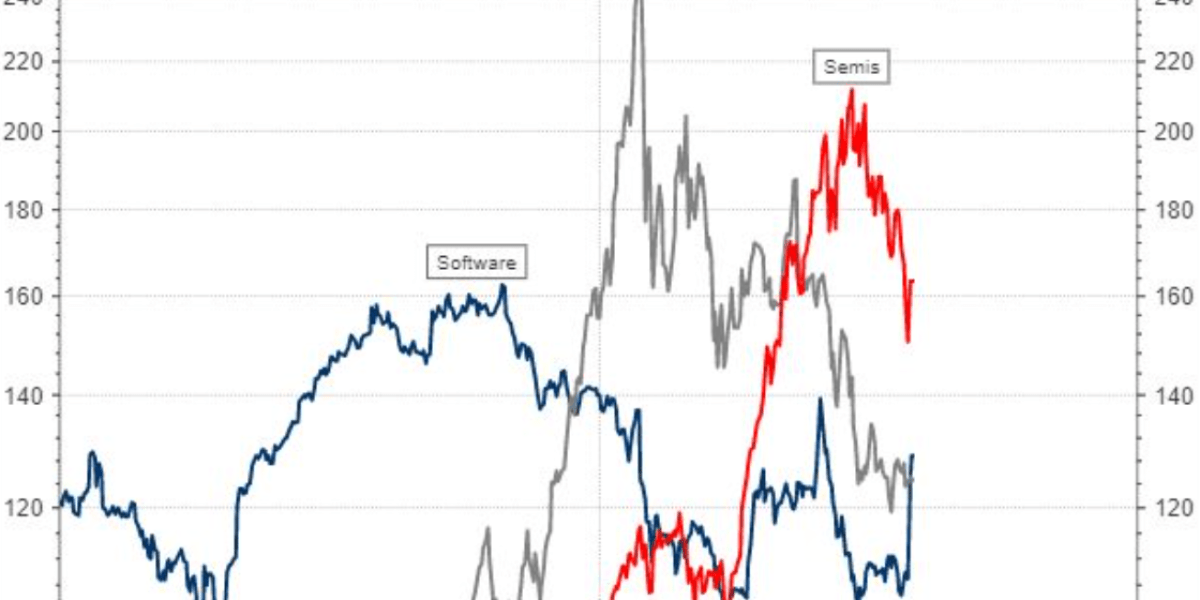
Joshi produced a chart showing that software stocks rallied on the idea that AI would be a productivity tool, then crashed as investors realized AI agents were threatening the SaaS subscription model itself. “So, the software boom turned to bust.”
Silver also had a boom and bust. Prices spiked as the metal is seen as the best electrical conductor for power-hungry data centers: “On reassessment however, this could not justify a near trebling of the silver price when there are other good conductors.”
Semiconductors then rose on the idea of seemingly limitless pricing power for chipmakers, but Joshi argued that investors are realizing that chipmakers don’t have “moats” around their profits. He offered a prediction: “Astronomical margins will crash back to earth when demand and supply equilibrate, as they ultimately must. So, the semis boom is unwinding – though has further to go.”
In an interview with Fortune, Joshi said he slightly disagreed with his former colleague, BCA’s Peter Berezin, that the market is in an earnings bubble, calling it more of a “profit margin bubble” instead. It’s not that earnings are unjustified by price or the P/E, price-to-earnings ratio, but now “the market is finally saying, ‘How is the E high?’ Because you’ve got very high margins, but can you maintain those margins?”
The obvious counter is that this is simply price discovery: markets testing a thesis, finding it wrong, and correcting. The amplitude is the difference here — a near tripling of silver overshoots any plausible fundamental by an order of magnitude. “If you can make a fortune in a matter of weeks or months, and, crucially, then lose it all just as quickly or even quicker,” Joshi said, “then that constitutes a ‘bubble.’” In his view, the market’s normal reassessment of winners and losers should not be so extreme in “magnitude and rapidity.”
Rather than fundamental reassessment, some kind of narrative contagion is setting in briefly, like a mania, before rolling off to somewhere else. And the silver example also shows that this misallocation isn’t just in equity markets.
“In real time, we are making educated guesses about which rapid inflations are at risk of rapid deflation,” Joshi told Fortune.
The good news, for now, is the cyclical nature of the reinflation, which has prevented a correlated selloff so far. But what investment, he asked — if any — will come next in the rolling sequence?
Everyone agrees overspending is happening
Joshi is far from a lonely voice on bubble risk, as the mayor of Wall Street himself — Jamie Dimon — has repeatedly voiced concerns over elevated valuations, while Bank of America Research’s Global Fund Manager survey has named “AI equity bubble” as the top tail risk. Even OpenAI CEO Sam Altman as well as Goldman Sachs CEO David Solomon and Amazon founder Jeff Bezos have conceded that something bubbly is going on. But the bubble was supposed to pop in 2025 and yet has kept going.
The latest earnings season changed the conversation with regard to hyperscaler free cash flow, which is being eaten by capital expenditure, with Google even going free cash flow negative for the first time in its history. Reuters calculated in late July that Microsoft, Alphabet, Amazon, Meta and Oracle were on pace for capex to overtake free cash flow by 2027. The debate is not so much about whether overspending is occurring, but whether the overspending is rational.
Joshi’s former firm, BCA Research, has sent mixed signals, upgrading equities in May on the logic that AI capital expenditure is the dominant force driving markets forward, though BCA strategist Juan Correa warned “We suspect that we could be in the early innings of a violent blow-off rally in AI-related stocks.”
Joshi is disaggregating the AI asset class into a sequence, explaining why no single AI-linked selloff has triggered a market crash. He also offers a testable, repeatably pattern that can be checked against new candidates as they emerge. When Fortune asked Joshi what the peak of AI capex would be, he responded it would most likely be late 2026 or the first half of 2027. Regarding outsized returns in earnings, he said those profits are premised on “stratospheric and unsustainable profit margins,” but he was open to changing his mind if those profit margins normalized without hurting profits.
Highly accommodative monetary policy is a major condition for any bubble, the strategist told Fortune, so a major risk would be a tightening in that area — “rather than capital just sequencing into the next bubble, it would exit risky assets entirely.” When asked what could unravel the entire sequence at once, he said three things could break the pattern: if real interest rates and/or real bond yields rose sharply, if the capex cycle unwinds very sharply, or if “a non-mild recession” hits.
He also tracks a fourth risk: a lack of what he calls market “complexity,” a metric he built by adapting the famous mathematician Benoit Mandelbrot‘s research into complex adaptive systems. Where Mandelbrot applied these principles to cauliflowers and river basins, Joshi applied them to financial time series, explaining that high complexity creates of equilibrium.
The deeper question underneath the rolling sequence is who, ultimately, captures the value of a general purpose technology like AI. Joshi laid out three scenarios.
The first is the web 2.0 model: corporations with genuine moats, like Amazon in ecommerce or Google in search, which capture everything because winner-takes-all network effects let them sustain margins.
The second is the superstar individual: a top lawyer or consultant who uses AI to collapse their own staff costs while maintaining premium-quality output, pocketing the revenue.
The third is “massive competition” so intense that nobody can hold margins, and “the winner is just the general consumer, because prices collapse.” That is one way the rolling sequence of bubbles could conclude, he said, explaining that what looks like rolling hills are really a giant wall of capital looking for somewhere to go after exhausting moats, one by one.
In a separate post, Joshi found one possible candidate: a 20-year-old, near-obsolete memory chp called DDR3 RAM. It has surged 600% in less than a year. “To put that into perspective, it would be like paying $50,000 for a beaten-up 2007 Toyota Corolla!”
Joshi told Fortune he wasn’t sure what the next rolling bubble sequence would be: “That’s the million-dollar question!” He noted it was very unusual how crypto has not participated so far, “but if AI and blockchains can produce some synergies, then crypto could be a candidate.” In the meantime, this rolling sequence has created what he calls “playable segments” for investors nimble enough to catch each move. “Anything that’s moved up very, very sharply in a short space of time is a candidate,” he said. The discipline is keeping your ears to the ground for what narrative is inflating next — and which moat turns out to be all dried up.
Disclaimer : This story is auto aggregated by a computer programme and has not been created or edited by DOWNTHENEWS. Publisher: fortune.com




