
European Union countries issued a total of 3.9 million new residence permits to non-EU citizens in 2025, a 10 percent increase compared to 2024, and the “highest level” since records began, according to new data. But which countries issue the most?
Overall some 355,350 more permits were issued by EU in 2025 compared to the previous year, according to new figures published by Eurostat, the EU statistical office.
A rise compared to 2024 was recorded for almost all types of residence permits, for employment (+16 percent), family reasons (+14 percent) and education (+9 percent), Eurostat data revealed.
Only permits issued for other reasons – which may concern pensioners or people in need of temporary protection – saw a 1 percent decline.
The main reason for new residence permits across the EU was employment, followed by family, education and other purposes.
In total, as of 2025 there were 27.8 million residence permits held by non-EU citizens in EU countries, with Germany accounting for the largest number (5.9 million permits), followed by France (4.4 million), Spain and Italy (4.3 million each).
Spain issues highest number
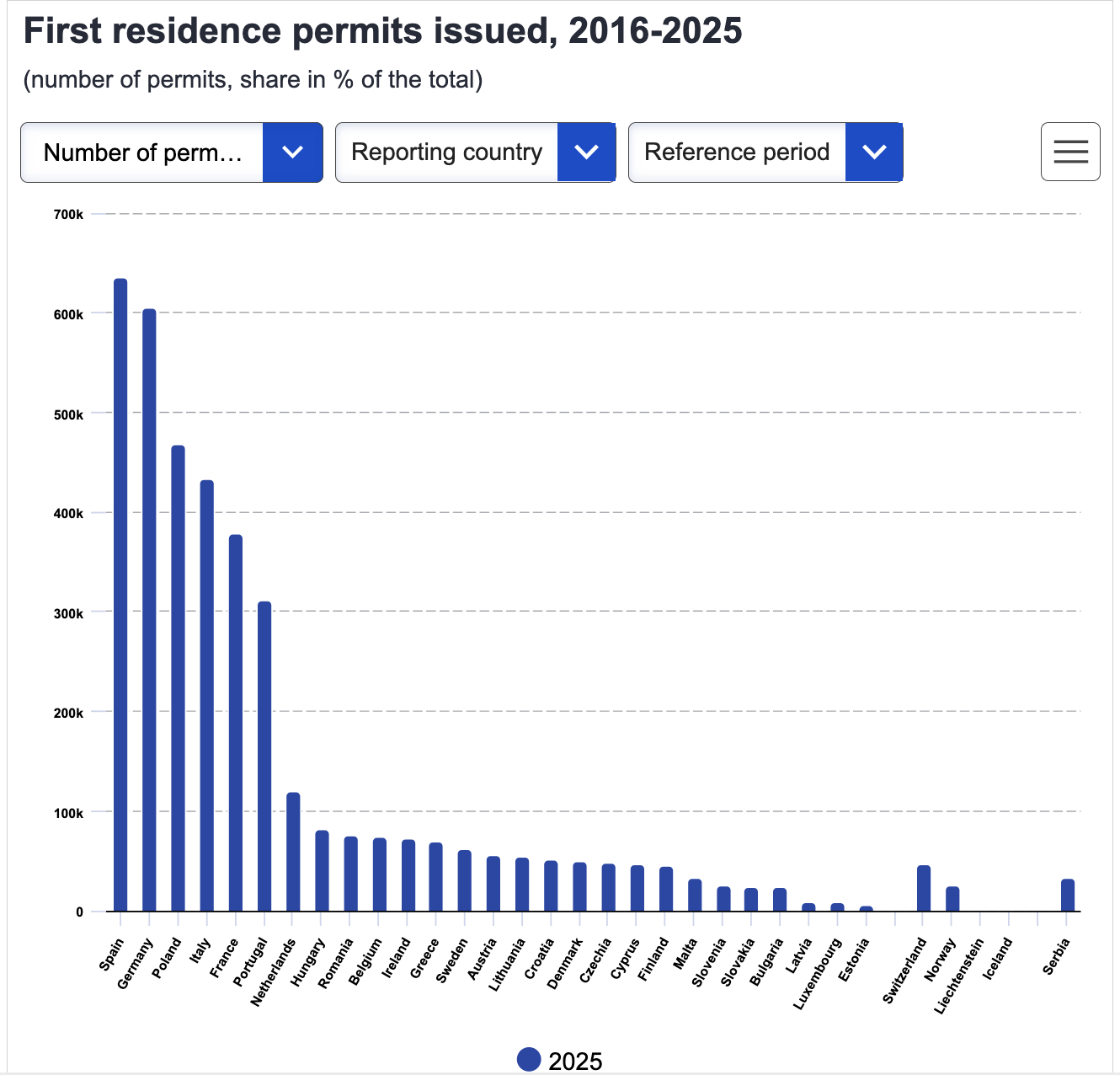
Among EU countries, the highest number of first-time residence permits issued in 2025 was by Spain (635,438 permits), followed by Germany (605,292), Poland (467,314), Italy (433,099) and France (377,462).
Sweden issued 61,196, Austria 55,486 and Denmark 49,882. EFTA countries Switzerland and Norway issued 46,272 and 25,197 respectively.
The largest increases compared to the previous year were recorded in Portugal, Romania, Italy, and Slovakia, while the most visible declines were in Croatia, Greece and Austria.
Employment reasons
Information provided by national authorities to the EU statistical office revealed that employment was the main reason for new residence permits being handed out. A total of 1.3 million were issued in 2025, almost 34 percent of the total.
The main destinations for non-EU citizens entering Europe for work reasons were Poland (318,186 first permits), Portugal (240,523), Spain (115,040), and Germany (108,091).
Ukrainians and Brazilians were the largest communities receiving a first residence permit for employment reasons. The vast majority of those for Ukrainian citizens were issued by Poland and for Brazilians it was Portugal.
Family reunions
The second most common reason to obtain a residence permit for the first time by an EU/EFTA country was “family formation and reunification”. This concerned 1.1 million people, or 28 percent of total permits.
In terms to overall numbers, the EU countries issuing the highest number of new residence permits for family reasons were Spain (275,869), Germany (225,591), Italy (176,876), and France (90 959).
Moroccan citizens were the largest nationality for recipients of permits for family reasons, with more than half the total number receiving a permit from Spain.
Education purposes
Some 600,000 new residence permits were issued in 2025 for education purposes, or 15 percent of the total.
In three countries – Ireland, Denmark and France – education was the most common reasons to grant a residence permit.
In absolute terms, the top choices for non-EU students were France (118,404 first permits), Germany (112,500) and Spain (105,419).
Indian nationals were the largest group to receive first residence permits for education purposes, with almost 40 percent issued in Germany.
‘Other reasons’
Some 900,000 first residence permits were issued for ‘other reasons’ (23 percent of the total), which may range from international protection or other types of residence, including for pensioners.
In 3 EU countries – Greece, Estonia and Austria – this was the most common basis for new residence permits in 2025.
Afghan citizens were the largest group receiving such permits, of which 42 percent were granted by Germany.
Ukrainians first recipients
The largest groups obtaining a residence permit for the first time in an EU country in 2025 were citizens of Ukraine (335,100), India (227,600), and Morocco (202,100), followed by Brazil, Belarus, Colombia, Turkey, China, Syria and Pakistan.
READ ALSO: What the mobility deal between the EU and India will mean for skilled workers
Eurostat notes that several factors can influence the choice of a destination when moving across borders, from geographical proximity, to historical and linguistic ties or established migrant networks.
For instance, a high number of Ukrainians and Belarusians sought residence in Poland, and Moroccans in Spain and France. Significant communities of Venezuelans, Colombians, and Peruvians chose to move to Spain, and Brazilians to Portugal, while Germany has established networks of Turkish citizens.
The top three nationalites receiving a first residence permit in the countries covered by The Local (2025):
Austria: Ukraine, Afghanistan, Syria
Denmark: US, India, Nepal
France: Morocco, Algeria, Tunisia
Germany: Syria, Turkey, India
Italy: Bangladesh, Morocco, Egypt
Spain: Colombia, Morocco, Venezuela
Sweden: India, Pakistan, China
Norway: Syria, India, Vietnam
Switzerland: US, India, China
Record number of Indian nationals
A total of 227,577 Indian citizens were granted a first residence permit in EU countries in 2025, the highest level recorded since records began in 2013. More than 100,000 received a permit for employment reasons, 60,000 for education, 46,000 for family reunions, and 19,000 other purposes.
Indian nationals were the largest community receiving a first residence permit in Sweden, Ireland, Cyprus, and Luxembourg, and the second in Denmark and the Netherlands.
EU countries also issued first residence permits to more than 91,000 US citizens, also the highest level since 2013.
For US nationals, the most common reason to move to Europe was education, (32,500), followed by family (about 23,000), employment (almost 19,000) and other reasons (17,000).
US citizens were largest community receiving a first residence permit in Denmark and Switzerland, the third in Czechia and the fourth in Sweden, Ireland and the Netherlands.
Some 44,000 UK citizens also received a first residence permit in EU countries, similar to the previous years. Just about the same number (12,900) were for employment and family reasons, 6,600 for education, and almost 12,000 for other purposes.
About 15,700 Canadians and 9,000 Australians also received first residence permits in the EU in 2025.
If you want to explore the data even more visit the Eurostat site where there are interactive charts.
Disclaimer : This story is auto aggregated by a computer programme and has not been created or edited by DOWNTHENEWS. Publisher: thelocal.de



