- BRICS aims to strengthen global growth, cooperation, Global South.
- India targets $200 billion BRICS exports by 2030.
- Growing trade deficit, non-tariff barriers pose challenges.
Brick by brick, the 11-member BRICS grouping, which accounts for approximately 40 per cent of global GDP and 26 per cent of world trade, is building momentum to transform itself into a stronger engine of global growth. The grouping is also seeking to strengthen BRICS as a platform for global cooperation and give the Global South a stronger voice.
Industry leaders and experts are confident that India can raise its exports to BRICS nations to USD 200 billion by 2030, from USD 96 billion in 2025-26, with electronics, automobiles, pharmaceuticals and other sectors expected to drive the growth.
BRICS Seeks Stronger Business Outcomes
Nirmal K. Minda, President of ASSOCHAM, said Prime Minister Narendra Modi’s vision of transforming BRICS cooperation into concrete business outcomes could help position the grouping as an important pivot in the global economic landscape.
“Deepening trade and investment, emphasis on innovation, digital solutions, infrastructure and initiatives such as the BRICS Startup Innovation Fund can further strengthen collaboration and enable Indian enterprises to scale globally. These priorities will unlock new markets, deepen business partnerships and strengthen the competitiveness of emerging economies,” Minda said.
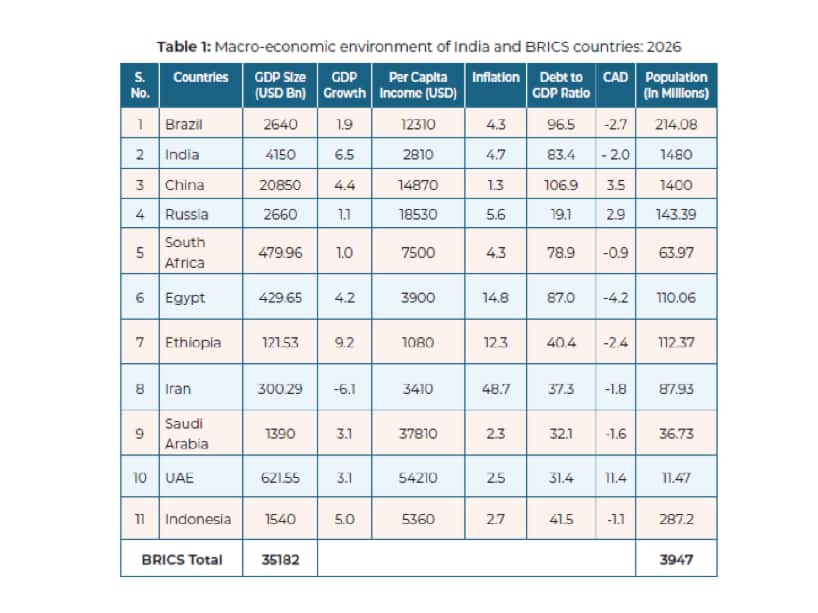
The BRICS 2026 grouping is at an inflection point, with India among the fastest-growing large economies in the bloc. According to the IMF’s April 2026 Outlook, the UAE is projected to have the highest per capita GDP among BRICS members in 2026 at USD 54,210, followed by Saudi Arabia at USD 37,810 and China at USD 12,706.
The three countries with the lowest projected per capita GDP are Ethiopia at USD 1,080, India at USD 2,810 and Iran at USD 3,410.
India’s BRICS Exports Seen Reaching $200 Billion
Despite the potential for greater economic cooperation, significant challenges continue to weigh on trade and commerce within the grouping.
Global imports by BRICS member countries in India’s top 25 export product segments are close to USD 700 billion, according to industry data. However, India’s share in these imports remains significantly low.
India’s exports to BRICS countries stood at USD 96 billion in 2025-26. ASSOCHAM Chief Economist SP Sharma said India could increase its exports to USD 200 billion by 2030 by raising its share of BRICS members’ global imports to 4 per cent and strengthening South-South cooperation.
However, Sharma noted that India’s goods trade deficit with 10 BRICS countries has increased sharply, rising from USD 75 billion in FY2021 to USD 226 billion in FY2026. The increase in imports has pushed BRICS’ share in India’s total imports from 35 per cent to 42 per cent.
Growing Trade Deficit Raises Concerns
Ajay Srivastava, founder of the Global Trade Research Initiative, highlighted the trade asymmetry within the grouping.
“BRICS supplies 42 per cent of India’s imports, but buys only 22 per cent of its exports. India’s BRICS trade doubled, but the deficit tripled: Total trade rose from USD 203.1 billion in FY2021 to USD 417.5 billion in FY2026, while the deficit increased from USD 74.5 billion to USD 226.1 billion,” Srivastava said.
He noted that although BRICS is a major global trading bloc, internal trade remains limited. In 2025, the grouping accounted for 21.6 per cent of global exports and 17.3 per cent of global imports, while intra-BRICS trade represented only around 4-5 per cent of world trade.
Srivastava also flagged China’s dominance of the BRICS trading network.
“China exported USD 550.8 billion to other members and imported USD 464.9 billion from them,” he said.
Sharma agreed that the widening trade deficit remains a major concern, with imports from BRICS countries rising faster than exports.
“China is a key import source and along with UAE, remains major trade partners,” Sharma said.
The trade imbalance is particularly pronounced with China, Russia, Saudi Arabia, the UAE and Indonesia, while Brazil, South Africa and Iran maintained nearly balanced trade in 2025-26, Sharma said.
Exports to the UAE recorded the highest growth at 124 per cent, followed by South Africa at 78 per cent and Saudi Arabia at 76 per cent.
Major Indian exports to BRICS include refined petroleum products, electronic goods, gems and jewellery, passenger vehicles, rice and diamonds.

Electronics, Autos And Other Sectors Offer Export Potential
Sharma said Russia recorded the highest growth in imports from India since 2020-21, rising by more than 900 per cent, mainly due to crude oil imports.
“In absolute terms, China recorded the highest increase in imports, with record levels reached in 2025-26 at more than USD 130 billion,” Sharma said.
India’s imports from Iran and Ethiopia remain below USD 1 billion, while imports from Brazil, South Africa and Egypt are still below USD 10 billion.
“Looking ahead, India’s role within the expanded 11-nation grouping will be shaped by its ability to balance growing import dependencies with efforts to boost outbound shipments and diversify supply chains,” Sharma said.

Srivastava said India should focus on correcting the growing imbalance by seeking better market access in China, Russia and Indonesia, addressing non-tariff barriers, promoting higher-value exports and reducing excessive dependence on a few BRICS suppliers.
“Without stronger export growth, deeper intra-BRICS trade could further widen India’s already large trade deficit,” he said.
Non-tariff Barriers Remain Major Hurdle
Reducing non-tariff barriers (NTBs) remains a major challenge for BRICS economies.
Pankaj Chadha, Chairman of EEPC India, said around 75 per cent of problems faced by exporters could be addressed by eliminating NTBs and establishing smooth and efficient payment mechanisms in national currencies.
“We can have a common agreement on NTBs between BRICS nations and agree to a set of standards. While we have been discussing this for a while now, it is time to move to its execution,” Chadha said.
Non-tariff measures are widely recognised as adding more costs to exports than tariffs in many countries, making it necessary to simplify regulatory procedures between trading partners.
India’s engineering exports account for nearly 27 per cent of its total merchandise exports. Brazil, China, Indonesia, Saudi Arabia and South Africa are among the key destinations for Indian engineering exports within BRICS, Chadha said.
MSMEs Need Easier Access To BRICS Markets
Harsh Pati Singhania, Chair of the International Chamber of Commerce (ICC), said NTBs, documentation and access to finance continue to hold back micro, small and medium enterprises.
“The MSME sector accounts for around 60 per cent of global employment, yet their share of global trade remains much smaller. Access to finance, documentation and non-tariff barriers continue to hold them back. Interoperable standards and secure digital trade documents can reduce costs and enhance trade flows,” Singhania said.
Kenenisa Lemi, Secretary General of the Ethiopian Chamber of Commerce and Sectoral Associations (ECCSA), said MSMEs are not yet active participants in BRICS trade and value chains.
“We need to move beyond connectivity between countries to connectivity between companies,” Lemi said.
Marianne Ghali, Managing Director of Qalaa Holdings in Egypt, highlighted the constraints faced by women-led MSMEs, particularly businesses that remain too small to operate at their full potential despite their involvement in processing, packaging and exports.
“We want to create platforms that aggregate these small businesses into something larger – giving women scale, access to markets and the opportunity to create value chains across BRICS,” Ghali said.
Services And Digital Connectivity Could Unlock Trade
Trade in services represents another major opportunity for BRICS, but fragmentation remains a key obstacle, according to John Denton, Secretary General of the ICC.
Denton called for practical cooperation on greater mobility, recognition of professional qualifications and the movement of data across borders.
Yu Xubo, Chairman of China General Technology (Group) Holding, suggested that BRICS could strengthen trade facilitation by developing products and business models through integrated value chains, technology transfer and joint training of medical professionals.
Local Currency Financing Gains Traction
The establishment of the New Development Bank (NDB) in July 2015 by Brazil, Russia, China and South Africa was a pivotal step in BRICS’ approach to financing development projects.
One of the key developments has been the rapid expansion of the NDB’s local currency operations. Local currency lending increased to 29.3 per cent of cumulative loan approvals by the end of 2025, from 23 per cent at the end of 2021, bringing the bank close to its 30 per cent target for 2026.
Similarly, local currency borrowing increased to 34.7 per cent from 27 per cent over the same period, surpassing the bank’s strategic target ahead of schedule.
Greater use of local currency financing can deepen domestic capital markets, improve financing resilience during periods of global volatility and reduce exchange-rate risks.
Federation of Indian Export Organisations (FIEO) President SC Ralhan said easier cross-border payments would be crucial to developing commercially viable mechanisms for settling intra-BRICS trade in local currencies.
“Payment uncertainty can itself become a trade barrier. Efficient, transparent and compliant payment arrangements can reduce transaction costs and give businesses, particularly MSMEs, greater confidence to enter new markets. The opportunity is not simply to sell more to BRICS countries. India should become an integral part of the production, sourcing and value chains being developed across these economies,” Ralhan said.
Food Security Emerges As Another Growth Area
With food security becoming a shared BRICS priority and member economies accounting for a significant share of the world’s population and food production, agricultural cooperation is emerging as another potential business driver.
Chen Gang, Vice President of COFCO Corporation and Chair of the BRICS Business Council Agri-business Working Group, said BRICS could build a more resilient and sustainable agri-food ecosystem by combining technology, expertise and market access.
Sagar Kaushik, Chair of the BRICS Business Council Agri-business Working Group at UPL Limited, said the grouping already has a strong foundation of agri-tech startups.
“The opportunity now is to connect these capabilities across countries and move from best practices to joint pilots and centres of excellence,” Kaushik said.
Ahmad Al Hassan, CEO and MD, GCC Region, DP World, backed the creation of integrated agri-logistics hubs to help businesses scale efficiently while reducing time, risk and losses across supply chains.
“For BRICS, greater alignment on customs and digital certifications can unlock significant value in food trade,” Hassan said.
From Dialogue To Implementation
Mtho Xulu, President of the South African Chamber of Commerce and Industry (SACCI) and Executive Director of JSX Investments, said the BRICS Business Council’s more than a decade of data and insights could help governments better understand the challenges faced by businesses.
“We need to institutionalise this public-private dialogue and use experiences to shape trade, investment and logistics policies,” Xulu said.
Serrador of Embraer highlighted the need to move from identifying barriers to implementing actionable recommendations, translating the work of the BRICS Business Council and Trade & Investment Working Group into concrete business opportunities, stronger trade and greater investment.
Luciana Brum, Head of Foreign Relations at Vale in Brazil, said BRICS continues to offer significant opportunities despite challenges facing global trade.
She stressed the need to strengthen connectivity and explore alternative energy solutions, ranging from biofuels in shipping to new pathways for the energy transition, to build more resilient, sustainable and integrated trade networks across BRICS markets.
Disclaimer : This story is auto aggregated by a computer programme and has not been created or edited by DOWNTHENEWS. Publisher: abplive.com