Donald Trump has said Ukraine and Russia have agreed not to hit one another’s energy targets.
In a post on his own Truth Social platform, the US president claimed that the world’s diesel price rise is “mostly caused by the Russia-Ukraine war, not Iran”.
He wrote:
Ukraine has agreed not to hit Russian Energy targets. Russia has agreed to do, likewise! The World’s Diesel price rise is mostly caused by the Russia/Ukraine War, not Iran.
Trump on Sunday called on Ukrainian president Volodymyr Zelenskyy to halt strikes on Russian oil refineries and other infrastructure used to produce and distribute diesel, saying the attacks are causing a global shortage.
He spoke after diesel prices in the US hit a record on Friday, soaring past $6 a gallon on average.
Ukraine has for months been targeting Russia’s oil and gas industry with long-range strikes, prompting fuel rationing across the country and causing Moscow to ban diesel exports in July, removing supplies from the already tight global market.
The European Union needs icebreakers to bolster its presence in the Arctic, EU foreign policy chief Kaja Kallas has said, as global warming makes the region more attractive to global superpowers.
The EU’s top diplomat made the remarks at a press conference at an EU-Arctic summit in Rovaniemi in northern Finland.
Given “the situation that we are in, and considering also climate change and the opening of maritime routes, we need icebreakers or ships that are able to navigate in these very difficult” conditions, Kallas said when asked about dedicating EU funds to purchase Finnish-made icebreakers.
It was not immediately clear whether Kallas was proposing a joint acquisition programme or urging member states to bolster their own capacities.
Donald Trump has said Ukraine and Russia have agreed not to hit one another’s energy targets.
In a post on his own Truth Social platform, the US president claimed that the world’s diesel price rise is “mostly caused by the Russia-Ukraine war, not Iran”.
He wrote:
Ukraine has agreed not to hit Russian Energy targets. Russia has agreed to do, likewise! The World’s Diesel price rise is mostly caused by the Russia/Ukraine War, not Iran.
Trump on Sunday called on Ukrainian president Volodymyr Zelenskyy to halt strikes on Russian oil refineries and other infrastructure used to produce and distribute diesel, saying the attacks are causing a global shortage.
He spoke after diesel prices in the US hit a record on Friday, soaring past $6 a gallon on average.
Ukraine has for months been targeting Russia’s oil and gas industry with long-range strikes, prompting fuel rationing across the country and causing Moscow to ban diesel exports in July, removing supplies from the already tight global market.
Multiple injuries including bruising and fractures have been documented by a health service supporting people returned to France under the controversial “one in, one out” scheme.
The pilot scheme, which the French call “one for one”, involves one asylum seeker who crosses the Channel in a small boat being returned to France in return for another in northern France being legally brought to the UK to claim asylum. The scheme is due to end on 1 October.
Samusocial de Paris (SSP) has been commissioned by Île-de-France’s regional health agency to provide healthcare for asylum seekers returned to France in the first eight days after their deportation from the UK, when they are accommodated in a shelter in Paris.
They have documented the cases of 90 returnees between 22 January and 7 June 2026. All are young men, mostly in their 20s and early-30s, who sought sanctuary in the UK after fleeing a variety of conflict zones including Eritrea, Sudan and Afghanistan.
Approximately 1,400 people have been forcibly removed to France by the Home Office since the scheme began in August 2025, although some have subsequently returned to the UK in lorries or small boats.
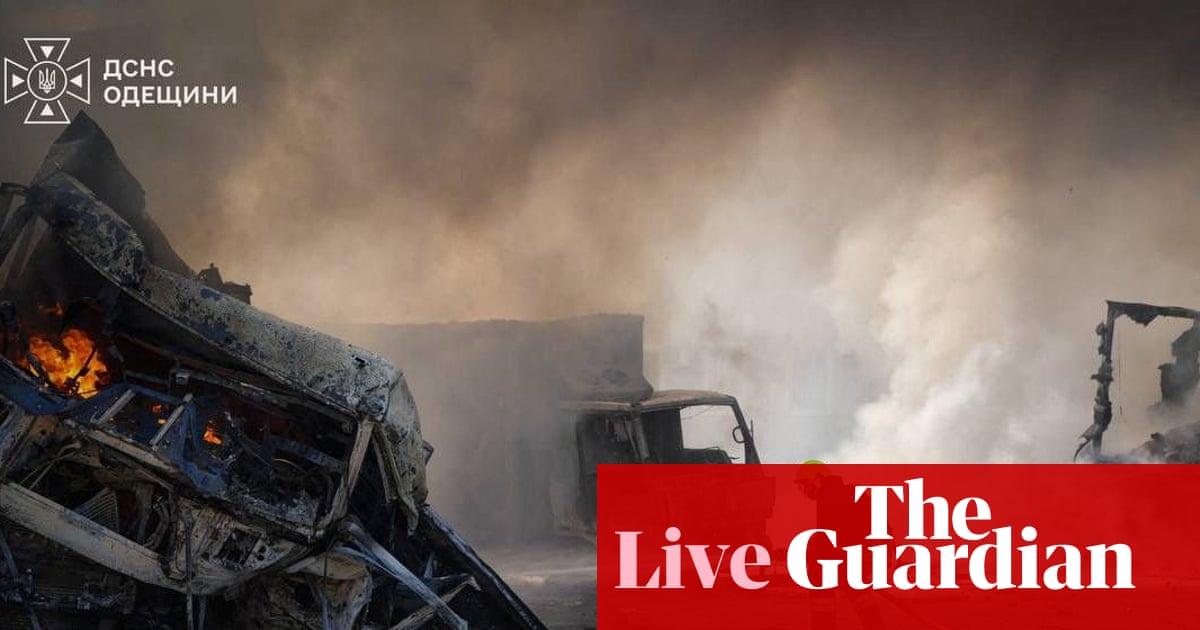
Russia launched a barrage of strikes on western Ukraine in the early hours of Sunday, hitting the engine of a passenger train near the border with Poland, according to Ukrainian Railways.
Ukrainian and Polish authorities said a separate drone attack caused two lorries to catch fire less than 1km (0.6 miles) from the Dorohusk-Yahodyn border crossing. There were no immediate reports of casualties.
Ukraine’s foreign minister, Andrii Sybiha, described the attack as Vladimir Putin’s “terror knocking directly on the doors of the EU and Nato”.
European leaders joined forces to highlight growing competition in the Arctic, where global warming is opening new shipping routes, governments are vying for vast natural resources and a Russian military buildup is heightening security concerns.
The leaders, mostly from Nordic and Baltic countries, put a spotlight on environmental challenges, economic opportunities and military vulnerabilities at a time of doubts about whether the United States, through Nato, will remain a bulwark against Russia.
“This region has become a geopolitical hotspot,” German chancellor Friedrich Merz told a joint news conference, insisting a new EU focus should complement Nato’s work. “Russia is building up its military capabilities here, and Russia uses its presence for hybrid activities every day.”
Prime minister Petteri Orpo of Finland, which hosted the meeting in the capital of Lapland that’s home to a Santa Claus village, noted “high demand for concrete EU action in the Arctic” and a changing security environment.
“The Arctic has emerged as the central arena of great power competition,” he said.
The two-day gathering that began Sunday comes after a Norwegian seizure of a Russian vessel earlier this month in the remote Arctic archipelago of Svalbard at the request of Ukraine.
Meanwhile, Sweden’s neighbour, Finland, has joined France’s initiative to extend the reach of its nuclear deterrent through collaboration with partner European countries, Reuters reported.
In response to US president Donald Trump’s expressions of concern about the US security commitment to Europe and to the security implications of the Ukraine war, France in March announced the Forward Nuclear Deterrence Initiative.
“The initiative is first and foremost about strengthening European security. It reinforces Europe’s responsibility for its own defence and helps prevent escalation,” Finland’s president Alexander Stubb said in a post on X.
Under the initiative, the French president alone has the authority to decide when nuclear weapons are used, in contrast to the North Atlantic Treaty Organization, which has a shared Nuclear Planning Group.
However, it offers joint exercises, the possible short-term deployment of nuclear-capable assets on allied territory and deeper consultation.
Finland’s defence minister Antti Häkkänen said in a separate statement that the agreement was a “natural step” after other Nordic countries, such as Norway, Sweden and Denmark, joined the initiative earlier in the year.
Jennifer Rankin in Brussels and Charlotte Higgins and Amy Hawkins in Kyiv
Catching up with other news from across Europe, the head of Nato has said a Russian drone attack on a train close to Ukraine’s border with Poland would not deter Kyiv’s western backers.
Mark Rutte said the strike on a passenger train showed how desperate Vladimir Putin had become.
“He thinks that he can stops us from supporting Ukraine and that he can undermine our unity. He is wrong. Our answer is to increase support,” the Nato general secretary said.
European leaders have condemned the strike in which a Russian drone hit a passenger train on Ukraine’s border with Poland on Sunday shortly after a convoy of high-level diplomats and former leaders had passed through.
The earlier train, which was carrying the former UK prime minister Boris Johnson and the former CIA chief David Petraeus and running ahead of schedule, may have been the target of the Russian drone strike, Ukrainian Railways has said.
Early signals are promising for the opposition bloc, as Social Democrats are seemingly encouraged by the Centre party’s openness to talk about the future government.
Foreign policy spokesperson Morgan Johansson said the party’s conditions on not letting fringes control the government (13:53) “sound very good.”
“It’s one of the pieces of the puzzle that needs to be in place to solve this,” he said, quoted by SVT.
“Everyone on this side wants to change the government. That’s the starting point,” he added.
But any formal talks are likely to start only after we know the official results later this week.
Nordic correspondent
Since the party was founded in 1988, the story of the far-right Sweden Democrats (SD) has been one of such continuous growth that a triumph in Sunday’s general election seemed inevitable.
In 2022, they capitalised on electoral gains – and the desperation of right-leaning parties to form a minority administration – and almost made their way into government.
A supporting role in prime minister Ulf Kristersson’s Tidö coalition earned the party, which has neo-Nazi roots, huge influence and mainstream acceptance by the political establishment.
This year’s election had been billed as final confirmation they were no longer pariahs but serious political heavyweights.
Early in the campaign, Kristersson announced that, if his coalition were to win, the SD would take key ministerial positions.
But Sunday’s results suggest the march of the far right into the heart of Sweden’s government has been halted – for now.
Having fallen from Sweden’s second biggest party to third place and, with the right-leaning parties unlikely to be able to form a coalition, the SD appear to have lost their route into government.
So, what has gone wrong for them?
The Centre Party is expected to play an important role in any post-election talks.
Although aligned with the opposition, the party made clear this morning that potential coalition partners – including Magdalena Andersson’s Social Democrats – “will need to see the big picture” and not let fringe powers dictate policy.
The party has long been critical of its potential future government partner in the Left Party, which feels emboldened by its strong election result and expected to demand a shift leftwards and its policies to be reflected by any future administration.
The projected result “shows the voters neither want to an economic turn leftwards, not a large role for the [far-right] Sweden Democrats,” party secretary Hannes Hervieu told SVT.
“There is no demand for fringe politics, but a desire for political stability,” he said, adding that the party would bring these points to the Social Democrats.
Curiously, prime minister Ulf Kristersson made similar noises last night about building an alternative majority around centre-right economic policies, but do not read too much into this: it’s still a very long way to go before that means anything more than just early post-election talk.
While the Social Democrats are understandably raring to take a crack at forming the next government, it’s easy to overlook that, despite coming out on top again, the party has actually lost ground since 2022 – recording its lowest vote share since universal suffrage was introduced in 1921.
With 95% of votes counted, the party sits at 28.1%, down more than two percentage points from 2022 (30.3%) and below its previous low of 28.3% in 2018.
Leader Magdalena Andersson was briefly asked about it last night, but waved these questions away, at least for now, as the focus is obviously elsewhere.
Still, worth noting.
But leading Social Democrats are not exactly impressed by Kristersson’s chill approach.
The party’s foreign policy spokesperson, Morgan Johansson, accused him to trying to “cling on” to power, saying it was an “unsightly” behaviour, Expressen reported.
“If [the governing coalition] Tidö no longer has a majority, he will probably have to face the consequences of that.”
But in a stark warning highlighting just how tricky the government formation process is likely to be, Kristersson also said that if all parties stick to their red lines, “Sweden will not have a government.”
It’s clear he has some appetite for exploring a different majority to the red bloc.
Perhaps we should all just channel the Swedish PM, Ulf Kristersson, who essentially said this morning he was “going to take it pretty easy” until the final results are in.
He says there are some conversations scheduled in the meantime – including with fellow coalition leaders this evening – but he essentially wants to see the final results show first.
He also repeats his last night’s suggestion of exploring alternative majorities in the parliament.
One possible option could involve the Centre party switching sides, but it’s not immediately obvious how Kristersson would get them to accept a government with the far-right Sweden Democrats with it.
Senior figures in the Social Democratic party are meeting this morning with party leader Magdalena Andersson to discuss next steps.
The party topped the polls – that is certain – and is most likely to have a first go at forming the next government, but it will have to navigate the complex and often openly contradictory demands of the left-leaning bloc.
It remains to be seen whether they can get the Left Party to work with the Centre Party in particular, given rumbles on both sides about the feasibility of such an alliance.
But today’s doorstep comments suggest there is no rush just yet: all parties will want to wait for the final results on Wednesday or Thursday before committing to exploratory talks.
Party secretary Tobias Baudin confirmed, however, that he has exchanged texts with colleagues in other parties, SVT reported.
Asked about potential differences, he told P1 that he was “completely convinced” the parties would give it out with some “give and take” for all involved.
Hej from Stockholm as the dust settles (a bit) after a hectic election night.
With 95% of votes counted overnight, the left-leaning opposition bloc – led by Magdalena Andersson’s Social Democrats – has widened its lead to three seats, leading 176 to 173 against the reigning centre-right coalition and their far-right partners in Sweden Democrats.
Formally, the result is not settled yet: there is only some 28,600 votes separating the two blocs, with 6% of the votes yet to be counted – and that includes some 200,000 votes expected to come and be counted only on Wednesday.
Still, the Swedish public broadcaster SVT said last night it was 90% confident that the opposition would clinch the victory, even accounting for all the votes yet to be counted.
There is plenty of time for early exploratory talks: the parliament won’t meet until 28 September, when its due to elect a new speaker, and any votes on who could be the next prime minister can only come after that.
But the process of forming the new government could take weeks if not months leaving Sweden in a state of political limbo at a time of unprecedented geopolitical uncertainty in Europe.
No doubt first text messages, frantic WhatsApp or Signals, and phone calls are already exchanged today.
I will be here to cover all this drama for you.
It’s Monday, 14 September 2026, it’s Jakub Krupa here, and this is Europe Live.
Good morning.
Disclaimer : This story is auto aggregated by a computer programme and has not been created or edited by DOWNTHENEWS. Publisher: theguardian.com