Immigration and German citizenship rules are some of the most important topics for foreign residents in Germany. Ahead of Sunday’s election in Berlin, we round up what political parties in the capital have to say about their immigration policies.
Voters in Berlin will head to the ballot box on Sunday to elect a new state parliament.
As The Local has been reporting, it’s a close race with the centre-right Christian Democratic Union (CDU) and the far-left Die Linke (The Left party) neck and neck in the polls. They are followed by the far-right Alternative for Germany (AfD), the Greens and the centre-left Social Democrats (SPD).
While we won’t know which coalitions are possible until after the election, polls indicate that the CDU and Die Linke will be hoping to head up the next government. One thing to keep in mind is that parties do not work with the AfD so it’s unlikely the far right will enter a state government in Berlin.
READ ALSO: What foreign residents need to know about Berlin’s upcoming election
State governments have limited powers when it comes to enforcing immigration and citizenship changes but it’s possible to get an idea of what they’re pushing for. This is where the larger parties stand.
Die Linke
Die Linke can be described as an immigration-friendly party.
In its election programme for Berlin, The Left states: “Berlin is and has always been shaped by various waves of immigration and displacement… This diversity makes Berlin a city worth living in and loving. As the Left, we defend this open and diverse society, as well as the right to flee and migrate.”
The party says it wants all Berliners to have equal rights “regardless of whether they were born here or have lived here for years or only a short time”.
It is aiming for a “fundamental shift in policy – towards global freedom of movement, equal rights for all and a society based on solidarity with migrants”.
The party also wants to make it possible for people without German citizenship to vote.
“We therefore intend to exhaust all legal avenues available under state law to grant all Berliners – regardless of their passport – the right to vote and to stand for election after no more than five years of residence in Germany,” the party programme states.
READ ALSO: Six smaller parties running in Berlin’s state elections
When it comes to citizenship, Die Linke wants to ease the rules.
“Naturalisation must be made accessible regardless of income and without the requirement of demeaning naturalisation or language tests.
“We will therefore utilise all available scope under state law, as well as provisions for exceptions and hardship cases, to facilitate more naturalisations and to ensure the state office for immigration operates with sensitivity to discrimination.”
Another interesting aspect in the programme: if The Left wins, it wants to push for a ‘city ID card’ (modelled on the NY City ID in New York and the Zurich ID) for all Berliners “in order to improve access to resources for undocumented people”.
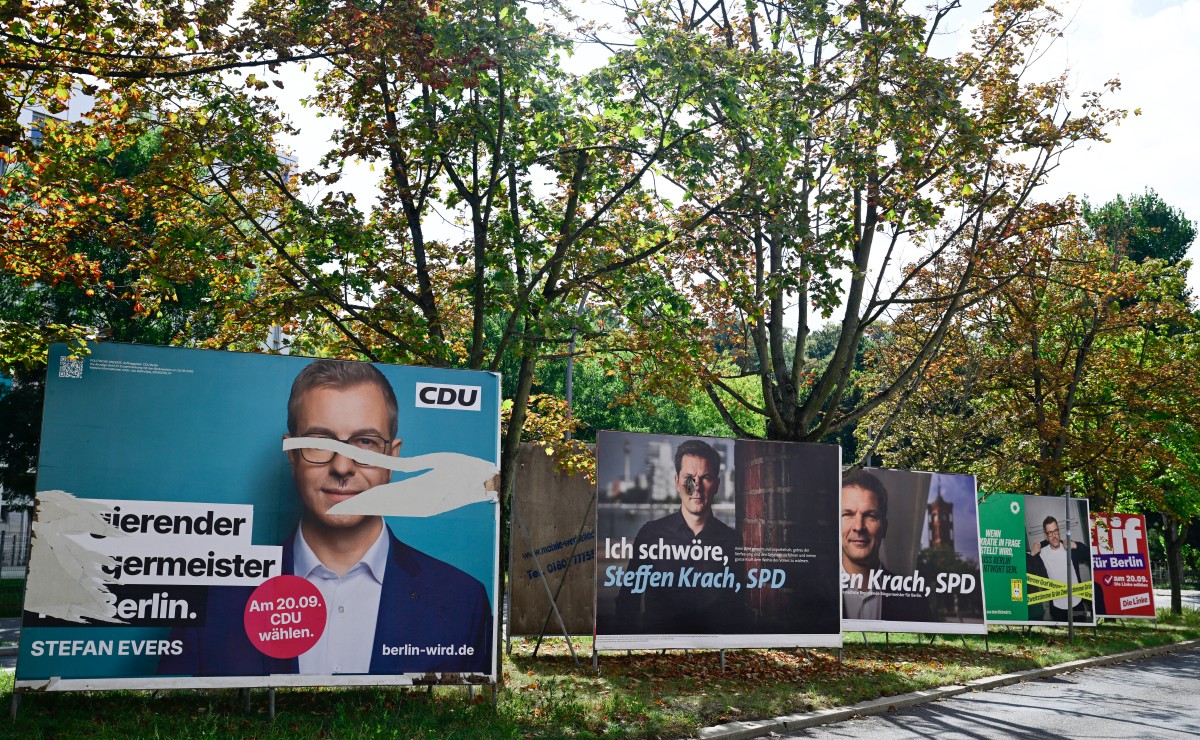
Election campaign posters for the upcoming Berlin state elections. (Photo by John MACDOUGALL / AFP)
CDU
As you might expect, the CDU takes a tougher approach to immigration matters.
Consistent with the party’s federal position, the CDU wants to see stricter controls on migration and asylum and a reduction in irregular migration. It also wants to enforce ordered deportations, particularly for offenders.
Integration is a key theme throughout the manifesto. The party programme states that it welcomes diversity in Berlin but adds: “Social cohesion does not happen by itself. It requires clear rules, mutual respect and an integration policy that opens up opportunities and demands responsibility.
“We want those who live in Berlin and Germany, whether permanently or for a few years, to integrate and become part of our society.
“This includes being open to our culture, respecting our legal system and values, and learning the German language.”
The party says it wants to expand German language courses at adult education centres (Volkshochschulen). “Anyone wishing to live and work in Berlin must demonstrate a willingness to learn German and actively integrate,” the CDU adds.
The CDU says it will support “international skilled workers, as well as Berlin-based companies and training providers” and it wants to speed up recognition of foreign qualifications.
Following the Canadian model, the CDU says it wants to introduce a mentoring programme where volunteers “support immigrants in their daily lives… and help them get settled”.
When it comes to naturalisation, the CDU in Berlin doesn’t share too much information but says: “Anyone wishing to become a German citizen must clearly commit to our country and its values.”
CHECKLIST: What do I need to apply for German citizenship?
Greens
The Greens’ programme has a strong focus on human rights across the board
The party wants Berlin to provide comprehensive rights and support to refugees from the moment they arrive, including access to housing, healthcare, education and work.
The Greens strongly oppose deportations to countries where people face serious risks and want deportations to be used only in exceptional circumstances.
The party states it wants to increase the number of skilled workers: “We want to specifically recruit international professionals and qualified graduates, particularly from the tech sector.”
They want to see procedures sped up and red tape cut to make skilled immigration easier. The Greens also argue that skilled workers should be able to come with their family.
The Greens want to transform Berlin’s immigration authority, the Landesamt für Einwanderung (LEA), into what they call a “welcoming authority”.
There isn’t much mention of citizenship in the Greens’ current manifesto but previously the party has supported making naturalisation easier.
SPD
The SPD says that Berlin “has always been a city shaped by immigration” and that this “defines who we are”.
To that end, the party promotes diversity, adding that it prioritises “openness, participation and integration”.
In its election programme it calls for refugees to be given opportunities to work. It also argues that people seeking protection should have access to integration opportunities as quickly as possible. It supports deportation of people who have no right to remain, particularly serious offenders.
The Social Democrats are in favour of expanding labour migration and speeding up recognition of foreign qualifications.
“Migration has made our economy strong,” the party states. “Now, the shortage of skilled workers is growing once again and our society is ageing. That is why we will continue to need labour migration in the future, and to this end we will significantly simplify and speed up the recognition of foreign qualifications.”
On the topic of citizenship, the SPD wants to encourage more people to apply to become German.
“We want all Berliners to have a say in democratic decision-making,” the party states.
The SPD in Berlin says it wants to reach out to people with a migrant background who qualify for citizenship but have not yet applied in a bid to “win them over to naturalisation, equal rights and democracy”.
AfD
As you would expect, the AfD takes the toughest stance on immigration and citizenship.
It opens this section of its programme with the line: “Germany is not a country of immigration.” The party wants to see significantly tightened policy around asylum seekers and refugees, stating it rejects “all forms of uncontrolled migration”.
In line with the party’s federal position, it calls for “remigration” – a controversial term used to describe mass deportations and in some far-right circles also refers to removals of “non-assimilated citizens”.
It calls for the “immediate deportation of all those required to leave the country – up to 20,000 people – from Berlin”.
READ ALSO: INTERVIEW – ‘Remigration could not be implemented by a state government’
On the topic of citizenship, the party takes an equally hard line.
The AfD wants “an immediate halt” to naturalisations and applications in Berlin while investigations take place into what it calls irregularities regarding falsified language and naturalisation tests. The party wants naturalisations to be reversed in cases found to be “unlawful or obtained through deception”.
READ ALSO: Just how widespread is the use of fake language certificates in Germany?
The AfD wants to see citizenship rules significantly tightened – particularly following the relaxation of naturalisation rules in 2024 – stating that: “German citizenship must not be given away.”
And the AfD is also very much against people holding more than one citizenship, saying that it promotes loyalty conflicts.
READ ALSO: Why is the AfD pushing for a harder citizenship test?