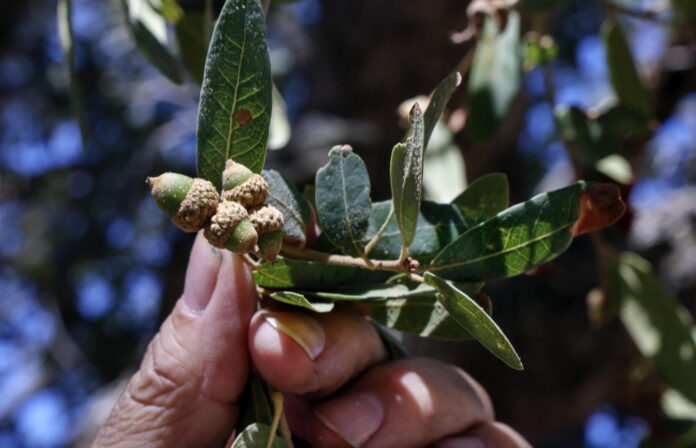
Ten thousand times, Jim Crouch has picked up an acorn. Ten thousand times, he’s planted that acorn. And 10,000 is about the number of oak seedlings he’s entrusted to the hands of people who pledged to care for the tree that has become his mission and obsession.
It began after he retired. For years, he’d been a classroom science teacher in suburban San Diego County, and now, with that chapter behind him, the trees have become his life. He hopes to meaningfully contribute to the regrowth of burned Altadena.

California has Thousand Oaks, Sherman Oaks, Oak Park, Fair Oaks, even Oakland. That’s just in English. Consider Encino, Encinitas and Paso Robles. They paint a picture of a California covered in oaks. But many regions have lost their oak canopy. Some trees succumbed to insects after being weakened by drought. Some were cut for developments, some were cut down illegally. Some oaks have been cut after fire.
Crouch witnessed this loss. He felt it. He took to collecting acorns — the seeds of oak trees. He planted them in deep pots. For the first eight years, he was a one-man operation working out of his backyard He began handing off the seedlings to others. Then many seedlings, to many others.
He began opening small nurseries, staffed by volunteers. He named his organization Re-Oak California after a group in the Bay Area with the same name. His motivation “started with climate, but then I learned you can’t do anything better for nature than protect the best keystone species.”
Englemann oak acorns at the Santa Ysabel Open Space Preserve.
(Sandy Huffaker / For the Los Angeles Times )
Oaks support a wide range of organisms, anchoring entire ecosystems, and also serve the vital task of storing carbon on a warming planet.
In a kind of treasure hunt, Crouch gathers all the acorns on private lands. He uses a hunting app to identify who owns which patch of remote land, then mails the property owner a letter asking for permission to gather.
A growing cadre of volunteers increasingly helps with the next step, the actual harvest, scooping acorns off the ground and into bags and buckets. That’s in part because Crouch is 75, and a bicycle accident has him using a cane. “My constant companion,” he says.
Recently, one volunteer leveled up Crouch’s game by making him a mapping app that includes not only the property ownership information but also tree locations from the app iNaturalist, layered together with research from Victoria Sork, a UCLA professor and dean of life sciences, who has studied oak trees for more than 30 years.
Sork’s lab, along with the Nature Conservancy, is sequencing oak DNA to identify which trees are best built to survive a hotter, drier California. The goal is to put those findings to work on the ground by planting acorns from trauma-affected trees that still survive. In other words, the toughest oaks could help produce the next generation.
It’s a strategy Sork hopes can make California’s forests more resilient to climate change — something she’s hoping Crouch can help her with. For Crouch, it’s a partnership he’s still a little starstruck about. He compares getting a call from Sork to being asked for shooting tips from NBA star Stephen Curry.
Sork sees the value in the partnership too.
“My best role is to generate knowledge and then partner with the people who are trying to get things going,” she says. Crouch, she adds, is one of the keys to getting her research “out from the ivory tower to the practitioners.”
On a recent Tuesday, Crouch steered his 2011 Nissan Frontier from his home in Escondido up to La Cañada High School off the 210 Freeway. This is where Re-Oak is opening its first nursery in the Los Angeles area, intended to serve hard-hit Altadena. It will be the group’s sixth, on Oak Grove Drive.
“It’s a bit of a challenge because I can’t be there every day, you know?” Crouch says. But “Altadena needs more trees, [and] we’ll give them whatever they need.” The new La Cañada nursery is going up in the high school’s garden: a crescent-shaped plot between the track and field and tennis courts, carpeted with mulch and sectioned off with native plants, annuals and edibles. It was started three years ago by English teacher Daryl Bilandzija, a former student of Crouch’s who saw that handing over the plot to his old teacher would mean learning for his students. “If we could get them to put a couple of acorns in the ground wherever they go, it could start to have an effect on the local environment,” Bilandzija said. “And before you know it, you’ve re-oaked a neighborhood.”
Some Altadena trees survived the 2025 fire there, yet those that remain are more vulnerable because of the overall loss of what arborists call “friction” that helped them weather storms as a group. More trees are vital to the overall health of the remaining population in Altadena. This nursery joins several other tree efforts in the community.
Altadena Green estimates that west Altadena lost roughly 70% of its tree canopy in the Eaton fire, and the losses haven’t stopped, with developers and homeowners continuing to clear what’s left.

Wayne Ortega, who works with Jim Crouch, looks over Englemann Oak acorns at the Santa Ysabel Open Space Preserve.
(Sandy Huffaker/for The Los Angeles Times)
A mother-daughter team called the Los Angeles Humane Society had given away more than 1,000 coast live oaks in Altadena and Santa Monica by the end of last year. The Los Angeles County Fire Department Forestry Division also has been offering free oaks, in addition to other native plants, at its two nurseries in San Dimas and Malibu for years.
In addition to the La Cañada High School nursery, Crouch is establishing a smaller one in Santa Clarita. It will be staffed by 20-year-old Anderson Khalil, who found Crouch the way most young volunteers do now: social media.
“I just saw him on Facebook giving away free oak trees, and here we are,” Khalil said.
He had been searching for a tangible way to help the environment and allay his anxieties about the planet’s future when he came across Crouch’s posts.
“I can’t speak so much for the rest of my generation because I have a few close friends and they’re all pretty aware,” he explained, “but we have to care more about the environment if we want to keep living the way we are living.”
Re-Oak California has an eighth nursery planned for Irvine, its first outpost in Orange County.
The oaks they give away are about 6 inches tall with six leaves, plus a whole foot of roots. Oaks are considered neither fast nor slow growing. A homeowner planting one today might wait more than a decade to sit in its shade.
But it’s a wait advocates say is well worth it, one that will prove that a community, Altadena or elsewhere, can rebuild its canopy if it’s willing to invest now.
His reliance on the cane has slowed him down, so Crouch has shifted roles, from field hand to recruiter, operating mainly as the guy behind the keyboard, lining up volunteers to plant, scout, harvest and build the next nursery. He is working, with a volunteer’s help, to formalize Re-Oak California as a nonprofit.
The costs of the pots, racks and soil are nominal individually but add up fast at the scale he now operates. For 10 years he’s covered the gap himself, supplemented by donations and buoyed by a 2025 segment on CBS 8 San Diego that brought in $12,000. Re-Oak California needs donated acorns, volunteer planters and propagators, and money — especially if Crouch is to reach his dream goal of planting 20,000 trees a year.
“I’ve never been so ambitious,” he says, “and I’ve never done a project with as much love in it and as little ego.”
He’s betting that as more people understand what’s at stake, they will keep showing up — even if they are planting trees for a future he’ll never see.
More to Read
Disclaimer : This story is auto aggregated by a computer programme and has not been created or edited by DOWNTHENEWS. Publisher: latimes.com