There is something slightly counterintuitive about selling comfort: the thing you are promised may not feel comfortable at first.
That is part of the Birkenstock story. For a brand whose footbed has become synonymous with comfort, the first experience can be surprisingly unfamiliar. Its cork and latex construction is designed to gradually mould to the wearer’s foot, so what eventually feels natural may initially require some patience.
Yet that learning curve has not stopped people from coming back.
A customer tries one pair, gets accustomed to the distinctive footbed and often returns for another. Around them, friends, colleagues and family members notice the shoes, ask about them and eventually try a pair themselves. The brand’s growth has, in part, followed this simple route: one wearer introducing another.
At Birkenstock’s new store in Banjara Hills, Hyderabad, that familiarity is everywhere. Arizona, Gizeh, Madrid, Boston, Mayari and Florida form the core of a product vocabulary that has remained recognisable for decades. Look closer, however, and the familiar starts to shift.
The Autumn/Winter assortment brings new colours, textures and finishes to established shapes. Animal-inspired surfaces, metallic treatments and embellishments give classic silhouettes a different character. The idea is not to replace the shape but to reinterpret it.
That is where Birkenstock’s fashion story gets interesting. While seasonal fashion often depends on constantly changing silhouettes, Birkenstock has built much of its identity around shapes that are instantly recognisable. The variation comes through what is placed on those shapes: colour, material, finish and, increasingly, collaborations.
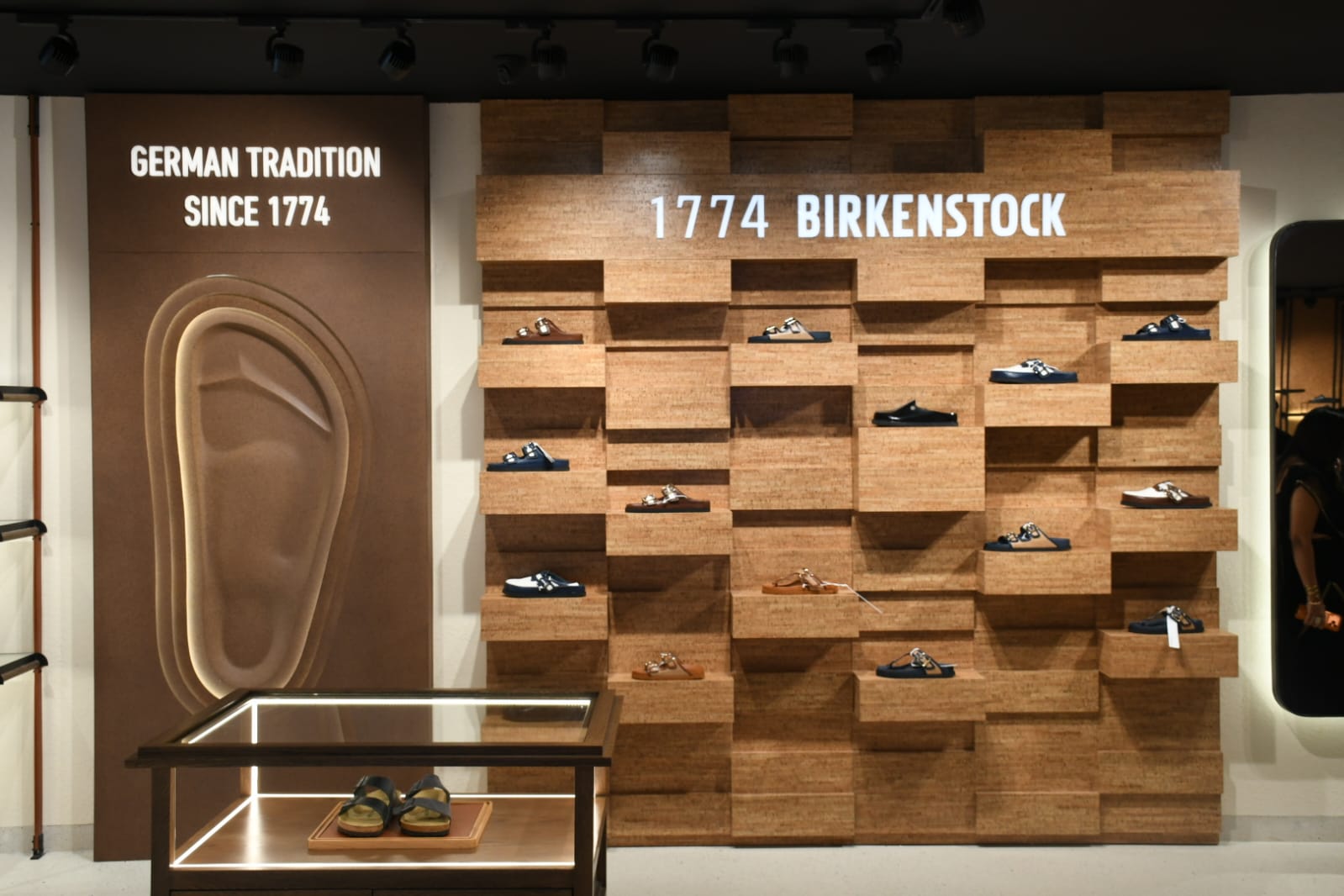
The 3,216 sq ft Banjara Hills store puts that approach on display. Alongside the core collections is the 1774 range, the brand’s more design-led line featuring collaborations and reinterpretations of familiar forms. It is the first Birkenstock store in Hyderabad to feature a 1774 display.
For one customer, the attraction may still be straightforwardly practical. For another, it could be a particular colour or finish. Someone else may arrive because they have seen a pair on a friend.
That last route is particularly important to the brand. Birkenstock’s appeal often travels through personal recommendations rather than a traditional fashion-to-consumer pipeline. Someone notices a pair, hears about the comfort, tries one and potentially becomes the person recommending it to someone else. It is a particularly effective cycle for a product that can take some getting used to.
The brand’s original proposition was functional: its footbed was developed around supporting the foot and encouraging a more natural walking experience. That principle remains central even as the visual language has expanded.
The new store reflects that evolution. Alongside the footwear are elements of personalisation, including charms and customisable details, allowing customers to put their own stamp on otherwise familiar products.
It is a small but telling shift. The Birkenstock silhouette is no longer simply something to recognise. It can also be something to personalise, collect or reinterpret.
That helps explain the brand’s ability to appeal to both longtime wearers and first-time shoppers. The former know what the footbed feels like. The latter are discovering a product that sits somewhere between functional footwear and fashion object.
The Banjara Hills opening, then, is not simply another address for a familiar brand. It shows how Birkenstock is extending an established product language without abandoning what made it distinctive in the first place.
The footbed remains the constant. The shapes remain recognisable. The reasons for choosing them keep changing.
Disclaimer : This story is auto aggregated by a computer programme and has not been created or edited by DOWNTHENEWS. Publisher: deccanchronicle.com