
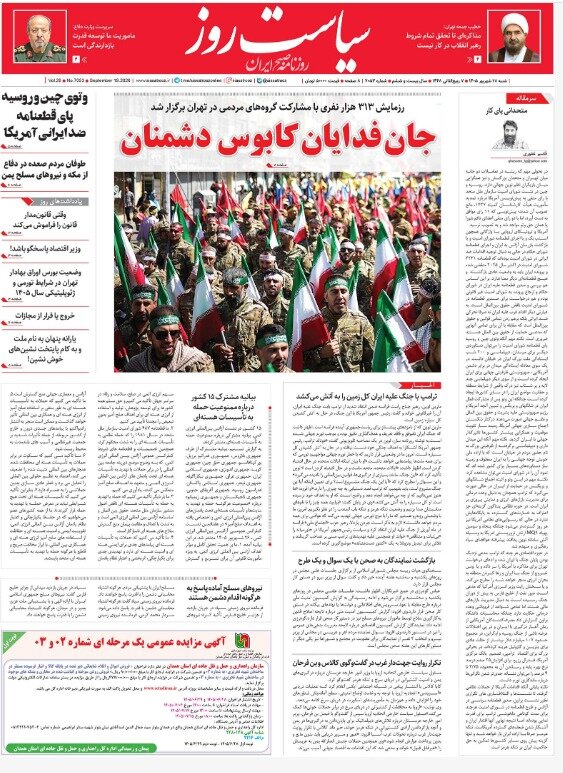
Siasat-e-Rooz examined the meeting of senior military commanders from the United States, Israel, and several Arab countries in Germany, writing that Arab states are currently facing a major crisis: the collapse of their security-building strategy based on US presence and, in some cases, normalization with Israel.
This reality became clear not only during the Ramadan War but also in recent developments in Yemen. Although these states have previously formed coalitions with the US, making this nothing new, the key point is that the Berlin meeting will ultimately not change regional equations. Such a gathering will neither improve regional security nor reduce tensions; instead, it will intensify them and further contribute to the tightening of the Strait of Hormuz. Arab countries that rejected the Oman meeting cannot now expect the Berlin meeting to force Iran to surrender or reopen the Strait of Hormuz. Therefore, before becoming trapped in a difficult situation, they should abandon the illusion of an American security umbrella and take steps toward localized security alongside Iran.
Shargh: Why has China entered the Hormuz file?
Shargh evaluated the importance of the Strait of Hormuz for China. Chinese Foreign Minister Wang Yi considers reopening the Strait of Hormuz essential for stabilizing energy transport and preventing the crisis from spreading to Yemen and the Red Sea. Beijing’s motivation is not merely political. China has long been the largest buyer of Iranian oil, and any disruption in Persian Gulf energy exports directly affects its economy. Thus, when Wang Yi speaks about reopening Hormuz, there is a clear economic and security concern behind his position. Attacks on Saudi energy infrastructure and pressure on the Bab al-Mandab route have expanded the crisis from a single strait to a network of vital energy corridors. As a result, Beijing can no longer treat Hormuz as merely an Iran–US issue; each day of continued crisis makes the energy and trade implications more serious for China.
Hamshahri: The map of Middle East trade routes
Hamshahri wrote that disruptions in shipping caused by the Iran–US war have pushed Middle East countries toward roads, railways, pipelines, and even new fiber‑optic routes, reshaping the region’s trade map. The war has challenged the region’s historic dependence on maritime routes. Disruptions in ship traffic through Hormuz have ushered in a new phase of regional trade—one in which roads, railways, land borders, pipelines, and even alternative sea routes have become core elements of economic security. At the same time, recent events—such as the attack on Saudi Arabia’s East–West pipeline—show that even alternative oil routes are not immune to war. Thus, the issue is not simply replacing Hormuz; the conflict is exposing the vulnerability of an entire chain of regional corridors. The new transformation in the Middle East is therefore not just the revival of land routes but a simultaneous competition and reconfiguration among multiple trade and energy corridors.
Sazandegi: The JCPOA is still alive
Sazandegi analyzed Thursday night’s event at the UN Security Council, where China and Russia vetoed the US draft resolution against Iran. The incident shows the JCPOA can still influence Iran’s legal and political dynamics. Russia and China vetoed the US resolution to extend the mandate of the Iran sanctions expert panel by citing the very clause in the JCPOA and Resolution 2231 that outlines the termination of Iran’s file at the Security Council. For this reason, the Islamabad understanding should be taken more seriously, and efforts should be made to implement it. The issue is not merely the text of an Iran–US understanding; it is about creating a pathway for resolving disputes—especially given that both countries have experienced the costly consequences of withdrawing from agreements and returning to confrontation. The veto by Russia and China once again revealed the divide among permanent Security Council members over the legacy of the 2015 nuclear deal.
Farhikhtegan: Why BRICS matters for Iran
The composition of BRICS shows clearly that it is not a unified bloc. Russia, facing Western sanctions, has adopted firmer positions toward the West. China seeks to avoid confrontation, and India does not want BRICS to be defined as anti‑Western. Nevertheless, a large portion of Iran’s economy depends on interactions with BRICS members. China, the UAE, India, Brazil, and Russia are among Iran’s main partners—and all are BRICS members. Emphasizing national currencies and creating alternatives to SWIFT can reduce much of the impact of unilateral sanctions. Beyond economics, the West has tried for at least two decades to isolate Iran diplomatically, but BRICS membership has undermined that strategy. Another reason BRICS is important is its ability to prevent anti‑Iran statements: since Iran is a member and final communiqués require unanimous approval, no anti‑Iran statement will be issued within BRICS.
Disclaimer : This story is auto aggregated by a computer programme and has not been created or edited by DOWNTHENEWS. Publisher: tehrantimes.com








