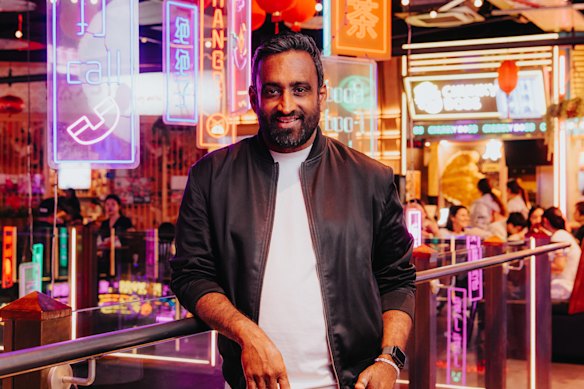

The state’s 24-hour economy commissioner has made nine overseas trips investigating nightlife abroad since February 2024, with his role and these expenses now under parliamentary scrutiny amid wider cuts across the arts sector.
Madrid, London, Hong Kong, Beijing, Amsterdam, Singapore, Barcelona and San Francisco are among the cities NSW 24-Hour Commissioner Michael Rodrigues has visited, staying in boutique hotels and flying premium economy or business class.
Logged expenditure, accessed via a standing order and obtained by this masthead, reveals Rodrigues travelled between Europe, the US and Asia multiple times over the two years, meeting with overseas counterparts and attending multiple venues and networking events.
Critics have blasted Rodrigues’ trips, noting they were undertaken as the 62-year-old Australian Design Centre was forced to close due to a lack of government funding, and a parliamentary inquiry found that the push to revive Sydney’s night-time reputation has come at direct cost to the state’s arts and culture sectors.
Details of the commissioner’s travel spending have emerged following this masthead’s reporting on a pre-operational spending spree at the billion-dollar Powerhouse Parramatta. The Powerhouse and the Office of the 24-Hour Economy Commissioner are in NSW Arts and Night-time Economy Minister John Graham’s remit.
Rodrigues was appointed to the newly established role in 2021 as the state’s first 24-hour economy commissioner to improve Sydney’s night-time economy. A spokesperson for the NSW Department of Creative Industries said his role included raising Sydney and NSW’s international profiles, strengthening our reputation as a vibrant global destination, and attracting investment and tourism.
Graham said the commissioner’s overseas travel helped restore Sydney’s reputation among global “thought leaders” at some of the most “influential policy forums”.
“An important part of the commissioner’s work has involved rebuilding our reputation overseas after the lockout era damaged the global reputation of Sydney,” Graham said.
On a three-day trip to Barcelona in January and February 2025, Rodrigues met his Spanish night-time commissioner counterpart for “both cities to exchange insights and share experiences in addressing challenges associated with nighttime governance”.
Rodrigues spent the first day in the Spanish city with Barcelona-based Venezuelan night-time governance consultant Andreina Seijas and went to a private event featuring Italian artist Davide Quayola. This was followed by dinner at Xeixa, a restaurant specialising in Catalan cuisine inside a former brothel that inspired one of Picasso’s works, then the historic Dr Stravinsky cocktail bar.
The second Barcelona day’s morning involved informal and formal discussions with the city’s night office, followed by lunch at the city’s oldest restaurant, Can Culleretes. Rodrigues then took an “institutional photograph” that included Graham, who paid for his own trip while on work leave.
Next, the commissioner visited Barcelona’s beachfront clubs and bars with other representatives, later explored the historic theatre district, including three venues (Sala Apolo, El Molino and La Paloma), had dinner to discuss the “challenges and opportunities in the local scene”, and ended the day with a club visit to Razzmatazz.
Here, Rodrigues stayed until 1am to observe “its transition from a concert venue to a mega-club” as well as review its “weekend operational strategy … [and how] neighbouring venues and local police manage safety in response to rising noise complaints”, according to a document titled “lessons learned” following the trip.
The commissioner’s third and final day in Barcelona began at historic Catalan cafe Els Quatre Gats, where Picasso held his first-ever solo exhibition before heading to the Time Out Market. Rodrigues capped off the day by walking along the Consell de Cent Superblock and visiting three bars, including Sips, which was ranked third in the world at the time.
Some of Rodrigues’ learnings from Barcelona included comparing each city’s Olympic legacy, the need for Sydney to adopt a decentralised approach, and the importance of public-private collaboration and nocturnal heritage.
“During the 19th century, the people of Barcelona began experiencing the proliferation of new forms of life, leisure and social interaction, laying the foundation for its night-time economy,” his reflections noted.
“Establishments such as Bar Marsella (est. 1820), Els Quatre Gats (est. 1896) and London Bar (est. 1910) have historically served as meeting points for intellectuals, artists, workers and unionists, with frequent visitors including Picasso, Dali and Ernest Hemingway.
“The tangible and intangible value of these establishments highlights the importance of implementing mechanisms to protect them from disappearing and to preserve their cultural significance.”
In a statement to this masthead, Rodrigues said his travelling was part of “international engagement, [which] is an important part of ensuring NSW remains competitive globally”.
“My focus is ensuring that all international engagement delivers value for NSW businesses and communities and continues to drive the growth and success of the 24-hour economy in our state,” he said.
NSW Greens MP Cate Faehrmann said she made the travel inquiries following industry concern that the 24-hour economy commissioner had a significant and growing budget, at a time of cuts in other areas of the arts budget, with “not a lot to show for it”.
“It must be particularly galling for struggling artists and musos to see money that is supposed to be revitalising this state’s arts and cultural sectors being spent on business-class flights and posh hotels,” Faehrmann said.
“The closing of the Australian Design Centre should never have been allowed to happen on this government’s watch, but clearly its priorities lie elsewhere.”
Rodrigues’ Barcelona trip, where he stayed at four-star hotel Casa Bonay for about $350 a night, was part of a larger trip to Europe that included London, Amsterdam and Birmingham. That trip alone cost roughly $10,000 in flights and accommodation.
He stayed at the $500-a-night Hoxton Shoreditch in London, the $600-a-night Hotel V Nesplein in Amsterdam and the more budget-friendly Hyatt Regency in Birmingham, which is about $200 per night.
In March, when the commissioner travelled to China and Hong Kong for a NSW Creative Industries multi-day event, he flew from Sydney in business class and premium economy. Meanwhile, Amelia Rowe, a screen investment manager at Screen NSW, flew premium economy to the same event.
All up, the commissioner’s travel from February 2024 until March 2026 exceeds $80,000, including flights, accommodation, meals and incidentals.
But the 24-Hour Office said Rodrigues’ most expensive trip was funded by non-profit organisation Aspen Institute, costing roughly $16,800 for a trip to Madrid in April 2026 to speak at Bloomberg’s CityLab conference on urban planning ideas.
Meanwhile, Singapore’s National Development Office covered the commissioner’s accommodation and transport between the hotel and airport for the World Cities Summit in June 2026.
Rodrigues’ travel expenses to San Francisco in October 2025 to attend the World Economic Forum are yet to be formally reported.
“All other travel has been funded in accordance with existing departmental travel and financial policies,” a spokesperson for the Department of Creative Industries, Tourism, Hospitality and Sport, which houses the 24-Hour Office, said.
During budget estimates in August, committee chair Faehrmann asked Rodrigues about the travel.
“I was invited to speak in the UK and I took that opportunity to go to Barcelona, partly because it’s one of the comparable cities that the Committee for Sydney had identified that we should look at,” he said.
“Temperate environment, coastal, as opposed to other international cities that we sometimes draw comparison to.”
In his statement, Rodrigues said international travel was part of the government’s 24-Hour Economy Strategy.
“The 24-hour economy … [is] a growing, $110 billion sector that supports more than 1.27 million jobs across NSW,” he said.
“Increasingly, NSW is being asked to share our industry-leading expertise on precinct management, cultural activation and night-time economy policy with other jurisdictions in Australia and overseas, establishing NSW’s reputation as a tourism destination of first choice.”
Start the day with a summary of the day’s most important and interesting stories, analysis and insights. Sign up for our Morning Edition newsletter.
 Kayla Olaya is a culture reporter at The Sydney Morning Herald.Connect via email.
From our partners
Disclaimer : This story is auto aggregated by a computer programme and has not been created or edited by DOWNTHENEWS. Publisher: www.smh.com.au