
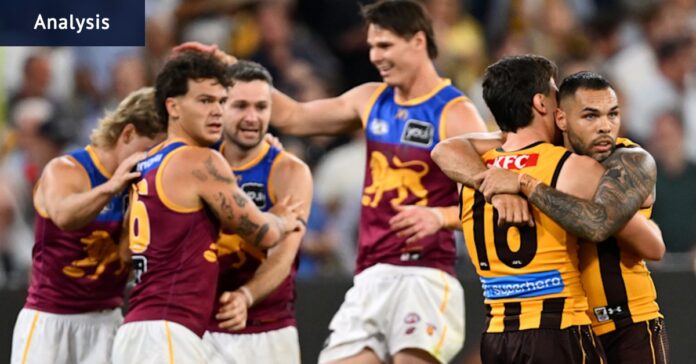
The skills of the players in this intense, classic preliminary final between Hawthorn and the Brisbane Lions were the real highlight but when three free kicks are paid in the final 61 seconds and the lead changes those umpiring decisions will be examined and reviewed in fine detail.
Football writers Peter Ryan, Marc McGowan and former AFL grand final umpire “Razor” Ray Chamberlain took a close look at the final three free kicks to the Brisbane Lions and whether they were justified.
1. Lewis shows insufficient intent (62 seconds remaining)
Peter Ryan says: The only query is whether a free kick would be paid in the first minute of a game, but beyond that, there is no doubt it was a free kick. The AFL clarified the rule after round two this season in a memo to clubs, which basically said a token effort to touch the ball before it went out of bounds would be insufficient intent. Mitch Lewis would have got away with it if he’d either grabbed the ball and momentum took him out or made a genuine attempt to keep the ball in play (which is difficult as he would have risked missing the ball). It’s a fair call. And remember Lewis hardly fumbled all match. His response to the decision was very professional.
Marc McGowan says: Lewis wasn’t trying to keep the ball in play. AFL headquarters made it clear early in the season that simply attempting to touch the ball to avoid a “lasso” free kick would no longer suffice, so as harsh as this seems, the umpire made the correct call.
Ray Chamberlain says: The action of Lewis is all that matters when it comes to insufficient intent, but for context, Jack Ginnivan kicks an end-over-end grubber along the boundary line. If it goes out of bounds without being touched it is a last-disposal free kick. Lewis has to show sufficient intent to keep the ball in play. Has the Lewis’ action demonstrated sufficient intent to keep the ball in play? No. The umpire made the correct call.
2. Zorko cops high contact (53 seconds remaining)
Peter Ryan says: Tiggy touch wood, but high contact was made and many of those are paid or not paid during a season depending on what the umpire sees. Josh Weddle’s arms made contact with Dayne Zorko above the shoulder, so it is a free kick.
Marc McGowan says: Glancing blow or not, it is crystal clear that Josh Weddle made high contact to Dayne Zorko while coming from the opposite direction as the veteran Lion spun around. Would there be any controversy if Zorko had done this to Weddle?
Ray Chamberlain says: There is certainly high contact. He is not decapitated by any stretch, but you can’t make high contact. He has flicked him across the face. It is going to get paid.
Impey caught holding the ball
Peter Ryan says: Great decision by the umpire. When Jarman Impey takes possession of the ball, he has both arms free momentarily. It gives him a second where he could have handballed or kicked the ball, but he decided to do neither. Hugh McCluggage’s tackle was outstanding for the situation. After holding Impey for about a second around the waist, he then latched on to his hand, so the Hawks’ defender couldn’t handball either, making kicking Impey’s only option. The Hawk just froze and hoped the umpire would not be brave enough to pay holding the ball. Four seconds lapsed between taking possession and the decision being made.
Marc McGowan says: Hugh McCluggage was brilliant, and Jarman Impey was not. The umpire was equally good. You can also effectively forget whether Impey had an initial opportunity with both arms available. McCluggage executed a tackle as players are taught – pin one arm, and remove half the options. In this scenario, Impey needed to be saved by a third party instantly coming in, or he had to attempt to get a kick away far earlier than he did. The risk was he would drop the ball and not get a foot to it, but Impey’s feigned efforts to dispose the ball were never going to be enough. Brave call, and right call.
Ray Chamberlain says: The law has to line up before any decision is made with the umpire correctly assessing there was no prior opportunity, a legal tackle had been laid and the ball had not been pinned. But then there is what I call “a cadence piece” which is a question of how long do you give the player [to dispose of the ball]. If it is pinned and he can’t dispose of the ball or he is unable to make a genuine attempt, then you can call for a ball up, but if not, as is the case here, then it is free kick against Impey for holding the ball. Bravo to the umpire.
And for the record …
Not only were all three free kicks above the correct decisions, but Hawthorn were fortunate with non-calls on the Jacks, Ginnivan and Gunston, in the dying minutes.
Mitch Lewis’ forward-50 hanger with three-and-a-half minutes to go, which would have gone down in club folklore if they won, followed Gunston shoving Harris Andrews in the back, forcefully enough that he could not contest the ball.
The other damning factor? Gunston’s arms were extended as he did it, so he was lucky not to cost Lewis his brilliant mark.
There was another with about two-and-a-half minutes left.
After Harry Morrison’s shocking turnover to Zac Bailey, which was a clear mark, Ginnivan wrenched the ball off Bailey then handballed over his head.
The umpire showed leniency to the Hawk and did not pay a 50-metre penalty.
Get around our AFL finals coverage
Keep up to date with the best AFL coverage in the country. Sign up for the Real Footy newsletter.
From our partners
Disclaimer : This story is auto aggregated by a computer programme and has not been created or edited by DOWNTHENEWS. Publisher: www.smh.com.au








