THEATRE
Luke ★★★★
Red Stitch, until October 11
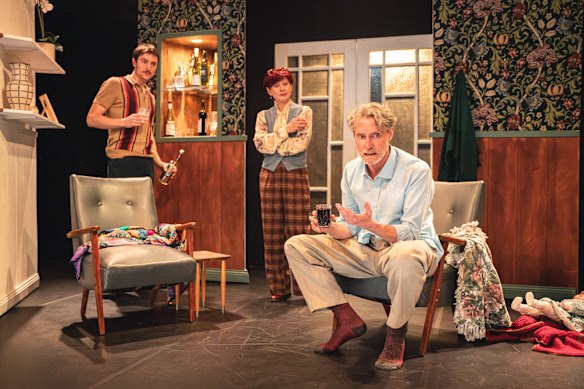
Local playwright Angus Cameron has teamed up with Red Stitch for the world premiere of Luke – a disturbing, emotionally complex three-hander that weaves a provocative play of ideas into a psychological mystery of troubling currency.
I was bewildered by the opening sequence. Two adults race across a living room playing dress-ups. They’re engaged in some kind of private game, based on the Bolshevik assassination of the Romanovs during the Russian Revolution, but something about the scene feels off, inauthentic somehow.
A clever reason for this will remain an enigma until well after we discover that the pair are high school teachers in country Victoria.
It’s 2007, and Damon (Dion Mills) and Olena (Olga Makeeva) are unwinding at term’s end after a gruelling night of parent-teacher interviews. When Chris (Will Lonsdale) – the school’s 19-year-old rowing coach and a former student of Damon’s – joins them, the games continue.
Some of the playfulness is literary or historical – a relic of the ludic flamboyance essential to Damon’s pedagogic style. He’s an inspiring educator, discreetly gay, and his mentor-like relationship with Chris, who came out to Damon as a student, is tinged by affection and by a body of queer knowledge excluded by the official (read heteronormative) education system.
When conversation turns to a never-seen character, Luke – a year 11 student leaving the school after inappropriate attention from a member of staff – the game mutates through a series of twists, with a possible child sex abuse scenario, and its consequences, playing out over decades. Iain Sinclair’s direction guides three excellent performances.
Mills’ suspect teacher has the charisma, passion, idealism, and sheer eccentricity of a gifted educator. There’s no question he leaves a mark on his students: his scenes with Lonsdale’s Chris are tender and haunted – enlivened by the irrepressible joy they both take in the learning game, as well as the shadow of barely repressed desire.
Olena is the fulcrum of the play, and Makeeva is riveting as, through veiled parable and a clipped and embittered realism, the character weighs the truth of a situation in which the righteousness of her own acts is called into question.
She is a staunch counter to Chris – a young man heavily invested in his own righteousness, and solipsistic in the performance of it.
Luke tackles such uncomfortable subjects as the erotics of education and the ethics of making art from life. It has stern things to say about the cultural amnesia afflicting Australian literature and drama, and it brings child protection concerns into contact with the reality of homophobia, knowing the ancient slur – the one that equates homosexuality with paedophilia – has never quite ceased to echo.
Yet this haunting play celebrates, too, the solidarity and strangeness of found family, the clandestine solidarity and the mentorship relations that can exist between queer men finding their tribe.
In this, it has an artistic genealogy that can be traced back to some of the most fearless and unsettling voices in queer Australian literature – the implied pederasty in David Malouf’s short story Under Southern Skies, say, or Frank Moorhouse’s The Everlasting Secret Family – updating the issues to a world of changing mores in which progressive rhetoric can disguise more difficult and painful human truths.
Reviewed by Cameron Woodhead
THEATRE
The Homecoming ★★★★
Athenaeum Theatre, until October 3
The lights come up to reveal two characters in a living room and it doesn’t take long for the sense that something is off-kilter to take hold. A pugnacious aged patriarch and ex-butcher Max (Richard Piper) blathers on in an unpunctuated stream of consciousness to the uninterested Lenny (Ben Geurens) – we don’t find out the two are family until Max admonishes the louche Lenny for speaking such to his “lousy filthy father”. The barely concealed hostilities are extended to the diametrically gentle Sam (David Field), Max’s chauffeur brother and the hulking wannabe boxer Joey (Eddie Orton), Lenny’s younger brother.
No one and nothing are quite as they seem in Harold Pinter’s 1965 comedy of menace The Homecoming, even once you account for the virulent sexism, barely concealed hatred, and dearth of familial love between these characters.
The intrigue deepens when all four of them retire to bed and the taciturn Teddy (Peter Houghton) enters the house, accompanied by his enigmatic wife Ruth (Kate Kendall). Teddy has effectively been estranged from his family for six years and now resides in America, with neither his wife nor family acquainted with one another. A series of decidedly strange interactions between all characters leave audiences none the wiser as to what is about to unfold in this claustrophobic domestic setting.
Under the direction of Greg Carroll, a slowly creeping sense of foreboding and listlessness overtakes the play, only strengthening its visor grip on the audience as it unfolds. The world Pinter has ensconced these characters in exists in and of itself, ungoverned by the moral sensibilities and social mores of the now, let alone that of the 1960s when this play first premiered in London.
Absurdist and fantastical despite its realist underpinnings, The Homecoming lulls its audience into an illusion of normalcy. When social contracts are broken with seemingly no repercussions, the play’s (and our) grasp on reality loosens – shining an uncomfortable spotlight on the confronting misogyny on display, calling into rebuke the meaning of the familial ties traditionally held so dear, and questioning the unspoken rules that allow society to function as it does. The famed Pinter Pause allows the requisite space for these consternations to fester.
A muscular black room is the fitting backdrop for the exertion of these men’s fragile, toxic masculinities, while Amelia Carroll and Margaret Goy’s costume design is a stunning cloak of civility that masks the innermost depravations of these characters. Clad in a babydoll dress throughout, Ruth is read as childlike and guileless – a misnomer that allows her to exert the full force of her feminine wiliness.
The strength of a production like The Homecoming lives and dies by its ensemble cast, and this one is uniformly excellent. Kendall is a particular highlight as the otherworldly, cosmically unflappable Ruth, simultaneously an antidote against the testosterone-soaked aggression of the men around her and the sun around which their neediness, desperation and contemptibility orbit.
Reviewed by Sonia Nair
MUSIC
Handel and Bach ★★★★
Melbourne Symphony Orchestra, Melbourne Recital Centre, September 19
Many Melbourne concertgoers will remember the stylish flair with which Australian fortepianist Kristian Bezuidenhout performed the complete Beethoven piano concertos with the Freiburg Baroque Orchestra on the cusp of COVID.
Returning with some of that flair, Bezuidenhout directed the Melbourne Symphony Orchestra from the harpsichord in this program of works by Bach and Handel.
Focusing particularly on rhythm and dynamics, Bezuidenhout brought crisp grandiloquence to the many French-style introductions on the program, whether to Bach’s Orchestral Suite No. 1 in C major or the Overture to Handel’s Admeto. There was also a general rhythmic buoyancy which lent itself well both to the dance-infused Bach Suite and Suites Nos. 1 and 2 from Handel’s familiar Water Music.
Carefully shaped dynamics applied to the whole orchestra made sense of the rise and fall of phrases and provided some well-judged dramatic contrasts.
Despite overall clarity, it was in Bezuidenhout’s arrangement of Bach’s incomplete Contrapunctus XIV from The Art of Fugue that the listener might have longed for some more granular detail in terms of articulation and pliability of tone in individual lines. Such qualities were more apparent in Handel’s Concerto grosso in D minor, Op. 3, no. 5 that followed.
Fine wind and brass playing hallmarked the second half. Beginning with the Sinfonia from Bach’s Cantata No. 52 (otherwise recognisable as the opening of Brandenburg Concerto No. 4) followed by the Water Music, the horns and oboes took up Bezuidenhout’s brisk tempos with alacrity.
Oboists Johannes Grosso and Ann Blackburn together with horn players Lucie Krysatis and Abbey Edlin crowned the festive mood of the Handel; their timbre setting up piquant contrasts with the strings, trumpets providing an additional regal air in the second suite.
Thanks to Bezuidenhout, the MSO proved it can bring some idiomatic lightness to the glories of the baroque.
Reviewed by Tony Way
The Booklist is a weekly newsletter for book lovers from Jason Steger. Get it delivered every Friday.
 Sonia Nair is a contributor to The Age and Good Food.
From our partners
Disclaimer : This story is auto aggregated by a computer programme and has not been created or edited by DOWNTHENEWS. Publisher: www.smh.com.au