You’ve probably never seen Michael Araujo, but if you’ve attended an Angels game since 2013, you’ve definitely heard him.
On Sunday, Araujo will work the final game of his 14th season as the Angels’ public address announcer. During that time he has started more home games than Mike Trout and finished hundreds more than any reliever to come out of the bullpen.
Yet for most fans, his voice has been little more than background noise, an acapella Muzak that only gets noticed when Araujo makes a mistake.
And mistakes just don’t happen, said Davin Maske, the Angels’ director of entertainment and production.
“I don’t remember any,” said Maske, Araujo’s boss. “There isn’t that one major mistake since I’ve been here that I could recall.”
Araujo, who is also the stadium voice for the Galaxy, has worked Gold Cup and Copa América soccer matches, eight World Cup games and the 2003 Women’s World Cup final. But the Angels’ gig is his dream job and he passed 1,000 games as the team’s PA announcer last month.
“He loves sports,” said his wife Kathryn Casey. “He really does enjoy being there and being part of it because he’s a huge fan. It’s not just a job.”
It is a job that comes with high expectations, though. Because if the broadcasts of the late Vin Scully were the soundtrack for baseball fans in Southern California, for people of a certain age, the booming baritone of John Ramsey will forever be the template for what a PA announcer should sound like.
Ramsey, who died in 1990, was the original PA voice of the Angels, as well as the Dodgers, Kings, Lakers and L.A. Raiders. He also did the Rams and USC football with a calm, articulate and authoritative delivery that was so powerful, it had its own echo.
“Would you all please rise (rise, rise, rise) and honor America in the singing of our national anthem (anthem, anthem, anthem).”
It was like being spoken to by God, an impression aided by the fact that Ramsey, hidden in a small booth near the press box, was heard but never seen.
“That’s not me, Araujo said. “So I try not to emulate that.”
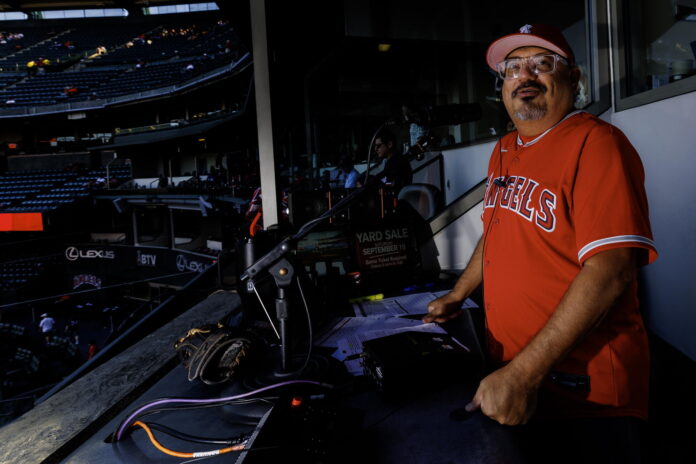
Angels public address announcer Michael Araujo overlooks the field in his booth before a game against the Minnesota Twins on September 17.
(Gina Ferazzi / Los Angeles Times)
Still, like Ramsey, Araujo’s gift is his voice. And though his delivery isn’t nearly as deep and commanding as Ramsey’s, it is unique in that it has a distinct, enthusiastic lilt, one he’s been able to maintain through what will likely be the Angels’ first 100-loss season.
“I try to bring the energy,” he said.
“It’s all about riding your vibes,” Maske added. That’s why Araujo’s perch on the club level behind home plate is exposed to the crowd rather than enclosed, like the booths to his right used by the radio and TV broadcasters. The idea is to feed off the fans, not lock them out.
“Baseball is gnarly. It’s repetitive. It’s a sport that’s inherently, at times, very boring,” Maske said. “So you’ve got to find those little moments to make it entertaining.
“It’s not NFL. It’s not the NBA. It’s baseball. Mike’s good at kind of finding that balance of excitement and traditionalism.”
And the excitement, even at the end of a blowout loss, is genuine, he said.
“The Angels were my team growing up, so the Angels was my dream job,” said Araujo, a former season-ticket holder. “I’ve been very fortunate.”
“I want to get paid to watch sports and that’s it,” he continued. “So whatever I’ve got to do to be invaluable so that I stay there, that’s kind of my mission.”
It’s not a mission that pays much, however, with most PA announcers across the majors earning between $100-$500 a game to announce each hitter as he comes to plate, read commercial copy between innings and, in Araujo’s case at least, to handle the play-by-play for the cartoon races that run on the scoreboard late in the game.
“It’s fun money,” said Casey who, like Araujo, is a teacher as well as the clock operator at Galaxy games, where she works alongside her husband. “We use it for travel.”
The job is one Araujo stumbled into. Despite a rich voice and a lifelong passion for sports, pairing the two was something that just happened, not something that was planned.
A teacher at an alternative-education high school in La Puente, Araujo, 54, has worked for the Galaxy since the MLS team’s second game in 1996, filling a number of roles from glorified errand boy to assistant game-day producer. That last job required him to stand behind the PA announcer and relay silent cues, and since he knew the gig, Araujo was handed a microphone and asked to fill in a few times during absences, sick days and other emergencies.
The biggest emergency came when Victor Villalba, the Galaxy’s regular announcer, left in the middle of a season to join the Dallas Cowboys radio team. Araujo was the natural choice to finish out the year and he’s been there ever since.
“That was 2002,” he said. “So I’m in my 25th season.”
It was similar desperation that led to his job with the Angels. When David Courtney, who had been with the team for nearly two decades, died at 56 two months after the 2012 season, the Angels began asking around for a replacement and Araujo’s name was the one they heard most frequently. So he was invited to spring training the following year to audition and he beat out two others to claim the job.
On game days Araujo gets to the ballpark about 2½ hours before first pitch, pausing in the parking lot to pull on an Angels cap and jersey with his name on the back. If the team wins, he’ll wear the same jersey the next day; if not, he’ll rotate through a closet of red, white, gray and City Connect jerseys.
Araujo’s only other tools are a microphone and a laptop, on which he’s installed an interactive software program he created that tracks the lineups of both teams. He can also call up pronunciation guides for players on all 30 major league teams, though he’s found the radio broadcasters for the visiting clubs are often more helpful.

Angels public address announcer Michael Araujo has worked more than 1,000 games at Angel Stadium and has been the Galaxy’s public address announcer since 2002.
(Gina Ferazzi / Los Angeles Times)
His cramped work space, about 90 feet from the field, has enough room for two green vinyl chairs, though Araujo prefers to stand when he’s working. And unlike many people whose vocal chords are their livelihood, Araujo says he has few ritualistic habits to protect his voice.
“In my bag I have a gazillion cough drops; a couple of different kinds, some with honey,” he said. “I definitely wouldn’t do anything carbonated before a game. Makes you burp and all that kind of stuff.”
Araujo is one of three Latino PA announcers in the majors, alongside Marysol Castro, who works for the New York Mets, and Frank Fernandez of the Miami Marlins. Given that 30% of big-league players are from Latin America, the fact that just 10% of the PA announcers are Latino is something Araujo said he thinks about during Hispanic Heritage Month.
“Did I grow up in Boyle Heights or anything like that? No, I’m no poster child or miracle story or anything like that,” said Araujo, who was raised middle class in La Verne, where his father, a sheriff’s deputy, and mother, a nurse, often spoke to one another in Spanish.
“We are here in 2026 and it’s not a little more prevalent. It can be an aspiration to any kid, even one of my students, that bigger things are possible.”
For a PA announcer, it turns out, there are times when it’s important to be heard and seen.
More to Read
Disclaimer : This story is auto aggregated by a computer programme and has not been created or edited by DOWNTHENEWS. Publisher: latimes.com