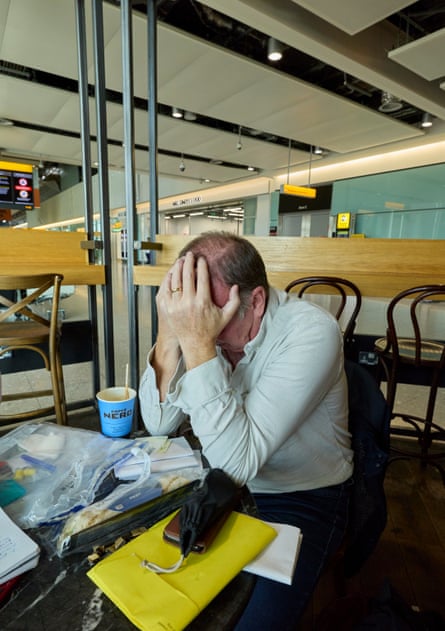
Doubled over a Heathrow baggage trolley, the former British business director is sobbing uncontrollably, exhausted emotionally and physically after being deported from Sweden.
Hours earlier the 65-year-old had been marched on to a plane in Stockholm, separated from his home and his Swedish wife after a five-year battle to stay in the country after Brexit came to an end.
An only child with no children and no property in the UK, Charles has effectively been made homeless. He was last in the UK in 2022 for one week, and before that not since 2017 when he emigrated.
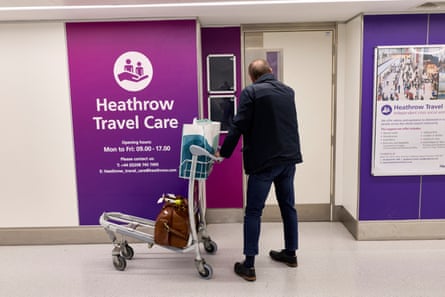
“I have nothing, nothing in the UK at all,” says Charles as he shows a text from the British consulate explaining where in Heathrow the suddenly homeless can get help.
“All I want is to return to my wife, my home and my friends in Sweden and to live a quiet, peaceful life,” adds Charles, who does not want to publicly share his full identity.
His forced flight on Tuesday shows that deportations of British citizens who lived in Sweden before Brexit are continuing. Stockholm has already deported 458 British people after rejected residency applications, a higher proportion in terms of its population than any EU member state.
The situation persists despite promises from opposition parties now on track to form a government that they will introduce urgent laws to give Britons a second chance to apply for residency.
“I’ve done nothing wrong but feel I’ve been treated like a criminal,” Charles says.
“Since arriving in Sweden nearly nine years ago, I’ve done everything I can to integrate myself into Swedish society. I’ve learned some basic Swedish, contributed to Swedish society and the Swedish economy, and for that, I’m being punished. Why are they doing this to good, honest, hard-working people like me and my wife?”
Shortly after disembarking in London, he is sitting down in an airport cafe processing what has just happened.
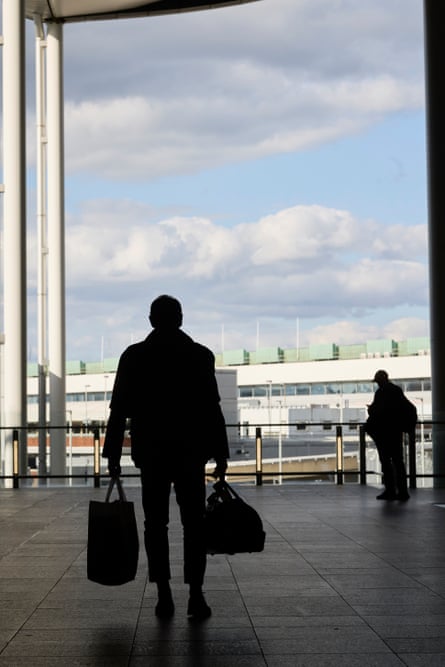
Pointing to a small holdall and a large reusable shopping bag, he says: “All I have is what my wife packed in my bag here with clothes and my little bag” in which he has belongings handed back to him by the captain as he got off the plane.
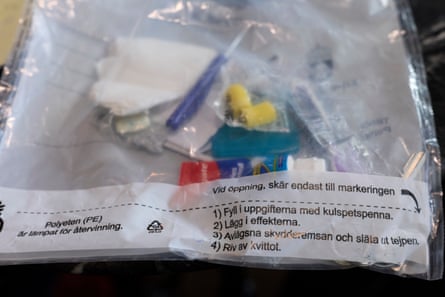
The bag includes a plastic envelope sealed and emblazoned with the words Kriminalvården, the Swedish Prison and Probation Service, containing meagre belongings.
In it is a miniature tube of toothpaste, a toothbrush and earplugs given to him in the detention centre where he was locked up for two weeks.
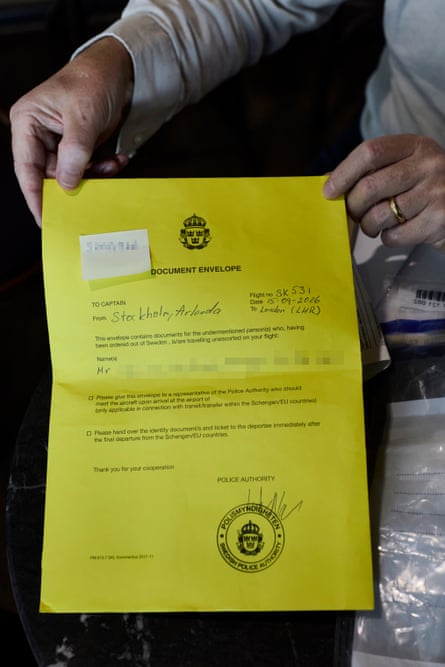
There is also a bright yellow envelope handed to him by the captain before disembarking which he opens for the first time.
One is a police document saying he does not need to be “escorted”. The other says he is being deported over a failed residency application under the Aliens Act – his latest legal attempt to stay in Sweden after a pre-Brexit residency application, made on time, was rejected.
Charles’s plight started just over two weeks ago when he and his wife received a text requesting that they come to their local police station to discuss their migration case.
They thought it was to discuss their five-year battle to persuade authorities they were in the country lawfully before Brexit. But he was immediately detained and told he would be deported.
“It was an incredible shock. I was distraught. This is not about leaving Sweden, this is about me being forced to leave my wife and my house. They are separating me from my wife,” he said.
“They said we think that if we don’t detain you you will abscond from Sweden because you are not co-operating.
“For the last nine years, all we’ve done is cooperate with them.” He said he begged authorities not to detain him, telling them he would go of his own accord but they said no.
He asked if he could drive back to the UK “so at least I could take some belongings with me because I have nothing in the UK, and they said ‘no, the decision has been made’”.
Before Brexit, British citizens could live, work, study or retire in any other member state. Under EU law deportation was reserved for exceptional cases of criminality such as terrorism.
After Brexit, Britons and EU citizens who had exercised those free movement rights were told their rights to remain in their host country would be guaranteed in the legally binding withdrawal agreement.
Campaign group British in Europe has raised concerns about the hardline treatment in Sweden for years but this summer it became an election issue after a series of controversial cases emerged, including a removal order issued to a 78-year-old British widow, Joyce Thomas, who had been in the country for 21 years.
A 74-year-old British man with dementia in full-time care was also ordered to leave after 25 years while another British man, 34, in the country since he was 10 years old, was deported in January.
The cases raised questions about whether Sweden’s hardline immigration position had infected decision-making relating to Britons there before Brexit, a cohort with special protection.
Charles says the experience has been humiliating, particularly as he spent a career in public service helping prisoners and unemployed people to start up businesses.
“When I first moved to Sweden, I thought it was a wonderful place to live. Clean air. We were very close to the sea. Forests, nature, the people that I met when I first moved there were all generally very nice people. That did change,” he said.
“Only two friends know what’s happened in the last couple of weeks. And they’re disgusted by it. One of them said, ‘I’m ashamed, I’m ashamed of what we’ve done to you’.”
Jane Golding, chair of British in Europe, says “it is another case that raises the question of whether Swedish implementation is in line with the spirit of the withdrawal agreement,” referring to the legally binding treaty that Michel Barnier, then the EU’s chief negotiator on Britain’s exit from the EU, and Boris Johnson, the then prime minister, promised would protect EU citizens in the UK and British citizens in the EU.
“This British man who has sufficient means and a home and a Swedish wife in Sweden now faces homelessness in the UK where he has nothing,” she says.
“This wasn’t the intention of the EU and UK negotiators of the agreement who said that citizens should broadly be able to continue their lives as before,” she adds.
She also points out that, unlike the UK, there is no statutory body in any member state to oversee correct implementation of the withdrawal agreement.
“Monitoring and support resources for UK citizens in the EU trying to enforce their rights are not commensurate with those in the UK, where there is a dedicated independent monitoring authority. Unfunded volunteers trying to help are overwhelmed,” says Golding.
Disclaimer : This story is auto aggregated by a computer programme and has not been created or edited by DOWNTHENEWS. Publisher: theguardian.com