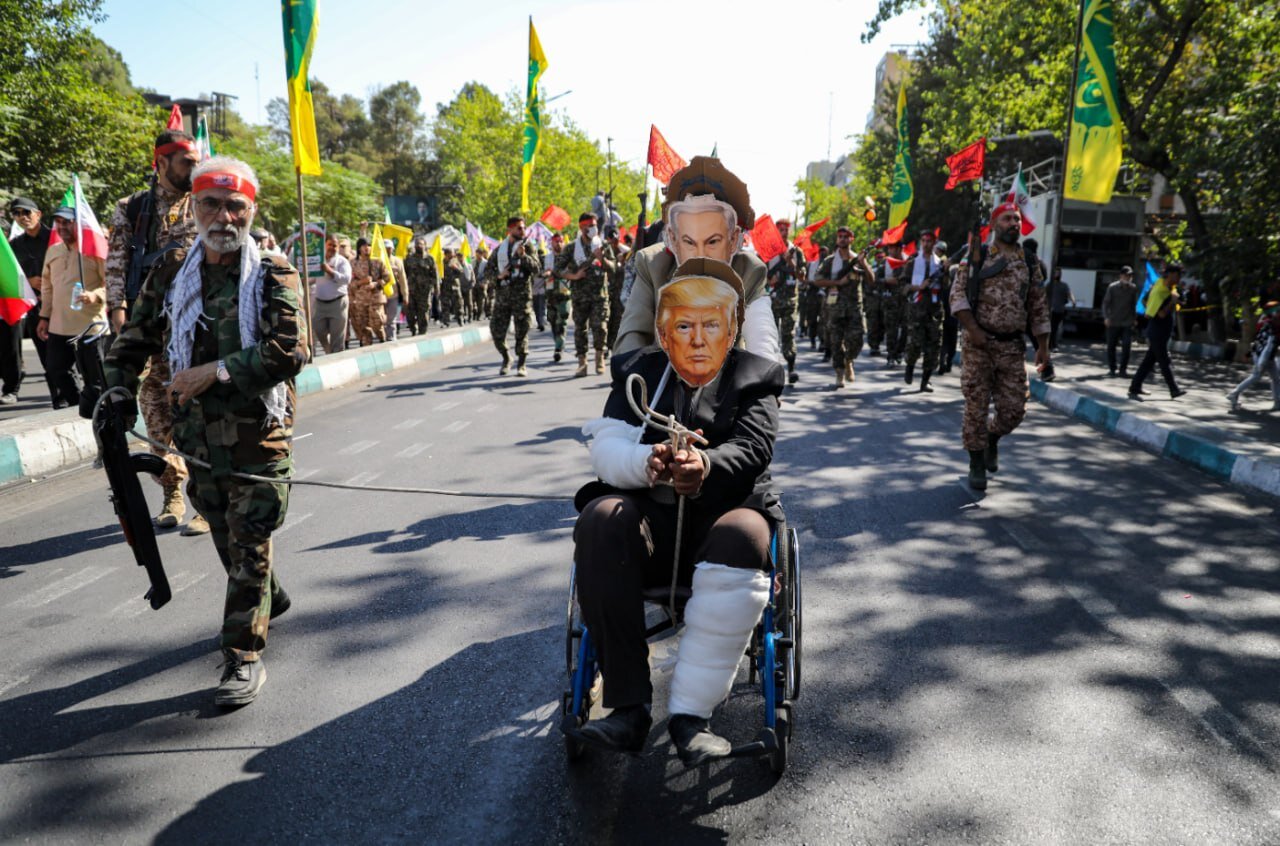
TEHRAN — Iran has issued a series of increasingly explicit political, military and strategic messages to the United States and its regional partners, warning that any renewed US aggression would trigger sustained attacks on American positions and interests across the region, while making clear that Tehran does not regard military pressure and diplomacy as mutually exclusive.
The latest statements, delivered by senior Iranian military and political officials on Sunday, came amid continued tensions over the Strait of Hormuz, the future of Iran-US negotiations and the country’s nuclear policy. Together, they point to an Iranian strategy that seeks to combine military deterrence, control over the strategic waterway and diplomatic leverage while keeping a range of options open.
Iran warns of “painful” regional response
The Khatam al-Anbiya Central Headquarters, the command center responsible for coordinating Iran’s military operations, warned the US and regional countries against any further hostile action against the Islamic Republic.
In a statement released Sunday, the headquarters accused the United States of seeking to conceal failures in its campaign against Iran and to manufacture “false gains” from the conflict.
It said that, based on information available to Iranian authorities, the United States had decided to resume action against Iran following a meeting in a European country and with the “green light” of some regional states.
The headquarters issued an unambiguous warning that any US military action against Iran would be met with sustained attacks on American positions and interests throughout the region.
“If the US makes any mistake against the Islamic Republic of Iran, all its positions and interests in the region will be targeted by sustained, effective and painful attacks,” the statement said.
The warning was also directed at regional states that might cooperate with Washington. The Iranian command said countries that aligned themselves with US aggression against Iran would be regarded as participants in that action and should not expect restraint from Iran’s Armed Forces.
The statement represents a continuation of warnings previously issued by Iran over possible US attempts to intervene in the management or security arrangements of the Strait of Hormuz. Iranian military authorities have repeatedly said that Washington cannot unilaterally determine the conditions governing navigation through the strategic waterway.
Hormuz becomes central to Iran’s negotiating position
The military warning came as Parliament Speaker Mohammad Baqer Qalibaf reiterated that Iran’s position on the Strait of Hormuz is closely linked to the broader political and security dispute with Washington.
Addressing parliament on Sunday, Qalibaf said Iran’s messages and conditions had already been conveyed to the United States through intermediaries.
He stressed that ‘the Strait would not return to its previous operating conditions until Iran’s legitimate rights were recognized, and US commitments were implemented.’
“The path of deception and unilateral imposition is closed,” Qalibaf said, adding that there would be no return to the previous framework of negotiations or reopening of the Strait until Iran’s conditions were met.
His remarks are consistent with Tehran’s position in recent months that ‘the reopening of Hormuz cannot be treated as a unilateral decision by Washington or any other outside power.’ Iran and the United States had previously reached an interim arrangement in June involving a halt to military operations and navigation arrangements, but that understanding subsequently collapsed amid US violations.
The significance of Hormuz extends well beyond the immediate Iran-US confrontation. The Strait is one of the world’s principal energy chokepoints, connecting the Persian Gulf with the Gulf of Oman and the Arabian Sea. Recent shipping data reported by Reuters showed traffic through the waterway remained substantially below its recent average, underscoring the extent to which the conflict has disrupted regional maritime commerce.
For Tehran, therefore, the issue is not simply whether commercial vessels can physically pass through the waterway. The dispute also concerns who determines the security architecture, operating conditions and rules governing navigation in a waterway located on Iran’s immediate southern flank.
Qalibaf rejects “war or negotiations” as a choice
Qalibaf also rejected the idea that Iran must choose between military confrontation and diplomacy. “We believe that the dichotomy of war or negotiations is not real; rather, we must both fight and negotiate,” he said.
He argued that Iran should use military power when necessary to repel attacks and then employ diplomacy at an appropriate moment to consolidate ‘battlefield gains.’
The formulation places diplomacy within a broader deterrence strategy rather than presenting negotiations as an alternative to military resistance.
Qalibaf further argued that the regional balance of power was undergoing a fundamental transformation, saying the previous US-led order in West Asia had collapsed and calling for Muslim countries in the region to participate in shaping a new regional order.
His comments suggest that Tehran views the present confrontation not only as a bilateral dispute with Washington but also as part of a wider contest over the future security architecture of West Asia.
Iranian commander invokes legacy of “Sacred Defense”
At a separate ceremony marking Iran’s Sacred Defense Week, Rear Admiral Habibollah Sayyari, deputy chief of the Iranian Army for Coordination, framed the current confrontation within the historical experience of the 1980–1988 Iran-Iraq War.
Sayyari stressed that modern warfare increasingly depends on intelligence, communications, weapons technology, and changing battlefield tactics, indicating the Army’s emphasis on adapting its military capabilities to a rapidly evolving security environment.
NPT withdrawal enters Iran’s strategic debate
At the same time, the confrontation with Washington and the dispute over Iran’s nuclear program have pushed another previously sensitive issue closer to the center of Iran’s strategic debate: possible withdrawal from the Nuclear Non-Proliferation Treaty (NPT).
Ebrahim Azizi, chairman of the Iranian Parliament’s National Security and Foreign Policy Commission, said the possibility of leaving the NPT was now “on the table.”
In an interview with Mehr News Agency, Azizi sharply criticized the International Atomic Energy Agency, arguing that it had moved away from its technical and professional role and had become subject to political pressure from major powers.
He said legislative proposals concerning withdrawal from the NPT had been drafted and submitted to the Parliament’s National Security and Foreign Policy Commission as well as the its legislative office.
At the same time, Azizi added that withdrawal would require concrete measures, coordination among the different branches and institutions of government, and a unified decision within Iran’s political establishment.
That distinction is significant: the existence of parliamentary proposals does not mean that Iran has decided to withdraw from the treaty. Rather, the issue has entered the political and strategic debate as one of the options being considered.
Under Article X of the NPT, a state has a right to withdraw if it determines that extraordinary events related to the treaty have jeopardized its supreme national interests. The treaty requires three months’ advance notice to the other parties and to the UN Security Council, accompanied by an explanation of the extraordinary circumstances cited.
Nuclear policy increasingly linked to security calculations
The growing discussion over the NPT is unfolding against a broader Iranian argument that international nuclear safeguards and security guarantees have failed to adequately protect Iran’s nuclear facilities and rights.
Iranian lawmakers had already called for a review of the country’s NPT membership in a September 15 statement, arguing that recent developments had demonstrated the inability of existing international mechanisms to protect Iran’s legal rights and nuclear infrastructure.
The debate also reflects a broader shift in Tehran’s calculation of the relationship between nuclear commitments and national security. For Iranian officials advocating a review of NPT membership, the central question is increasingly whether continued adherence provides sufficient security and diplomatic benefits in circumstances where Iran argues that its nuclear facilities have come under military attack.
A broader Iranian strategy takes shape
Taken together, the statements by the Khatam al-Anbiya Central Headquarters, Sayyari, Qalibaf and Azizi reveal several interconnected strands in Iran’s current strategic messaging.
First, Tehran is emphasizing deterrence. The military leadership is warning that any new US attack would not remain confined to Iran’s territory but could expose American positions and interests across the region to retaliation.
Second, Iran is treating the Strait of Hormuz as a strategic lever. Qalibaf’s remarks indicate that Tehran links the waterway’s reopening to broader political and security arrangements rather than viewing navigation as an issue separate from the conflict.
Third, Tehran is keeping diplomacy open while rejecting negotiations under unfavorable conditions. Qalibaf’s formulation that Iran must “both fight and negotiate” reflects an attempt to combine military pressure with diplomatic engagement.
Fourth, the nuclear issue is increasingly being considered through the lens of national security. The NPT withdrawal debate remains a political discussion rather than a confirmed policy decision, but its emergence among senior lawmakers indicates the depth of the strategic reassessment underway in Tehran.
The immediate trajectory of the confrontation will therefore depend not only on developments on the battlefield but also on whether Washington and Tehran can establish a framework that addresses the issues Iran has identified as prerequisites for renewed negotiations and changes in the status of the Strait of Hormuz.
For now, Tehran’s message is that military deterrence, control over its strategic maritime environment, and diplomacy are being pursued simultaneously rather than sequentially—with Iranian officials presenting these elements as interconnected components of the country’s response to continued US pressure.
Disclaimer : This story is auto aggregated by a computer programme and has not been created or edited by DOWNTHENEWS. Publisher: tehrantimes.com