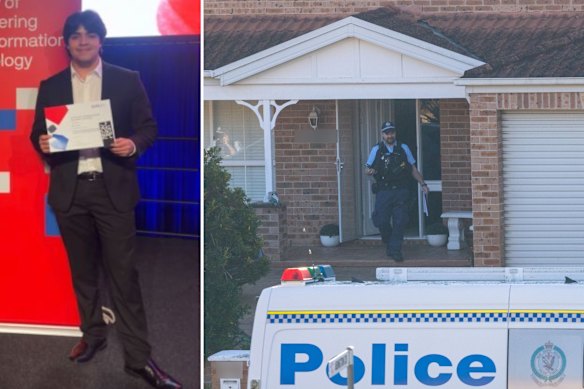

It took only a week after two mistaken identity gangland hits in as many days for the NSW government to introduce harsher penalties for child offenders linked to organised crime. And therein lies the problem.
Marco Tapia, 23, and Joshua Macdonald, 40, died a day apart this month after being shot inside their homes in killings that bore the hallmarks of organised crime.
In both cases, police do not believe that the victims were the intended targets of the attacks. Neither man had any known links to organised crime.
In both cases, police later charged teenagers in relation to the crimes. One of the children charged with murdering Tapia was just 14 years old.
The apparently growing phenomenon of crime bosses recruiting teenage hitmen to eliminate their rivals, reportedly for as little as a few hundred dollars, is certainly one that demands a response. Premier Chris Minns is clearly alert to this. Even before the alleged assailants in the Tapia case were identified as juveniles, he described the perpetrators as “bastards” and agreed that police had lost control of gang violence in Sydney.
The new measures he announced last week to address gangland violence followed through on his rhetoric. They include expanding the serious children’s indictable offences scheme to enable children committing offences linked to organised crime to face harsher penalties. Offenders charged under the scheme must be tried as adults in the District Court and Supreme Court, and they face longer prison sentences than if they were prosecuted in the Children’s Court.
To be sure, this tougher stance will send a message to those repeat offenders who believe that the youth justice system offers nothing more than a slap on the wrist.
But mollifying the law-and-order chest-beaters and addressing the problem are two different things.
Murder is already a serious children’s indictable offence. For other offences that might be caught by laws, sentencing is the wrong place to begin. Children who carry out such actions are not rationally thinking through the consequences, far less weighing up potential penalties.
By the time a perpetrator is sentenced, the moment for their path to take a different turn has been long lost.
A Senate report into Australia’s youth justice system noted on Friday that community-based diversion and early prevention programs were more effective and less costly than incarceration to reduce offending and improve public safety.
Such programs might include the one offered by the United Muslims of Australia, which Riley Walter reports in Monday’s Herald seeks to give boys a sense of belonging that many seek in criminal gangs.
“You’ve got to ask yourself what those boys are finding in those gangs,” said UMA’s youth co-ordinator, Zaid Omran. “They’re finding brotherhood, they’re finding identity, they’re finding social insurance, they’re finding a home away from home.”
The justice system is all too familiar with knee-jerk responses. But there are no shortcuts to solving the drivers of offending: poverty, trauma, disconnection from school, disability, drug and alcohol dependence and more. These take years and the involvement of many agencies to address. It’s just a lot less sexy to tackle the problem by doing what in many cases is already being done – but better.
Get a weekly wrap of views that will challenge, champion and inform your own. Sign up for our Opinion newsletter.
 The Herald’s View – Since the Herald was first published in 1831, the editorial team has believed it important to express a considered view on the issues of the day for readers, always putting the public interest first.
From our partners
Disclaimer : This story is auto aggregated by a computer programme and has not been created or edited by DOWNTHENEWS. Publisher: www.smh.com.au