
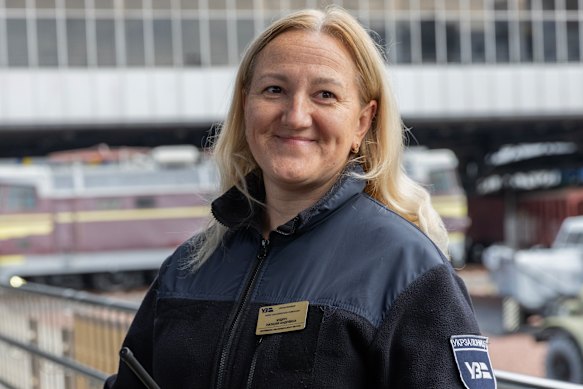

Kyiv: The burnt train carriage on a city platform reminds thousands of workers of the risks they run on their journeys across Ukraine each day.
The carriage at the central station in Kyiv was part of a passenger train that was hit by a Russian drone in eastern Ukraine last year, killing six people.
Looking at the smashed windows and the blackened interior, many railway staff might think twice about their daily work. But Natalia Kudrich, a railway steward, says she will not change careers.
“Why do we keep working? Because we are made of iron,” she says.
Kudrich, 40, comes from a family of rail workers in Lviv, in the far west of the country. She joined Ukrainian Railways when she was 19 and she has kept working throughout the war. That makes her just one example of the people who keep essential services running despite Russian attacks on civilians.
The national rail service, Ukrzaliznytsia, is so vital to the country that its staff call themselves “iron people” – a play on words because the company’s name incorporates the word for iron.
The latest attacks have heightened anxiety about civilian deaths. A drone strike on a locomotive triggered global headlines last week because Russia attacked a civilian service only 2 kilometres from the Polish border when visitors, including former British prime minister Boris Johnson, were on a train nearby.
The head of Ukrainian Railways, Oleksandr Pertsovskyi, says the attacks on trains should prompt the same outrage as a military strike on a civilian aircraft.
“If this happened to an aircraft somewhere in Europe, it would be on the front page of every newspaper. It is a very clear case of terrorism,” he tells this masthead in an interview in Kyiv.
“Unfortunately, it’s become normal here. And it should not be happening.”
Russian forces have destroyed or damaged more than 500 locomotives across Ukraine since the full-scale invasion began in February 2022, according to Ukrainian Foreign Minister Andrii Sybiha. Half of these attacks have occurred this year alone.
The civilian casualties are mounting. A Russian drone hit a commuter passenger train near Kharkiv Oblast last Friday, killing a man and injuring seven other passengers, Ukrainian officials said. Two carriages were engulfed in flames, killing one man and wounding eight others.
The Russian strike near the Polish border, on September 14, highlighted the risk to passengers as well as the Kremlin’s willingness to provoke Western countries.
A jet-powered drone hit a Ukrainian Railways locomotive at Yahodyn station just after passengers had been evacuated from their carriages. One of the passengers was former CIA director David Petraeus, who was leaving Ukraine after speaking at the Yalta European Strategy conference in Kyiv.
Videos posted to social media showed passengers running from the explosions and flames.
A separate train had passed through the station shortly before the drone strike, carrying another group of conference speakers including Johnson. Pertsovskyi says this service was ahead of schedule.
“Pretty much every international train at the moment carries ambassadors, business people, media. Safety-wise, we are concerned for each and every one, so it’s not that we differentiate between those trains,” he says.
“It just happened to be that one of them came earlier, others were still there, and the routing decision was made on the spot.
“Clearly, the Russians were aiming to hit very close to the EU and NATO border. Clearly, they were doing it at the station where there’s a bunch of trains with international visitors of all ranks.
“It shouldn’t be normal that a passenger train can be a target, or an area with passenger trains can be a target.”
Pertsovskyi, an economist, took on the chief executive position in August 2024 after running the passenger division for several years. Educated in Kyiv, he did a masters degree at Brandeis University in the US before joining logistics giant DHL, where he worked for six years in the US and Singapore. He returned to Ukraine in 2016.
What does he need most right now? More locomotives, he says. An Australian engine, however, would not work.
The Ukrainian network, a legacy of the Soviet era, uses the 1520 millimetre broad gauge. The best sources for locomotives are former Soviet states in eastern Europe.
The pressure on the rail service is intensifying because Russia has developed faster and more lethal drones that can reach further into Ukrainian territory, such as the lines near Poland.
“They advance the tools of assault; we need to catch up with our tools,” Pertsovskyi says.
“The rise of jet Shahed drones means that the speed of decisions should be very fast.”
The railway network is monitored by teams that alert drivers to potential attacks so trains can be stopped and passengers evacuated. In some cases, passengers sit in a field for hours while they wait for the danger to pass. In others, they sit in a stationary train while system managers re-route passenger and freight services.
In the past, managers would raise an alert when a drone came within 50 kilometres of a train; now, given the speed of the turbojet drones being launched by Russia on most days, the alert is raised when a threat is as far as 100 kilometres away.
“The speed is such that otherwise there would be no time to evacuate,” Pertsovskyi says.
“We learned this the hard way in one of the first instances of this a few weeks ago. Our train drivers were trying to bring a train to safety near Odesa. Unfortunately, the jet Shahed was too fast and killed both of them.”
The next phase in this race is likely to be a faster, more automated alert system.
“Literally, with jet Shaheds and ballistic missiles, we have minutes for people to react. So that’s why there are constant upgrades of the tools to notify our people faster,” Pertsovskyi says.
An air raid alert goes off soon after Pertsovskyi speaks to this masthead at the Kyiv railway station. It is a yellow alert for a drone attack. Soon afterwards, people at the station can hear air defence fire responding to the threat.
Some people at the station walk down a stairway to a shelter, but most continue with their day. Their mobile phone apps would light up with a red alert if the threat were a ballistic missile.
While thousands of Ukrainians keep the railways running, and others operate the Ukrposhta postal network and other essential services, not everyone has chosen to stay during the war.
About 4.4 million Ukrainians are living in the European Union under temporary protection, according to official figures. Many others are in Britain and the United States, and some are in Australia.
That highlights the commitment of workers who stay at their posts at a time of rising danger.
Kudrich says the task of the railway workers is to keep the service running even under attack.
“When, on the move, if a locomotive is hit, the crew will try to change and put on another one, so the train can get to its destination,” she says. “We keep working because of our confidence. And our stamina.”
Get a note directly from our foreign correspondents on what’s making headlines around the world. Sign up for our weekly What in the World newsletter.
 David Crowe is Europe correspondent for The Sydney Morning Herald and The Age.Connect via X or email.
From our partners
Disclaimer : This story is auto aggregated by a computer programme and has not been created or edited by DOWNTHENEWS. Publisher: www.smh.com.au





