It was a busy weekday morning at EuroSchool Kharadi in Pune, with the usual rush of classes, teachers, and schoolwork around her. When I called Principal Afreen Kazi Sheikh, she was in the middle of that familiar school-day bustle, yet as we began talking about a sustainability exhibition that had visited the school two years ago, she paused.
The conversation that followed was less a description of an event and more a recollection of what happened after the exhibits were packed away and the visitors had gone home.
For her, that was when the real impact of the experience began to show.
She remembered children returning to their classrooms with questions, discussing things they had seen and, months later, approaching their teachers with ideas of their own. Some wanted to make compost. Others wanted to reduce plastic use or find ways to save water. What stayed with her was not what the children had learnt during the exhibition, but how they continued to think about it afterwards.
For a school that had already been teaching children about waste, water conservation, climate change and environmental responsibility, the challenge had never been a lack of information. It was helping children see how those large ideas fitted into their own lives.
“I think the biggest challenge was for us to help students build real-world connections,” she says.
When the lesson left the classroom
EuroSchool Kharadi opened in 2021 during the lockdown, beginning with around 200 admissions and an entirely online first year. By the time she spoke about the sustainability programme, the school had grown to more than 2,800 students, from pre-primary to the senior classes.
Environmental awareness has been part of school life from the beginning. There were plantation drives, waste segregation activities, environmental clubs, awareness campaigns, and project-based learning. But the principal felt that children needed something more than conversations inside a classroom.
“You cannot engage children with minimal talk. You have to give them opportunities to engage,” she tells The Better India. “When you actually do something practically, when you get the feel of it, then you are never going to forget it.”
That opportunity came in mid-2024, when the school hosted ‘Shashwat Bharat Setu’, a mobile sustainability learning initiative created by ‘The Eco Factory Foundation’. The initiative was formally launched in February that year and was designed to take sustainability exhibits and demonstrations directly to schools, communities and other spaces rather than keeping them inside a permanent centre.
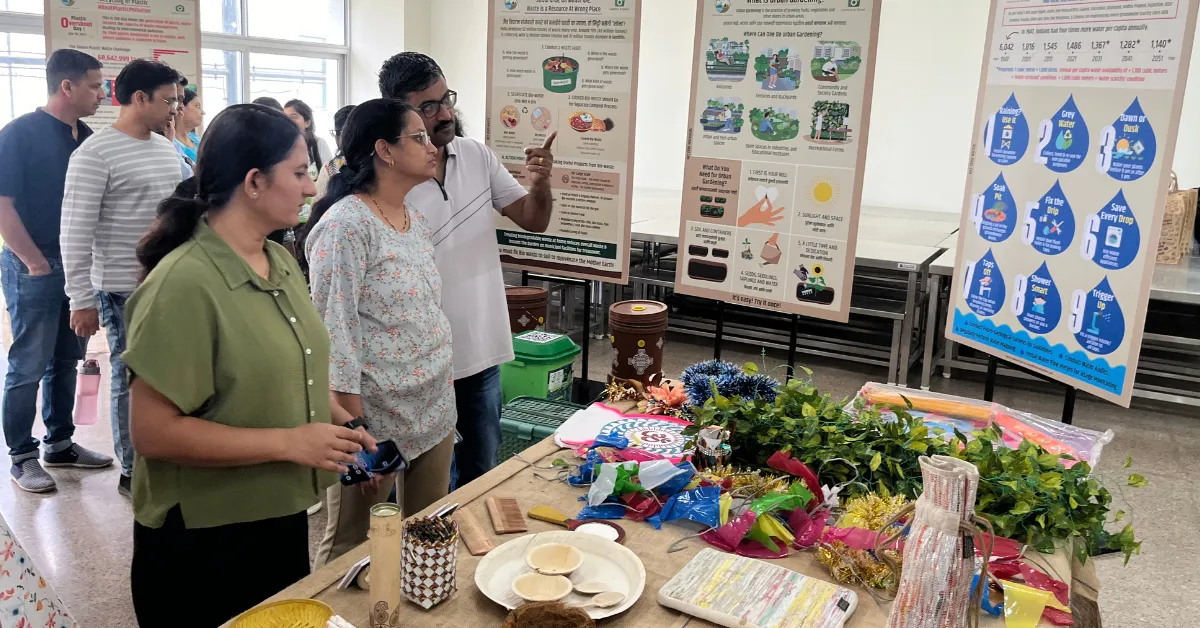
At the school, a large cafeteria that was not being used was converted for the exhibition. Furniture was moved out, exhibits were brought in, and the space was arranged so that students and parents could walk through different sections and interact with them.
More than 2,000 students and parents visited that Saturday.
The school had spent the previous week preparing the children through discussions and debates around climate change and environmental challenges. But once the exhibition opened, something changed. Instead of solely listening to a teacher explain a concept, the children could see how it worked.
There were demonstrations and displays around renewable energy, water conservation, waste management, biodiversity, composting, rainwater harvesting, urban gardening, sustainable agriculture and the circular economy. They could ask questions directly to people working with the exhibits and hear explanations beyond what they had read in textbooks.
For the principal, that was the difference.
“The programme was different because children were meeting new people and experts and seeing things that we could not always recreate inside the school,” she recalls.
What the children carried home
Thirteen-year-old Ayush Chowdhury, a Class 8 student, remembers being particularly interested in waste segregation.
Before the programme, sustainability meant keeping the surroundings clean, planting trees and avoiding pollution. He understood those ideas, but the exhibition helped him connect them with everyday choices.
He began paying closer attention to the waste produced at home, started using a reusable water bottle, and avoided single-use plastic wherever possible. He also became more conscious about switching off lights and fans and saving water.
What surprised him most was how something that appeared small could add up.
Aviraj Singh, who is nine years old now, remembers a composting demonstration. Watching food peels and other organic material gradually become something that could return to the soil made the idea feel real to him.
“It felt like magic,” he says.
The experience also changed what he noticed at home. He began separating wet and dry waste, turned off the tap while brushing and helped his family set up a small compost bin.
His parents joined him in the effort.
For both children, sustainability had moved from being something they were told was important to something they could actually practise.
And that distinction mattered.
“Earlier, it was mostly the school reminding children about these things, whether it was saving water, avoiding paper waste or simply being more mindful of their everyday habits,” Afreen says.
After the exhibition, she noticed something different.
“Months later, I had children taking initiative. They came to the teachers and said, ‘Ma’am, can we create something like manure?’ Or, ‘Can we do something like running a campaign for zero plastic use in the school?’”
Sometimes, the teachers would hesitate, unsure about how much could realistically be done.
The children had an answer.
“Ma’am, don’t worry. We’ll take care of it,” they would tell her.
Small ideas began taking root
The changes did not stop with individual habits.
Students began working on their own rainwater harvesting projects. A patch of land in the school was turned into a growing space for herbs and vegetables. Environmental themes began appearing in the school’s annual Student-Led Culmination Conference, where students from Class 1 upwards research subjects and present them to their parents through projects and role-plays.
/filters:format(webp)/english-betterindia/media/media_files/2026/09/18/shashwat-bharat-setu-2026-09-18-17-19-04.png)
Some chose themes around the Sustainable Development Goals, poverty and hunger, aquatic life and environmental responsibility.
The school also worked with Pune Climate Warriors on a zero plastic initiative. Paper use was reduced, waste paper and newspapers were reused, and students began thinking about whether materials really needed to be bought or whether something already available could be given another purpose.
One group even discussed making and selling green manure, with the idea of using the money raised through parent-teacher meeting sales to buy saplings and distribute them. None of these actions, Afreen points out, happened because children suddenly became environmental experts.
They happened because the subject was brought to life.
A lesson about water became a rainwater harvesting project. A discussion about waste became compost. A conversation about plastic became a campaign. A classroom activity became a vegetable patch.
That, she says, was the lasting value of the experience.
/filters:format(webp)/english-betterindia/media/media_files/2026/09/18/shashwat-bharat-setu-2026-09-18-17-33-09.png)
The idea behind the travelling classroom
The person behind the initiative is Mr Anand Chordia, founder of The Eco Factory Foundation and director, Innovation & Technology, Suhana Pravin Masalewale.
His interest in sustainability began with a question that arose in his own professional life. Could economic growth happen alongside environmental responsibility? That question led him to look more closely at waste, water, energy, and the way resources were being used, before eventually taking those concerns into communities, schools, farms, and industries.
The Eco Factory Foundation was established in 2016 with the belief that sustainability needed to become part of everyday life rather than remain a subject discussed only by specialists. Its work has since covered areas including rural and urban sustainability, waste management, sustainable farming, tree planting and resource conservation.
But Mr Chordia saw another gap.
There were already technologies, ideas and practical solutions that could help people reduce waste, conserve water or use resources more responsibly. What was often missing was a practical way for ordinary people to see those solutions, understand them and work out how they could apply them.
“At the heart of my approach is what I call the science of delivery. It is not enough to research solutions. We must find ways to take those solutions to people, make them practical, scalable and accessible, and create measurable impact on the ground,” he says.
That thinking influenced Shashwat Bharat Setu.
Rather than asking schools and communities to travel to a sustainability centre, the centre itself travels. The exhibits are carried in a truck and assembled at the destination, creating a temporary learning space wherever it arrives.
The idea is natural enough. See something, ask questions about it, and then think about whether it could work in your own surroundings.
The exhibits cover subjects ranging from water conservation and renewable energy to waste management, biodiversity, sustainable agriculture, urban farming, circular economy and reducing carbon footprints. The official initiative describes it as a mobile learning and awareness centre intended to help people connect sustainability with practical action.
Since its launch, the initiative has travelled to schools and other institutions, while the wider work has reached communities through different sustainability programmes. It has reached more than 28,000 citizens, including over 3,500 students. Its outreach has taken the travelling sustainability classroom across Karnataka, Delhi, Maharashtra and Gujarat, bringing experiential environmental learning to schools and communities.
For Mr Chordia, mobility is important because the intention is not to create one impressive exhibition. It is to take the conversation to places where people already live, study, and work. “We wanted sustainability education to reach people where they are, rather than expecting them to travel to a fixed learning centre,” he says.
/filters:format(webp)/english-betterindia/media/media_files/2026/09/18/shashwat-bharat-setu-2026-09-18-17-23-29.png)
A bridge between knowledge and action
Dr Rajendra Kumar Saraf, an environmental engineer and sustainability professional with five decades of experience in environmental control technology, has been associated with Shashwat Bharat Setu and the wider work for around three years. He is also a member of The Eco Factory Foundation’s advisory board, bringing his technical experience and perspective, particularly around water and environmental management.
For him, introducing children to sustainability early is not only about creating environmentally conscious students. It is about helping them develop habits before unsustainable ones become strongly ingrained.
“I believe sustainability education among children is important because the choices we make today will directly outline the world they inherit tomorrow,” he says.
Water scarcity, climate change, waste management, and biodiversity loss can sound like distant problems when discussed in abstract terms. But a child separating waste at home, turning off a tap, or understanding where food waste goes begins to see that these issues are connected to everyday life.
“When a child actually participates in activities such as tree plantation, waste segregation, composting, gardening or understanding how water is conserved, the concept becomes much more real and meaningful,” Saraf says.
That is also why he believes schools can become living laboratories for sustainability. Rainwater harvesting, gardens, waste segregation, renewable energy and responsible use of resources can all become part of a child’s surroundings rather than remaining topics in a textbook.
The change behind the scenes
Afreen wishes the exhibits could stay in schools for longer.
An exhibition may create excitement for a day, but children continue to confront the same environmental questions months later. A permanent environmental room or learning space, she feels, would allow students to return to the exhibits when those subjects arise in their lessons.
Still, she believes the most important part of the experience is already taking place. The children are asking questions, noticing things around them and, most importantly, beginning to think for themselves rather than waiting for adults to tell them what to do.
For Ayush, that means reminding his family to save water and avoid single-use plastic. For Aviraj, it means helping with composting and waste segregation. For others, it is an idea for a school project, a campaign, or a new way of using an old piece of paper.
These are small actions. But perhaps that is precisely the point.
Sustainability does not always begin with a grand project. Sometimes it begins when a child looks at a tap and remembers to turn it off, sees a food peel and knows it does not have to become waste, or asks a teacher whether the school can grow its own vegetables.
/filters:format(webp)/english-betterindia/media/media_files/2026/09/18/shashwat-bharat-setu-2026-09-18-17-25-58.png)
The travelling exhibition may have left the school, but those questions stayed behind.
And that is where the larger idea begins to make sense.
Mr Chordia believes, “Sustainability should not be seen as a burden or a sacrifice for the future. It is about the choices we make today, in our homes, schools, farms, workplaces and communities.”
At EuroSchool Kharadi, that responsibility is no longer just something written on a classroom board. For some children, it has become a habit. For others, it has become a question they want answered. And for a few, it has already become something they want to change.
All pictures courtesy The Eco Factory Foundation.
Disclaimer : This story is auto aggregated by a computer programme and has not been created or edited by DOWNTHENEWS. Publisher: thebetterindia.com