BepiColombo has been on a bit of an Odyssey. The space probe—named after an acclaimed Italian scientist who developed the “gravity assist” trick that enables interplanetary journeys today—was originally scheduled to arrive at Mercury last year. However, after a malfunction with the propulsion, the probe was forced to change course so it could reach Mercury at reduced power. As a result, the arrival date was pushed back by nearly a year, and now after eight years in space, BepiColombo is beginning its descent to low orbit around Mercury.
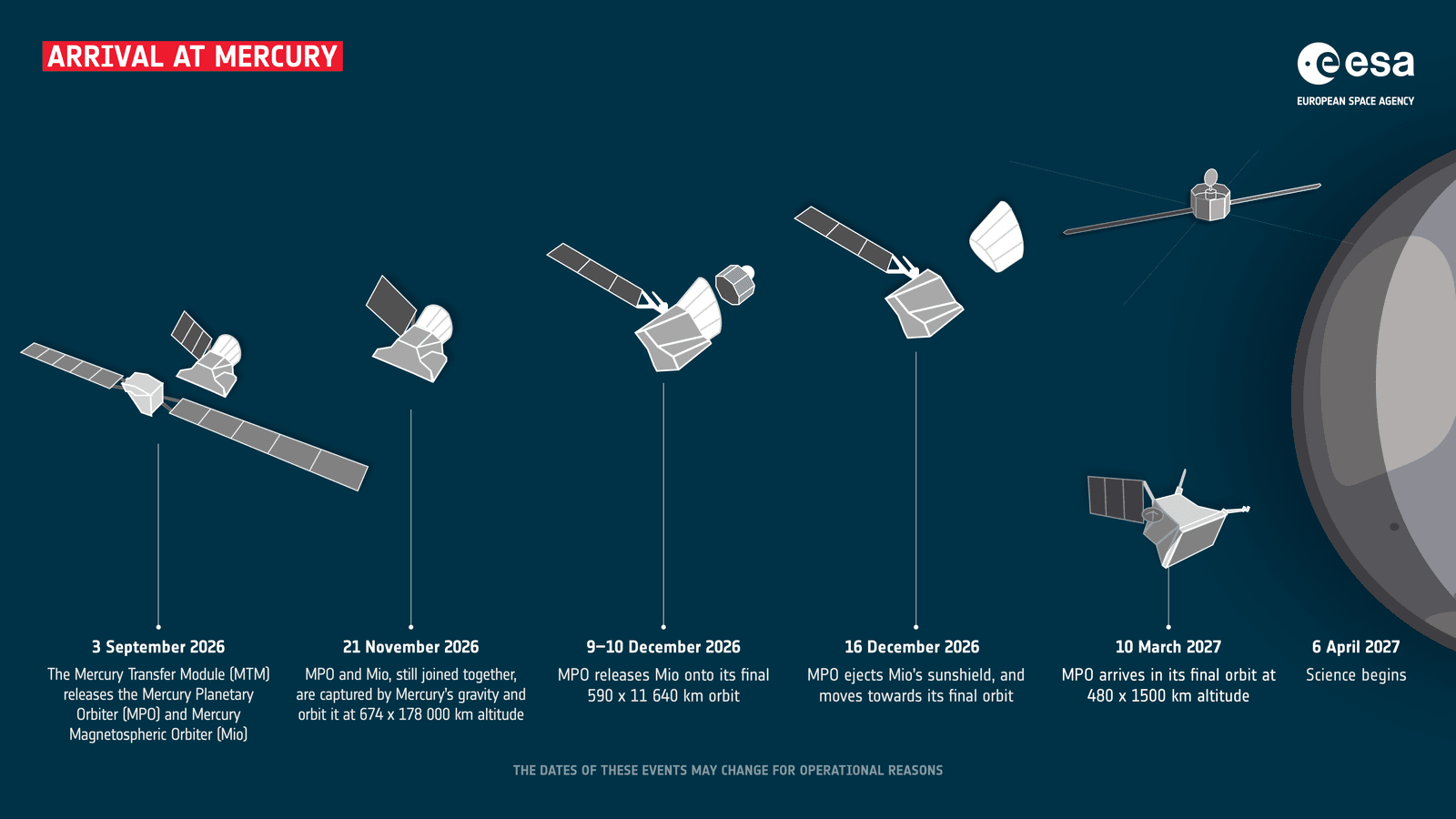
On September 3, ground control confirmed that the propulsion module had successfully separated from the rest of the craft, marking the final phase of the joint mission between the European Space Agency (ESA) and the Japan Aerospace Exploration Agency (JAXA). After a bumpy journey—reaching more than 200 million kilometers from Earth—transmissions from the probe indicated all went smoothly.
Mercury has only been explored twice before, both times by NASA probes. Because even without propulsion mishaps, Mercury is especially challenging to reach due to it’s position as the closest planet to our sun. When traveling towards the center of our solar system, a spacecraft is essentially “falling” from Earth towards the much greater gravity of the sun. That’s the easy part. The hard part is to not keep falling. Getting to Mercury therefore requires a lot of fuel not to travel there but to engage rockets to put on the breaks.
Spacecraft can also use the gravity of other planets as a means of slowing down, but that involves taking a more convoluted path, looping between celestial objects. To-date, BepiColombo has traveled approximately 6 billion miles (9.9 billion kilometers), swinging around Earth once, Venus twice, and Mercury six times for a total of nine gravity assist maneuvers to control its velocity.
Furthermore, being so close to the Sun, Mercury’s surface can be intensely hot—over 800 degrees Fahrenheit or about 430 degrees Celsius. And because the small planet has essentially no atmosphere, temperatures drop to -290 degrees Fahrenheit (-180 Celsius) at night. BepiColombo therefore needs to survive not just these extremes, but the daily swings between them.
Once in position, BepiColombo will break into two separate spacecraft: the Mercury Planetary Orbiter (MPO), which will study Mercury’s surface and internal structure, and the Mercury Magnetospheric Orbiter (dubbed “Mio”), which will investigate the planet’s magnetic field and tenuous atmosphere. This is the first time multiple probes will orbit Mercury simultaneously, with the goal of gaining a more comprehensive picture than any single probe could capture on its own.
Mio will enter a higher elliptical orbit oriented to circle across the poles. MPO will then lower its altitude further and is scheduled to reach its final orbit in March of 2027. Even after the probes take their positions, full-scale observations will not begin immediately. The probes must go through a series of procedures—such as the deployment of Mio’s essential sunshield—before conducting scientific observations, which are scheduled to begin in April 2027.
The two probes will attempt to uncover answers to much that remains unknown about the swift planet. Some key questions include why Mercury has an extremely large iron core relative to its size; why ice exists in permanently shadowed craters at the poles despite the scorching heat; why it’s the only rocky planet other than Earth to possess its own magnetic field; and the true nature of the mysterious depressions known as “hollows” that dot its surface.
Answers to into these questions are expected to provide crucial clues for how terrestrial planets—including Earth—formed and evolved within the solar system. Astrophysicists also plan to use precise orbital data from the mission to test Einstein’s general theory of relativity, because—due to its proximity to the sun—Mercury is an ideal testing ground for verifying the gravitational distortion of spacetime.
Disclaimer : This story is auto aggregated by a computer programme and has not been created or edited by DOWNTHENEWS. Publisher: wired.com