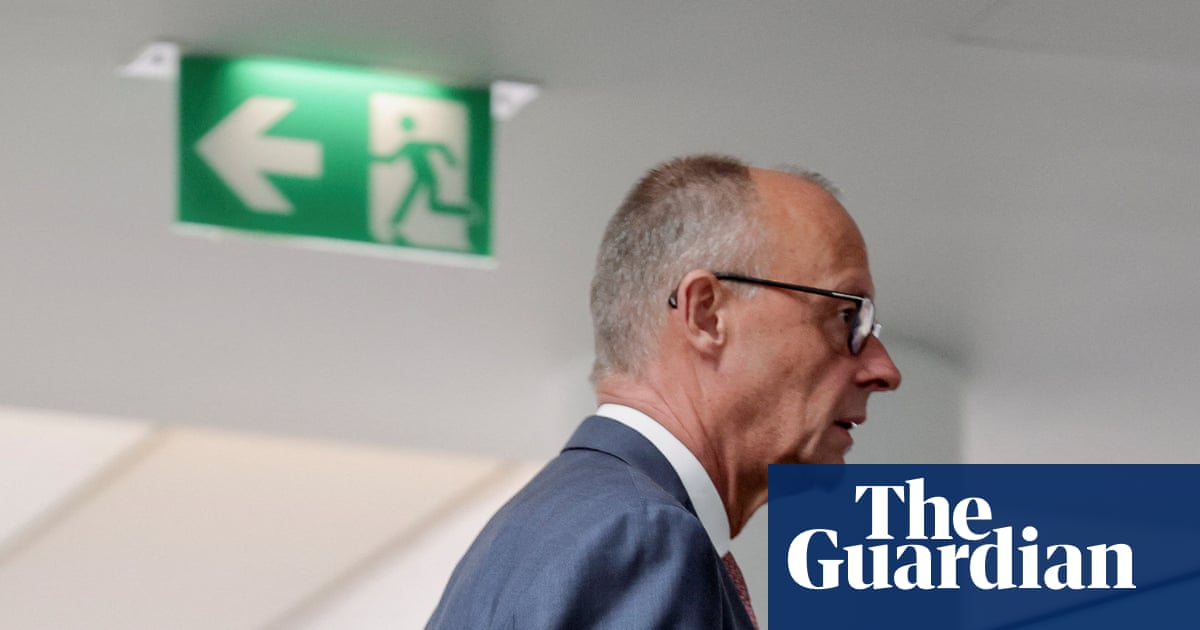
Friedrich Merz called it a “disaster”, and that was even before the full scale of the catastrophe for himself and his conservative Christian Democratic Union (CDU) came into view after Sunday’s state elections.
In what one outlet called a “power move”, the German chancellor made a highly unusual televised speech just minutes after polls closed in the states of Berlin and Mecklenburg-Western Pomerania, attempting to get ahead of the narrative with a pledge to stay on and fight for his economic recovery programme.
But as the results trickled in, it became apparent that the CDU had not only scored its worst-ever result in a state election, in Mecklenburg-Western Pomerania, it had crashed out of a regional parliament altogether for the first time in postwar history with just 4.9% of the vote in the region on the Baltic coast.
The far-right Alternative für Deutschland (AfD) came out on top for the third time in a German state, drawing 38% against 35.5% for the centre-left Social Democrats, Merz’s federal coalition partner.
Although the AfD has little chance of taking power because of a “firewall” of non-cooperation agreed by the other main parties, the anti-immigration, Kremlin-friendly party could celebrate a further success in destabilising the German political establishment.
In Berlin, the CDU will almost certainly have to vacate city hall once the coalition negotiations wrap up after a stinging defeat to the leftwing Linke party, which is calling for the expropriation of corporate landlords to address a housing crisis.
Polls had been predicting the humiliating result for Merz’s conservatives, which came after a historic rout two weeks ago in the former communist state of Saxony-Anhalt, where the CDU scored just 17% to the AfD’s nearly 44%.
But the cumulative effect of these losses, coupled with Merz’s dire approval ratings and a far right with clear momentum, can hardly be exaggerated. Despite his vow to stay the course, many regard the German leader to be on borrowed time.
“Friedrich Merz is fighting for his political survival,” said the Berenberg bank’s chief economist, Holger Schmieding. “Although Merz has vowed to stay on as chancellor to spearhead the much needed pro-growth reforms, it will not be easy for him to contain the unrest within his party.”
Speculation was already rife after the Saxony-Anhalt race about a Kanzlertausch, or chancellor swap. But as long as none of the potential successors appears ready to wield the dagger, and Merz remains unwilling to step aside, a volatile deadlock will reign.
Merz, 70, gathered the CDU leadership at the party headquarters in Berlin to watch the exit polls together late on Sunday.
Local media reported that some of those assembled loudly objected to the defiant, full-steam-ahead speech he planned to deliver regarding his programme, saying that it amounted to ignoring what voters were shouting from the rooftops with their choices.
Merz cancelled a planned trip to New York this week to speak before the UN general assembly, already anticipating he would need to be in Berlin to grapple with the state elections’ aftermath.
Now, more than ever, he will have his work cut out for him after just 16 months in office.
Disclaimer : This story is auto aggregated by a computer programme and has not been created or edited by DOWNTHENEWS. Publisher: theguardian.com