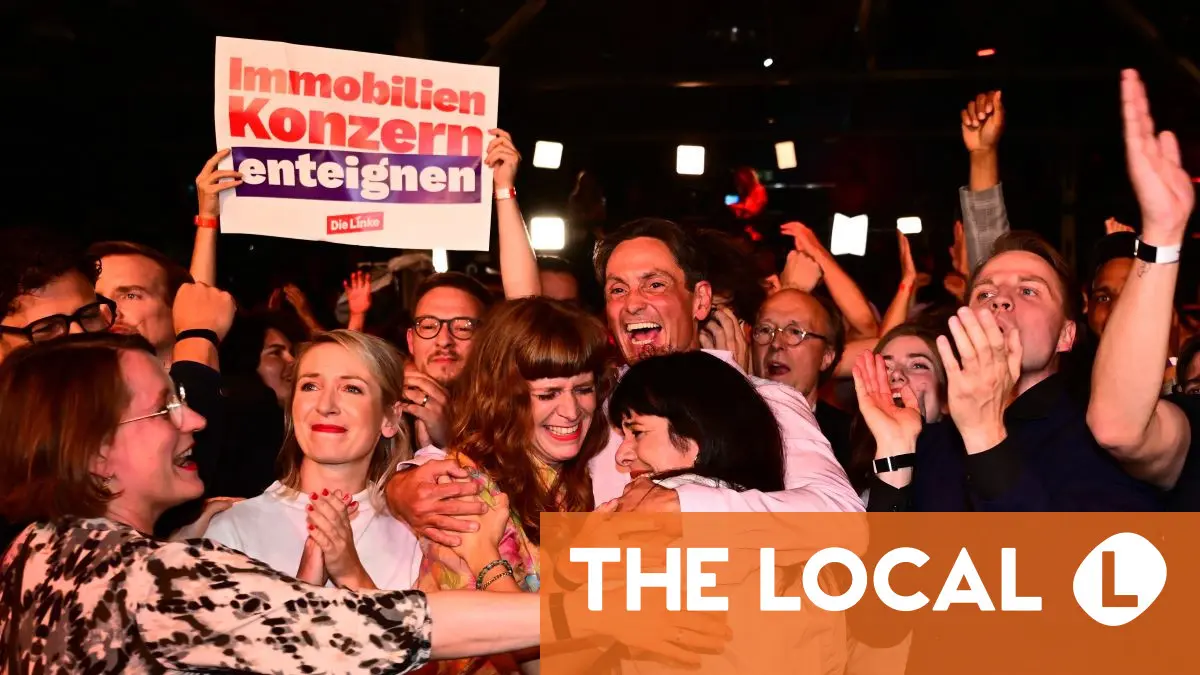
Berliners delivered a damning verdict on the city’s political leadership on Sunday. The result all but guarantees a change of government – but it could be months before the capital gets a new Senate.
Berlin’s voters have upended the city’s political landscape. The Left Party (Die Linke) emerged as the clear winner with 25.7 percent of the vote, more than doubling its support since the 2023 repeat election.
Meanwhile, the governing CDU and SPD suffered heavy losses, finishing second and fifth respectively. The AfD came third, ahead of both the Greens and the SPD.
The preliminary results suggest a clear rejection of the current CDU-SPD coalition. Since neither of the parties currently running Berlin finished in first place, and their alliance has lost its parliamentary majority, the city is almost certain to get a new governing coalition.
What coalitions are now possible?
Despite five parties winning significant shares of the vote, the coalition maths is relatively straightforward.
Because all major parties continue to rule out cooperation with the far-right Alternative for Germany (AfD), and because the CDU has categorically excluded a coalition with the Left Party, only two realistic governing options remain.
The first is a Left-Greens-SPD alliance, commonly known as a red-red-green coalition. Together, the three parties would control 95 of 158 seats, giving them a comfortable majority.
The second is a CDU-Greens-SPD coalition, often referred to as a Kenya coalition because of the parties’ colours. That alliance would hold the slimmest of possible majorities with 82 seats.
On paper, the red-red-green option looks more stable. It would also reflect the election result more closely. The Left not only finished first but surged by 13.5 percentage points, while the incumbent CDU and SPD were heavily punished by voters.
READ ALSO: What political parties in Berlin say about immigration and German citizenship
In purely political terms, that makes it difficult to argue that Berlin’s largest party should be excluded from government.
At the same time, coalition building in the capital is rarely determined by election arithmetic alone.
What are the obstacles to a red-red-green coalition?
The biggest problem for the Left Party is that leading figures in the SPD have repeatedly signalled they would rather govern alongside the conservative CDU than as the smallest partner in a more left-wing alliance.
The biggest policy dispute concerns housing.
The Left Party has made implementation of Berlin’s long-running housing socialisation campaign a central demand. The party supports transferring around 240,000 apartments owned by large housing corporations into public ownership, building on the result of a 2021 referendum in which a majority of Berliners backed the idea.
READ ALSO: Why an unresolved housing referendum is shaping Berlin’s election campaign
The Greens are broadly supportive. But the SPD opposes making expropriation a condition for coalition talks. That disagreement could become the single biggest obstacle to a red-red-green government.
There are other points of friction too. The SPD wants more police officers and rejects cuts to policing, while the Left Party has criticised what it sees as excessive expansion of police powers.
SPD leaders have also warned that any future coalition would need a clear stance against antisemitism following controversies involving members of the Left Party.
Yet the alternative is hardly straightforward. The CDU, Greens and SPD disagree on transport policy, the A100 motorway extension, development on the edge of Tempelhofer Feld and aspects of education policy.
Whichever party misses out on government – whether that’s ultimately the CDU or the Left Party – looks set become the largest opposition force in the capital.
Apart from anything else, this is a clear indication the far-right AfD has still failed to achieve the kind of breakthrough in Berlin that it’s managed in other parts of Germany, despite increasing its share of the vote to 16.3 percent (up from 9.1 percent in 2023).
A terrible night for incumbents
The CDU’s vote share fell by 9.4 percentage points, while the SPD dropped by 6.3 points to just 12.1 percent, its worst result in a Berlin state election.
The setbacks were not confined to party totals, as several prominent politicians also failed to win their constituencies, underlining the depth of dissatisfaction with the outgoing administration.
CDU lead candidate Stefan Evers lost his direct mandate in Treptow-Köpenick to AfD candidate Alexander Bertram.
SPD lead candidate Steffen Krach also failed to secure a constituency victory, finishing behind both CDU and Green candidates. Former governing mayor Franziska Giffey (SPD) also failed to win her district.
READ ALSO: ‘No promises’ – Decoding the political slogans plastered all over Berlin
When will Berlin get its new government?
Berlin is unlikely to get a new Senate immediately.
The Left Party announced on Monday that its goal was to have a coalition agreement in place by Christmas. Before that can happen, parties must decide whom they want to negotiate with, hold exploratory talks and then begin formal coalition negotiations.
Those discussions are likely to focus heavily on housing policy, public finances, policing and transport. Negotiators will spend the coming weeks looking for compromises that can bridge some very real ideological divides.
Disclaimer : This story is auto aggregated by a computer programme and has not been created or edited by DOWNTHENEWS. Publisher: thelocal.de