TEHRAN — The Islamic Revolution Guards Corps (IRGC) has warned that any renewed US or Israeli aggression against Iran would trigger a substantially different military response, with changes expected in the geography of the conflict, the weapons deployed and the targets struck.
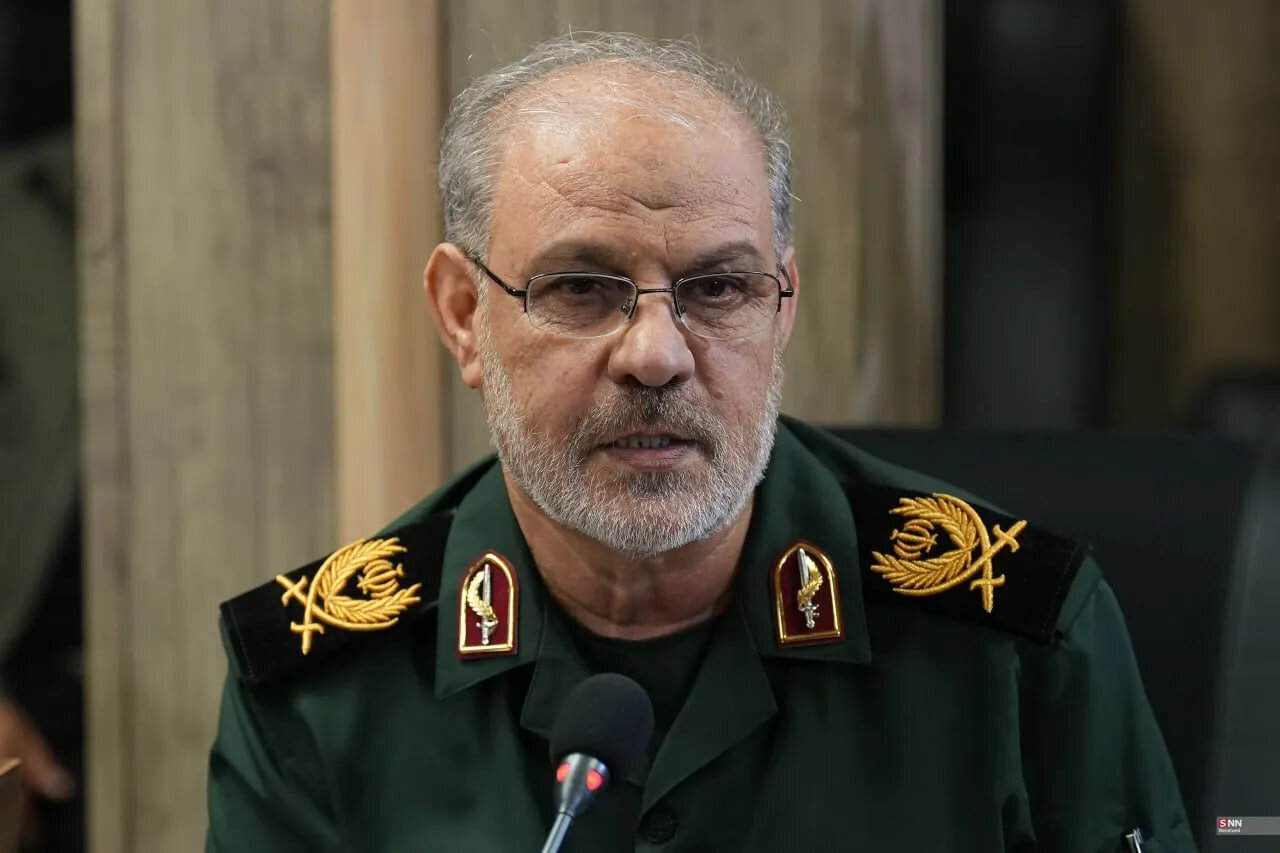
In an extensive interview, IRGC Spokesperson Brigadier General Hossein Mohebbi said Iran was prepared for a prolonged confrontation and that the IRGC was now better prepared for such a scenario than it had been before the recent conflict.
From Iran’s perspective, he said, the confrontation involving Iran, the United States, Israel and their allies should not be regarded as a concluded war followed by a new conflict, but as different phases of the same confrontation.
“From our point of view, it is the same war,” Mohebbi said, stressing that although the conflict had passed through different phases, “it has not ended.”
His remarks came alongside a broad assessment of major setbacks for Washington, particularly in the areas of military power, regional security, intelligence and advanced weapons technology.
Hormuz at the center of Iran’s assessment
Mohebbi identified the Strait of Hormuz as one of the clearest examples of a US strategic failure.
He said Washington had entered the region while presenting its military presence as a means of protecting energy flows and freedom of navigation. Yet, despite the United States possessing the world’s largest navy, he argued that Washington had been unable to reopen the strategic waterway.
According to Mohebbi, this outcome had created a contradiction at the heart of the US regional posture: a power that presented itself as a guarantor of maritime security had become an obstacle to security.
He also accused Washington of repeatedly violating agreements and linked the continuation of restrictions in the strait to US actions.
Mohebbi described the developments surrounding Hormuz as one of the United States’ most significant strategic setbacks in the region.
US military bases under Iranian attack
The IRGC spokesman also pointed to US military installations across West Asia, saying the United States had spent decades building a network of bases around the Persian Gulf and to Iran’s east and west.
According to Mohebbi, Iranian missiles and drones subsequently struck these installations, rendering a large number of them unusable and forcing the United States to relocate personnel and equipment to more distant positions.
He referred to US facilities in Jordan and other locations, as well as positions closer to Israel and the Gulf of Aqaba, arguing that even after redeployments Washington had faced difficulties in ensuring their security.
He further added that US warships had been pushed farther away from the Persian Gulf following the confrontation, saying the US Fifth Fleet had moved roughly 400 kilometers farther from the area.
In Mohebbi’s assessment, a significant portion of US military resources had consequently been diverted toward protecting American bases and personnel rather than carrying out Washington’s wider regional mission.
Intelligence capabilities also challenged
Mohebbi described intelligence capabilities as another area in which Washington had suffered a major setback.
He argued that the United States had long been regarded as possessing highly sophisticated intelligence networks and facilities that were difficult for others to penetrate or strike.
The IRGC spokesman said Iranian forces had nevertheless been able to identify and monitor US intelligence facilities in areas around the Persian Gulf and northern Iraq before striking them.
He presented this as evidence that US intelligence infrastructure was not beyond Iran’s reach and said the development had implications not only for Washington’s rivals but also for its allies.
US military technology ‘no longer beyond reach’
Mohebbi also challenged the perception of overwhelming American superiority in military technology.
He referred to systems including the F-35 fighter aircraft, Patriot air-defense systems, offensive missiles, aerial-refueling aircraft, submarines and drones.
According to the IRGC spokesman, the confrontation demonstrated that technologies once regarded as being largely exclusive to the United States could be challenged by Iranian offensive and defensive capabilities.
He said the conflict had conveyed two messages: for US rivals, that American military technology was not necessarily beyond reach; and for US allies, that questions could be raised about Washington’s ability to protect even its own forces and installations, let alone allied countries.
Washington miscalculated Iran’s resilience
A central element of Mohebbi’s assessment was that Washington had underestimated Iran’s ability and willingness to continue fighting.
He said the United States had initially expected Iran to surrender within days, an assessment that he attributed partly to intelligence and political assumptions conveyed to Washington by Israel.
Mohebbi stated that Israeli officials had told the US president that Iran could be forced to surrender within three to five days and that such an outcome would give Washington a result comparable to the Six-Day War.
He said the subsequent failure of that expectation represented a major strategic miscalculation.
The IRGC spokesman also said the United States had been surprised by the range, destructive power, accuracy, and diversity of Iranian missiles and drones, as well their ability to evade detection.
According to Mohebbi, Washington ultimately found itself in a position in which it could neither easily advance its objectives nor reverse course.
‘America has not simply lost a war’
Mohebbi framed the consequences of the confrontation in broader strategic terms, arguing that the United States had suffered setbacks in three dimensions that he associated with its regional hegemony: military superiority, the ability to provide security for allies, and political and moral legitimacy.
He argued that military setbacks had challenged the perception of American invulnerability, while attacks on US bases had undermined Washington’s image as a reliable security provider.
He also accused the United States of damaging its international standing through attacks on civilian targets in Iran, citing several incidents.
“America has not simply lost a war; it has lost a system,” Mohebbi said, arguing that a new regional and international order was emerging in which Washington would no longer determine West Asia’s security architecture on its own.
He further argued that regional states had come to understand that the United States could neither provide security against Iran nor guarantee regional security without Iran.
No direct IRGC channel to Washington
On the question of possible communication between the IRGC and the United States, Mohebbi categorically rejected the existence of any direct channel.
He said the IRGC’s constitutional role was military and defensive, while diplomatic affairs fell within the responsibility of Iran’s Foreign Ministry.
Mohebbi insisted that the IRGC had never maintained formal or informal relations with the United States and did not intend to enter the diplomatic arena.
A new attack would mean a different battlefield
The most direct warning in Mohebbi’s interview concerned the consequences of another US or Israeli attack.
He said a renewed assault would bring major changes to Iran’s defensive and retaliatory strategy, beginning with the geographical scope of the conflict.
“We will definitely change the geography of the war,” he said.
Iran would also introduce new weapons and military equipment with new capabilities, he added, warning that “the world will be surprised.”
Mohebbi said Iran had already struck targets that its adversaries had not expected to come under attack and cited the al-Tanf base and the Gulf of Aqaba as examples.
He further stated that Iran had additional targets that had not yet been attacked and remained outside the calculations of its adversaries.
The IRGC spokesman said some of Iran’s strategic weapons had not been used during previous phases of the confrontation and could be deployed if circumstances required.
Iran distinguishes neighbors from US forces
Mohebbi also sought to draw a distinction between Iran’s regional neighbors and the US military presence on their territory.
He said Iran regarded neighboring countries as states with which it shared historical, religious, commercial and cultural ties and stressed that Tehran did not consider these countries themselves to be enemies.
According to Mohebbi, Iranian attacks on locations in Bahrain, Qatar and Saudi Arabia had been directed at US military facilities rather than at those countries themselves.
He nevertheless criticized the presence of American military installations in regional states, questioning why countries in the region would permit a power located thousands of kilometers away to deploy forces on their territory.
“We will never target our neighbors,” he said, while emphasizing that Iran distinguishes between neighboring states and hostile foreign military forces.
Iran’s position on regional resistance groups
Mohebbi briefly addressed Iran’s relationship with resistance groups in Yemen and Lebanon, rejecting the description of these groups as Iranian proxies.
He said such groups made their own political and military decisions and were rooted in their respective societies. He similarly argued that Hezbollah maintained significant social and political roots in Lebanon.
A conflict has entered a new phase
Taken together, Mohebbi’s remarks portray Iran’s assessment of the confrontation as extending well beyond the question of battlefield exchanges.
His central message was that the war remains unfinished, while the IRGC believes the confrontation has exposed vulnerabilities in the US military presence, intelligence infrastructure and technological advantages.
At the same time, his warning about any future attack was explicit: Iran would not simply repeat its previous response.
The geography of the conflict could expand, previously unused weapons could enter the battlefield, and new targets could be selected. Some of the capabilities that Iran describes as strategic weapons, Mohebbi said, have yet to be employed.
Iran, he said, has prepared for a prolonged confrontation—and would enter any renewed conflict with a different battlefield, different weapons and different targets.
Disclaimer : This story is auto aggregated by a computer programme and has not been created or edited by DOWNTHENEWS. Publisher: tehrantimes.com