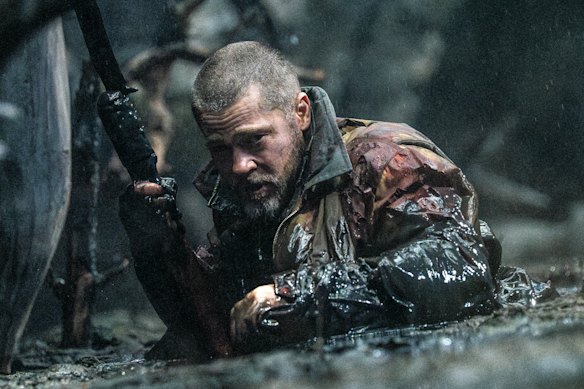
Heart of the Beast is about the bond between man and dog. But it’s also very much a film about trauma.
Director David Ayer and his leading man Brad Pitt adopted a mantra-cum-running joke while shooting their wilderness survival epic Heart of the Beast in the alps of New Zealand’s South Island. “A guy and a dog,” says Ayer with a wry chuckle. “How hard can it be?”
As it happens, pretty hard.
“We got shut down by lightning a couple of times, and washed out,” says Ayer, who did a three-year stint as a submariner in the US Navy before embarking on a filmmaking career. “Brad was pretty much cold and miserable for most of the film.”
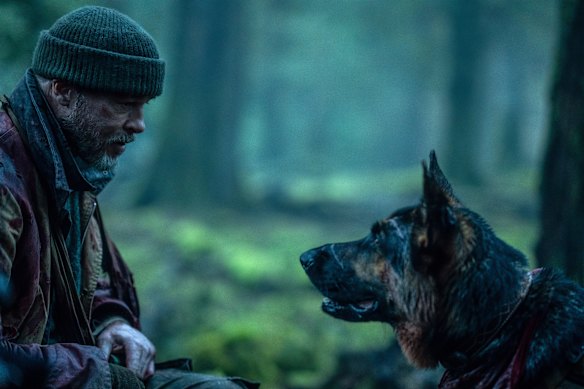
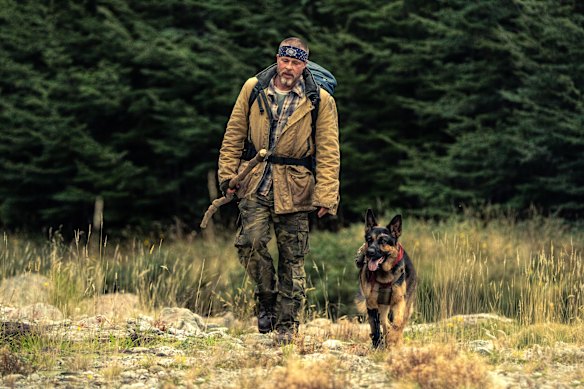
Pitt plays James Belmont, a battle-scarred and deeply traumatised former Navy SEAL. He’s a loner who likes to escape into the wilderness with Odin, the German shepherd who served alongside him in the military. But after a couple of idyllic days camping and fishing on a lake in Alaska, the pair of veterans come a cropper while trying to outrun a storm: James suffers a minor heart attack and the hydroplane he is piloting crashes, a long way from help.
From that point, it’s man and dog versus wild.
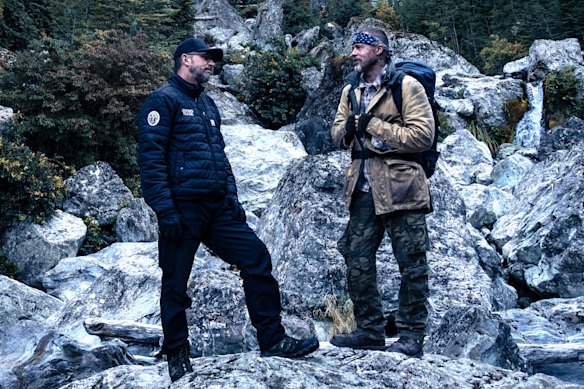
Making the film was largely a case of men and women and dogs versus the wild too. The production was based at Glenorchy, a small town north-west of Queenstown that is the gateway to Fiordland and some of the most stunning and remote scenery in New Zealand. It’s beautiful, but a long way from the usual filmmaking facilities a Hollywood director might expect to have at their disposal.
“We had to build our own infrastructure,” says Ayer. “The New Zealand government was incredible because they let us shoot in places where no one had ever been allowed. But we had to tread so lightly and leave no evidence we were there, and really respect the environment.”
Despite the obvious logistical challenges, Ayer was hooked on the idea of making the movie from the moment he started reading Cameron Alexander’s script, which made it onto The Black List – the online showcase for Hollywood’s most-liked unproduced screenplays – in 2017.
“I started reading, started crying, had to stop reading, picked it back up, started crying, had to walk around, gather myself, sit down again,” he says. “It tapped into something deep in me. I lost my father when I was very young, and it somehow echoed that journey – there’s a very father/son-like relationship between Odin and James. It was a story I knew I had to tell, not merely to grow as a filmmaker but also to grow as a person.”
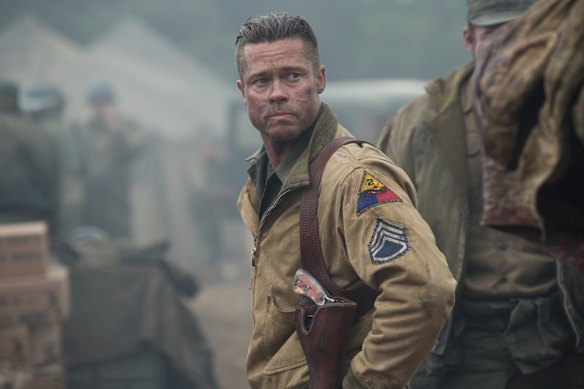
Ayer had worked with Pitt on his WWII tank drama Fury and insists the actor was “the only person I could think of to play this role. We had spent years trying to get it made, and then suddenly the sun came out [all the components fell into place], and the first and only actor I sent the script to was Brad.”
Did your leading man have any idea what he was signing on for?
“No, not at all. None of us did. I mean, he was cold, wet, tired all the time. I’m like, ‘get out of here, go to the trailer and warm up’, and he’d say, ‘No, I’m just gonna get cold and wet again. I might as well stay here.’
“He learnt dog handling, survival skills, fire starting, how to move across the terrain with map and compass, how to self-rescue medically. That’s all real skills he learnt. And he was the only actor on the call sheet for the most part.”

Normally, when your star needs a break, it’s possible to shift things around a little. But here, that just wasn’t an option. And sometimes, even if Pitt didn’t ask for downtime, Ayer would glance at him and know how much he needed it … and that he wasn’t going to get it.
“I’m looking at him, and I’m like, ‘he’s got to work tomorrow, I hope he’s OK’. And then he shows up tomorrow and does it again.”
With a story consisting of nothing but man, dog and wilderness – albeit a fictional Alaskan wilderness complete with wolves and bears and extreme cold – there was nowhere for Ayer to hide either. “You’re so exposed as a filmmaker. You don’t have the usual noise and cast and locations and changes and dynamics of a film in a city, let’s say. At the end of some of these days, we’d be so beat up and just look at each other: ‘A guy and a dog in the wilderness. How hard can it be?’”
Exhausting as it was for director and star, spare a thought for the canine lead. Odin is played by Uber, a former search and rescue dog who was found by Scotsman Andrew Simpson, one of the busiest and best animal trainers in the business, after an exhaustive search through New Zealand.
“He’d been on helicopters, he’d been on ropes and lowered, he was a bit of a veteran, like the character he was playing,” Ayer says of the dog. Crucially, Uber also had three sons who looked remarkably like him, each with their own particular skill set – one could really run, another was great at swimming – and through a combination of “breaking down the task into little pieces and a lot of camera trickery” the filmmakers were able to capture almost all of Odin’s stunts on camera.
“It’s really a handful of shots, if that, where we doubled the dog digitally,” says Ayer. (Animal lovers will be relieved to learn, though, that the prosthetic leg is a CGI addition.)
Which is not to say the old adage about never working with children and animals didn’t sometimes come to mind. “You have to really respect the dogs. They get cold, they get tired, they need breaks. It was a lot to manage, but we pulled it off.”
While it’s very much a story about the bond between a man and a dog, Heart of the Beast is also a film about war and its long aftermath. And it’s not just his own experience of service that draws Ayer to such tales.
“I think it’s an intense, high-stakes environment where strangers become brothers, and they take emotional damage, they pay an immense price,” he says. “And why are they doing it? They’re doing it to protect us. So there’s a nobility in that, and this hidden price.”
His ambition, he says, is “to tell their story in an emotionally realistic way. It doesn’t always happen that way; they can be treated like props, versus going inside the soul.”
Ayer’s work tends to exist almost exclusively in this male-dominated high-pressure space, from his early screenplays U-571 (a submarine drama) and Training Day to the Jason Statham action vehicles The Beekeeper and A Working Man he has directed more recently (the critically panned Suicide Squad, starring Margot Robbie as Harley Quinn, is arguably a departure, though not an altogether happy one). Is there, I ask him, a risk that in trying to treat the experience of veterans with empathy you end up glorifying war?
“Fury definitely doesn’t glorify war,” he says. “I don’t think this film glorifies war either. I mean, it’s James’ story, he’s trying to find his peace again after a career at war. It leaves an emotional impact. We’re asking so much of our soldiers, and they come back, and now they’re veterans, and we’ve got to integrate them and help them heal, and do a better job of that.
“I don’t need to glorify war,” he continues. “It’s always going to be there. It seems to be unshakable, sadly.”
Heart of the Beast is in cinemas from September 24.
Want more movies?
Disclaimer : This story is auto aggregated by a computer programme and has not been created or edited by DOWNTHENEWS. Publisher: www.smh.com.au