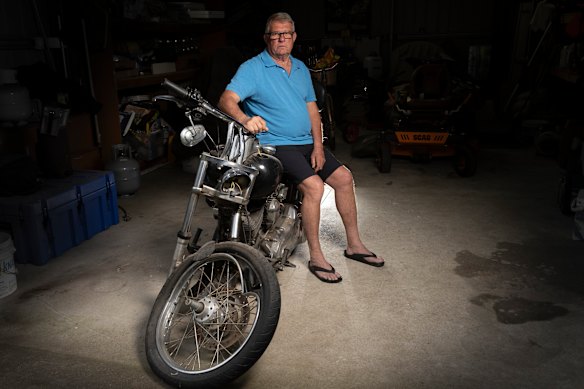

Boxing Day 2022 was turning into a great day for Russel Heggen. Cruising along Arthurs Seat Road on his Harley-Davidson, the bay spread out before him as he snaked his way back towards his Dromana home.
The then 62-year-old didn’t even see the pothole before he hit it. The patch of road had recently been repaired, but Heggen claims that the tar had become misshapen with cars driving over it, making a mound at one end and effectively turning it into a ramp.
The impact caused Heggen to involuntarily tighten his grip on the throttle, and he and his Harley went off the road, flying between two trees and off a cliff.
Emergency services estimate he travelled around 15 metres, but his memory of the crash is fuzzy.
“I was just very lucky to survive,” he said.
Luck aside, Heggen was seriously injured, suffering a broken femur and tibia, a fractured pelvis and spine, a collapsed lung and a brain injury.
The ordeal is now detailed in a writ before the Supreme Court, with the 66-year-old joining a growing number of Victorians making public liability claims against road authorities for the serious injuries sustained after accidents allegedly caused by the poor road surfaces.
In the vast majority of cases, the Transport Accident Commission (TAC) covers medical expenses related to road accidents. However, under Victorian law, in rare circumstances, road authorities – state and local governments – can be held liable for injuries.
The condition of Victoria’s roads, particularly in regional and rural areas, has been a hot-button issue in the lead-up to the November 28 state election. However, concerns boiled over earlier this month when Ballarat motorcyclist Peter “Tiki” Mason, 71, died on the Western Highway after his bike hit a pothole.
Several personal injury law firms spoken to by The Age said they were seeing an increase in inquiries from people wanting compensation for pothole-related road accidents.
“It’s a wave that’s coming,” Henry Carus, head of Henry Carus & Associates, said.
“I think people will get injured while taking evasive action just because of the size of the holes,” he said, noting his firm is currently overseeing a claim against South Gippsland Shire Council involving a motorcyclist who lost control after hitting a pothole.
Law firm Arnold Thomas and Becker has also begun action against Northern Grampians Shire Council on behalf of a woman who suffered several fractures and a torn artery when she lost control of her car near Stawell.
In each case, the lawsuits accuse the respective councils of a litany of failings, including “failing to adequately inspect, maintain, repair or warn road users” about the dangers of the roads in question – the same wording as Heggen’s claim against the Department of Transport.
Any recompense the plaintiffs receive as a result of these lawsuits will be in addition to TAC compensation, which all victims of road crashes are entitled to regardless of who is at fault.
The existence of a pothole or poor road surface is not enough on its own to prove liability for road authorities. Plaintiffs must be able to prove authorities knew of the threat a section of road posed at the time it caused an accident, and failed to address it appropriately.
In Heggen’s case, his wife Amanda and son Mitch took photos of the offending pothole on the same day as the accident. These images are included in the writ for his court action and show a clear mound of road surfacing material sitting several centimetres higher at one edge of the repaired area.
Amanda said this turned out to be crucial when her husband eventually decided in 2025 to pursue legal action after receiving less compensation from the TAC than other road crash victims.
“Our lawyers said, ‘That’s all you’re entitled to under the guidelines because no one is at fault’,” she said.
“The lawyers said only a few negligence claims had been successful, and they had all had photos and videos, which I gave to them.”
But even a claim with evidence is no certainty of success.
Last week, the Supreme Court ruled against a motorcyclist who had been injured the day before Heggen in 2022, on a stretch of road in Reedy Creek, 100 kilometres north of Melbourne.
Joshua Masters claimed he lost control of his motorbike after swerving to avoid a pothole and poorly repaired road.
But Justice Andrew Keogh concluded Masters had not proven the road authority, in this case Mitchell Shire Council, was liable for the accident.
Keogh ruled that while council had been aware of the defect and inspected it in a careless manner, the road was below the threshold for intervention.
Though the writ for Heggen’s case was issued in June, he has been advised it won’t be heard before August 2027.
In the meantime, the lifelong member of the Dromana Football Club continues physiotherapy and pool rehabilitation.
His wife has also helped by reorganising the layout of their home to assist him, and devising strategies to accommodate his short-term memory issues.
“I’m lucky Russel’s resilient. He works with me and never complains about pain,” she said.
Amanda says that pursuing legal action is in part about seeking compensation for Russel’s recovery, but is also about vindication.
“At the start of this, Russ said to me all he wanted was someone to acknowledge it was the road surface that caused the incident,” she said.
“It’s an issue of public safety. We’re really hopeful that this court case leads to more funding available to fix the root cause of the problem, rather than the government compensating people afterwards.”
A spokesperson for the Department of Transport declined to comment on Heggen’s case as it is before the courts.
“Speed, driver fatigue, distractions and a vehicle’s safety features remain the biggest contributors to serious injury crashes,” they said, noting more than 66,000 potholes had been repaired in recent months, with works set to ramp up to meet Premier Ben Carroll’s pledge of rectifying half a million of them.
From our partners
Disclaimer : This story is auto aggregated by a computer programme and has not been created or edited by DOWNTHENEWS. Publisher: www.smh.com.au