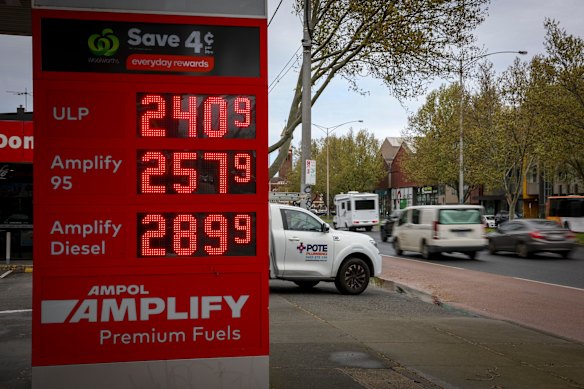

Australian petrol and diesel prices have returned to their highest levels in nearly six months and risk climbing further after drone attacks damaged a second major Middle East oil route.
The spikes at local fuel pumps – pushing the average price of unleaded back above $2.30 a litre – come after drone attacks two weeks ago disabled Saudi Arabia’s East-West pipeline, closing off the oil-rich kingdom’s primary bypass around the Strait of Hormuz and deepening analysts’ fears that the global supply crunch could worsen.
The 1200-kilometre pipeline has been the key workaround for Saudi oil exports since the US-Iran war began, transporting millions of barrels of crude across the Arabian Peninsula to Red Sea ports so they could reach global markets.
Energy analysts said the pipeline’s temporary shutdown was jeopardising about 4 million barrels a day – 4 per cent of the world’s oil supply – that it was previously carrying.
While global benchmark oil prices are trading around $US100 a barrel, the ongoing pipeline closure is limiting Saudi Arabia’s remaining export options and threatening to push energy prices higher if supplies keep falling.
“We think oil prices have a long way to go and could potentially rise another 50 per cent from current levels … if the current situation persists,” analysts at Barclays said on Tuesday.
Fuel prices in Australia rise and fall in line with crude oil markets, typically with a lag of seven to 10 days. As a general rule, fuel industry experts and economists say each $US10-a-barrel swing in the oil price translates to 10¢ a litre at local pumps. By this measure, a $US50 increase could add 50¢ to the cost of a litre of petrol or diesel.
To assess the threats that the outage poses to Australia, Federal Energy Minister Chris Bowen is preparing to fly to Saudi Arabia this week for face-to-face talks with his counterpart, Prince Abdulaziz bin Salman, seeking a timeline for repairs to the critical infrastructure.
Major Australian fuel importers have voiced concerns that a sustained disruption to Saudi oil flows could have potentially disastrous consequences locally, further crippling crude deliveries to the giant Asian oil refineries that deliver the bulk of Australia’s liquid fuel shipments.
Vivek Dhar, head of mining and energy commodities research at the Commonwealth Bank, said the pipeline closure was particularly troubling because global stockpiles had also weakened in the past three weeks. While a US-Iran diplomatic resolution to the war remained his most likely base case – a scenario that could push Brent back below $US85 a barrel – the threat of a military escalation inflicting damage on further energy infrastructure remained a risk that could send prices past $US150 a barrel, he said.
Figures from the National Roads and Motorists Association showed the national average price of regular unleaded was $2.37 a litre on Tuesday, up 39 per cent since July, while diesel had risen by 59 per cent over that period, from $1.79 to $2.88 a litre.
However, modest falls in the benchmark Asian diesel price, known as Gasoil, and regional oil benchmark Tapis in the past two sessions of trading were offering a “glimmer of hope” that Australia retail fuel prices may begin to ease, NRMA spokesman Peter Khoury said.
Gasoil had fallen by nearly $US18 a barrel in the past week, meaning local diesel prices could start to follow within the next seven to 10 days, he said.
“If that continues, we may actually see prices come back a little bit – but the big thing is ‘if’,” Khoury said.
Khoury doubted whether some analysts’ forecasts of oil prices breaching $US150 a barrel would ever materialise. “The situation on the ground could get worse, but it would have to get significantly worse for that to happen, and I don’t even know what that looks like,” he said.
“Oil has been at $US110 a barrel, and that’s with war on two fronts, the East-West pipeline being bombed, the Riyadh airport being hit, no signs of peace in sight and no signs of reopening the Strait [of Hormuz].”
The Business Briefing newsletter delivers major stories, exclusive coverage and expert opinion. Sign up to get it every weekday morning.
 Nick Toscano is a business reporter for The Age and Sydney Morning Herald.Connect via X or email.
From our partners
Disclaimer : This story is auto aggregated by a computer programme and has not been created or edited by DOWNTHENEWS. Publisher: www.smh.com.au